Subject-Wise Weightage: A deep dive into which subjects carry the most marks in your specific branch (e.g., "High-Weightage Topics for GATE CSE").
- Dec 30, 2025
- 6 min read
Updated: Dec 30, 2025
The Graduate Aptitude Test in Engineering (GATE) is more than just an exam; it's a gateway to coveted postgraduate programs and esteemed public sector undertakings in India. For Computer Science and Engineering (CSE) aspirants, navigating the vast syllabus and strategically allocating study time is crucial for success. This blog aims to shed light on the "high-weightage" topics – those subjects that consistently carry more marks in the GATE CSE examination, helping you optimize your preparation and maximize your score.

Understanding the subject-wise weightage isn't about skipping topics; it's about smart preparation. It's about focusing your energy where it yields the greatest returns while ensuring a foundational understanding across the board. Let's embark on this analytical journey to unravel the secrets of GATE CSE success.
The Foundation: General Aptitude and Engineering Mathematics & Subject-Wise Weightage
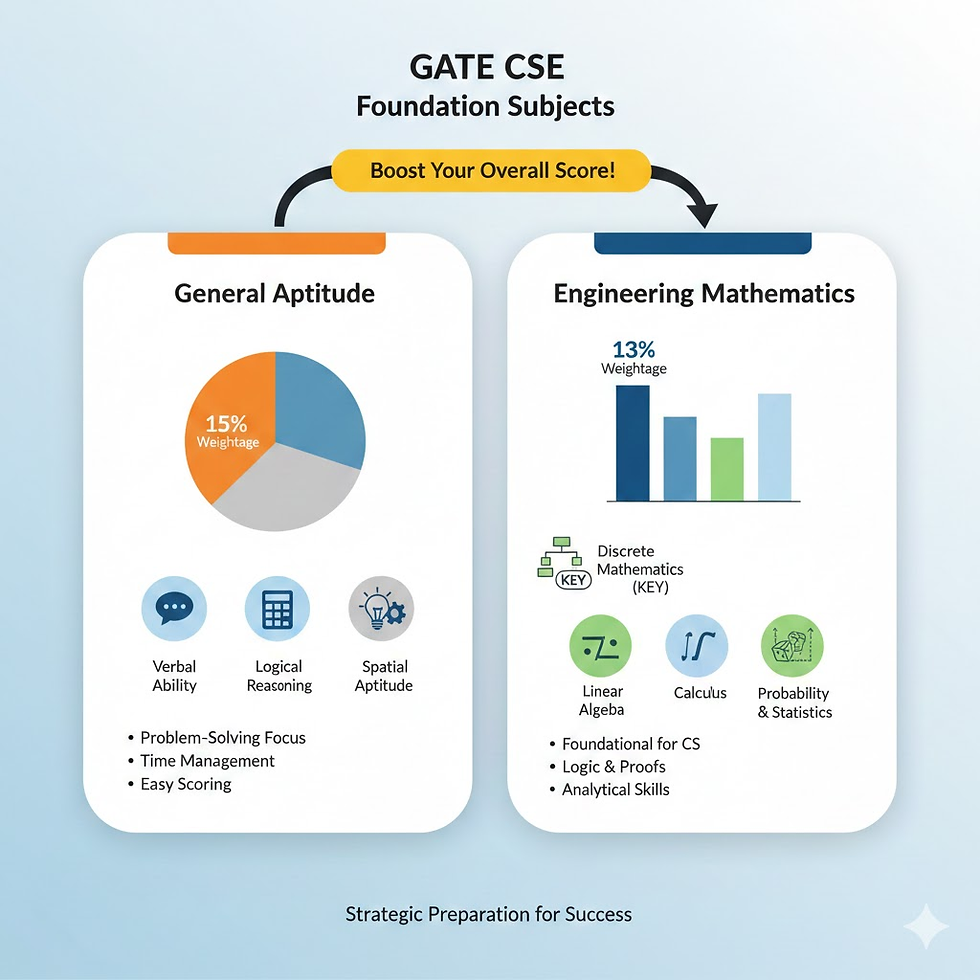
Before diving into the core CSE subjects, it's vital to acknowledge the foundational pillars: General Aptitude and Engineering Mathematics. These two sections are common to all GATE papers and often serve as scoring opportunities.
General Aptitude (approx. 15% weightage): This section assesses your verbal ability, numerical ability, logical reasoning, and spatial aptitude. While seemingly straightforward, consistent practice is key. Questions here are often designed to test your problem-solving skills under time pressure. Don't underestimate its potential to boost your overall score.
Engineering Mathematics (approx. 13% weightage): For CSE, this primarily includes Discrete Mathematics, Linear Algebra, Calculus, and Probability & Statistics. Discrete Mathematics, with topics like combinatorics, graph theory, and propositional logic, is particularly important. A strong grasp of these mathematical concepts not only helps in this section but also underpins many core CSE subjects.
Core CSE Subjects: The High-Weightage Powerhouses
Now, let's delve into the heart of the GATE CSE syllabus – the core subjects that demand significant attention due to their consistently high weightage.
1. Data Structures and Algorithms (DSA) (approx. 15% weightage):
This is arguably the most crucial subject for any CSE aspirant. From basic data structures like arrays, linked lists, stacks, and queues to advanced trees, graphs, and hash tables, a thorough understanding is non-negotiable. Algorithms cover sorting, searching, dynamic programming, greedy algorithms, and graph algorithms. The questions often test your ability to analyze time and space complexity, choose appropriate data structures for specific problems, and design efficient algorithms.
Why it's High Weightage: DSA is the bedrock of computer science. It's fundamental to software development, problem-solving, and efficient system design. Examiners use this section to gauge a candidate's core programming and analytical abilities.
2. Operating Systems (OS) (approx. 9-10% weightage):
OS forms the central nervous system of any computer system. Key topics include process management (scheduling, synchronization, deadlocks), memory management (paging, segmentation, virtual memory), file systems, and I/O management. Questions frequently involve analyzing scheduling algorithms, understanding memory allocation schemes, and solving synchronization problems using semaphores or mutexes.
Why it's High Weightage: A deep understanding of OS principles is essential for anyone working with system-level programming, distributed systems, or even optimizing application performance.
3. Computer Networks (CN) (approx. 9-10% weightage):
In today's interconnected world, computer networks are ubiquitous. This subject covers the OSI and TCP/IP models, network devices (routers, switches, hubs), various protocols (TCP, UDP, IP, ARP, DNS), routing algorithms, congestion control, and application-layer protocols. Expect questions on subnetting, network addressing, protocol analysis, and security aspects.
Why it's High Weightage: Networking is integral to almost every computing application and system. From cloud computing to mobile applications, a solid grasp of network fundamentals is indispensable.
4. Database Management Systems (DBMS) (approx. 8-9% weightage):
DBMS is vital for managing and organizing large amounts of data. Key areas include relational model, SQL (queries, integrity constraints), relational algebra and calculus, normalization (up to BCNF), transaction management (ACID properties, concurrency control), and indexing. SQL queries and normalization problems are common.
Why it's High Weightage: Data is the new oil, and DBMS is the engine that manages it. Professionals in almost every domain interact with databases, making this a highly relevant and frequently tested subject.
5. Theory of Computation (TOC) / Compiler Design (CD) (approx. 8-9% weightage combined):
This pair often carries significant weight, though the distribution between them can vary.
Theory of Computation (TOC): Focuses on finite automata, pushdown automata, Turing machines, decidability, undecidability, context-free grammars, and regular expressions. It's about understanding the limits and capabilities of computation.
Compiler Design (CD): Covers lexical analysis, parsing (top-down, bottom-up), syntax-directed translation, intermediate code generation, code optimization, and symbol tables.
Why it's High Weightage:
TOC provides the theoretical underpinning for all of computer science, while Compiler Design is crucial for understanding how programming languages are translated into executable code.
6. Computer Organization and Architecture (COA) (approx. 7-8% weightage):
COA delves into the internal working of a computer system. Topics include machine instructions and addressing modes, CPU organization (datapath, control unit), pipelining, memory hierarchy (cache memory, virtual memory), and I/O organization. Questions often involve performance analysis, instruction execution, and cache memory calculations.
Why it's High Weightage: A firm understanding of how hardware interacts with software is crucial for optimizing performance and designing efficient systems.

Other Important Subjects (Lower but Significant Weightage)
While the above subjects form the bulk of the paper, other subjects, though carrying less individual weight, can contribute significantly to your overall score and should not be ignored.
Programming and Data Structures (Often intertwined with DSA): This usually refers to C/C++ programming concepts, pointers, functions, and basic data handling, forming the practical application base for DSA.
Digital Logic (DL): Boolean algebra, logic gates, combinational and sequential circuits, and K-maps. Often around 4-5% weightage.
Engineering Ethics and General Studies: Sometimes integrated into General Aptitude or as standalone questions depending on the specific year/pattern, but generally minimal.'
Strategic Preparation: Leveraging Weightage
Now that we've dissected the subject-wise weightage, how do you translate this knowledge into a winning preparation strategy?
Prioritize High-Weightage Topics: Dedicate more study hours and practice time to DSA, OS, CN, DBMS, TOC/CD, and COA. Aim for mastery in these areas.
Understand Interconnectedness: Many CSE subjects are interconnected. For example, understanding Data Structures is crucial for efficient Algorithm design. Knowledge of OS is vital for comprehending certain aspects of Computer Architecture. Build a strong conceptual foundation across subjects.
Practice, Practice, Practice: GATE is not just about knowing concepts; it's about applying them under pressure. Solve previous year's questions diligently. Take mock tests regularly to simulate exam conditions and identify your weak areas.
Focus on Problem-Solving: GATE questions are often analytical and problem-based. Don't just memorize definitions; understand the underlying logic and learn how to solve various types of problems within each topic.
Short Notes and Revision: Create concise notes for quick revisions, especially for formulas, key algorithms, and critical concepts. Regular revision is paramount to retaining information.
Don't Neglect Low-Weightage Topics Entirely: While less emphasis, a few marks from these subjects can make a significant difference, especially when ranks are decided by decimal points. Aim for a basic understanding and solve some common problem types.
FAQ ?
Q1: Does the weightage remain consistent every year?
A1: While the approximate weightage for high-scoring subjects generally remains consistent, there can be minor fluctuations year to year. The percentages provided are based on historical trends. It's always a good idea to check the latest GATE information brochure for any specific changes and to analyze the last 3-5 years' papers.
Q2: Should I skip subjects with very low weightage?
A2: It's generally not advisable to skip entire subjects. Even low-weightage topics can yield easy marks if you have a basic understanding. If time is extremely limited, you might prioritize high-weightage topics, but try to cover at least the fundamental concepts of all subjects.
Q3: How many marks does General Aptitude contribute?
A3: General Aptitude typically contributes 15 marks out of the total 100 in the GATE examination. These marks are often considered relatively easier to score with consistent practice.
Q4: Which is the single most important subject for GATE CSE?
A4: Data Structures and Algorithms (DSA) is widely considered the most important subject due to its high weightage (around 15%) and its foundational role across various other CSE domains. A strong grasp of DSA significantly impacts your overall performance.
Q5: How can I find the exact weightage for the current year?
A5: The official GATE organizing institute usually releases the syllabus and occasionally provides guidance on subject distribution, though not always precise percentages. The best way to gauge current trends is by thoroughly analyzing the previous 3-5 years' question papers.
Others:
Don't leave your ranking to chance. Use our Interactive GATE CSE Weightage Tracker to prioritize your study schedule based on the last 10 years of exam trends.
Topic-wise breakdown of marks from 2015–2025.
100+ Practice questions on high-yield DSA and OS topics.
A personalized study planner to track your progress.
Conclusion
Success in GATE CSE is a marathon, not a sprint. A strategic approach, informed by a deep understanding of subject-wise weightage, can significantly enhance your preparation. By prioritizing high-weightage topics like Data Structures & Algorithms, Operating Systems, Computer Networks, and DBMS, while simultaneously building a solid foundation in Engineering Mathematics and General Aptitude, you can allocate your efforts efficiently.



Comments