Top Business Trends Shaping India in 2026: Economic Insights & Future Outlook
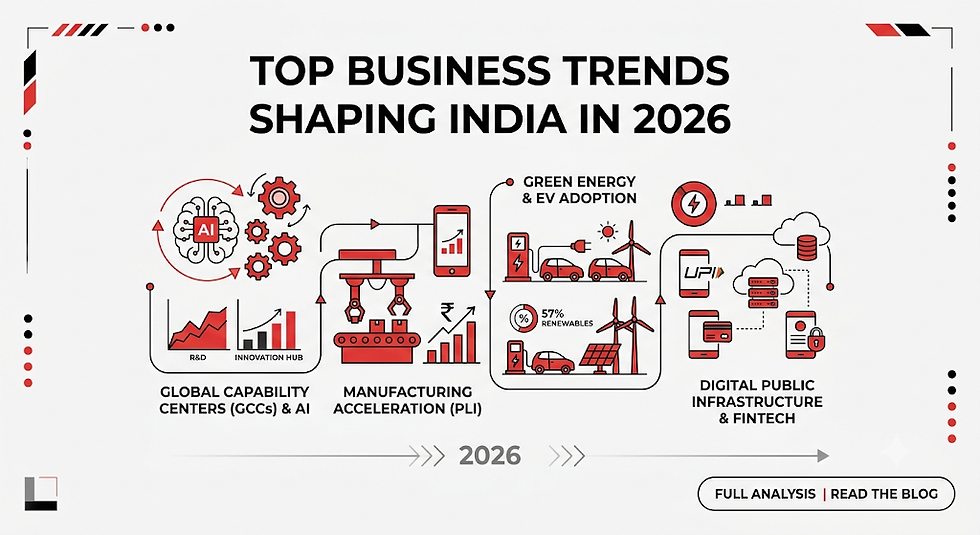
As the world’s fastest-growing major economy, India continues to demonstrate remarkable macroeconomic resilience and rapid structural transformation. Driven by robust domestic consumption, expanding digital public infrastructure, and strategic policy incentives, the Indian corporate ecosystem in 2026 presents an unprecedented landscape for local enterprises and multinational investors alike.
Understanding the dynamic shift across industries is essential for corporate leaders, investors, and entrepreneurs aiming to capitalize on emerging market opportunities. From the explosive expansion of Global Capability Centers (GCCs) to the acceleration of green energy transitions and agentic artificial intelligence, this article provides a detailed breakdown of the major economic and corporate developments defining the current financial landscape.
Executive Summary: India’s Growth Narrative in 2026
Despite persistent global supply chain re-alignments and foreign policy realignments, India’s economic growth remains notably strong. Current economic indicators reveal a projected real GDP growth rate of 6.9% to 7.6%, with nominal GDP climbing past $4.12 trillion, solidifying India's position as the world's fast-track growth engine.
+-----------------------------------------------------------------------+
|                 MACROECONOMIC POWERS OF INDIA IN 2026                  |
+-----------------------------------------------------------------------+
            |                                           |
            v                                           v
  [Domestic Demand Surge]                    [Global Integration]
  - World's 3rd largest consumer market      - China+1 strategy pivot
  - Rural purchasing power recovery          - High-tech manufacturing (PLI)
  - Expansion of Tier-2/3 retail hubs        - 1,700+ GCC operational bases
Low headline inflation (averaging under 3.5%) coupled with targeted tax cuts and sustained public capital expenditure has preserved strong consumer demand. Crucially, the country is transitioning from an economy largely dependent on traditional IT outsourcing to a high-value hub for frontier R&D, advanced manufacturing, and deep-tech innovation.
Key Core Drivers Behind the Corporate Transformation
1. The GCC Renaissance: From Cost Centers to Innovation Hubs
The evolution of Global Capability Centers (GCCs) represents one of the most structural shifts in the services export market.
Scale and Workforce Expansion: India now hosts over 1,700 operational GCCs, employing a combined workforce exceeding 6 million high-skilled professionals.
High-Value Mandates: Multinational corporations (MNCs) are no longer using Indian centers solely for back-office IT support or basic business process management. Instead, modern GCCs drive enterprise-wide artificial intelligence, cybersecurity frameworks, product design, and strategic data engineering.
Decentralization into Tier-2 Cities: While primary hubs like Bengaluru, Hyderabad, and Pune continue to lead, lower operating costs and talent availability are driving rapid GCC expansions into cities like Kochi, Ahmedabad, Coimbatore, and Chandigarh.
2. High-Tech Manufacturing and the Production-Linked Incentive (PLI) Impact
Under the government's ₹1.97 lakh crore incentive framework, India’s industrial sector is steadily moving up the global value chain. High-tech manufacturing now accounts for 46.3% of India's manufacturing value added, marking a transition toward high-complexity production.
Electronics & Semiconductors: Domestic smartphone manufacturing and initial commercial production from semiconductor ATMP (Assembly, Testing, Marking, and Packaging) facilities in Gujarat and Odisha have significantly lowered import reliance.
Capital Goods Growth: Industrial production data highlights accelerated growth in capital goods, signalling sustained private investment in new factories, power infrastructure, and machinery.
Supply Chain Diversification: As multinational corporations continue implementing "China+1" sourcing strategies, India has captured significant market share in electronics assembly, pharmaceutical active ingredients (APIs), and automotive components.
3. Deep-Tech, Agentic AI, and Digital Public Infrastructure
India’s digital ecosystem has advanced far beyond consumer fintech payments. In 2026, the integration of enterprise artificial intelligence and agentic automation is reshaping core operational workflows.
Agentic AI Integration: Enterprises are embedding autonomous AI agents into core logistics, financial auditing, and customer service operations, shifting from conversational LLM pilots to automated workflow execution.
Data Center Boom: Driven by rapid cloud adoption and national data localization mandates, India’s data center capacity is projected to reach 1,800 MW, establishing the country as a primary cloud infrastructure hub in the Asia-Pacific region.
B2B FinTech Evolution: Following the mass adoption of retail UPI, B2B fintech platforms are streamlining cross-border supply chain financing, automated invoice discounting, and embedded corporate lending for MSMEs.
Strategic Analysis: The Primary Business Trends Shaping India
To successfully navigate this evolving corporate climate, strategic decision-makers must evaluate how technology, sustainability, and administrative reforms intersect. Below is a detailed breakdown of the transformative trends currently altering the business horizon.
       +-------------------------------------------------------------+
       |             Key Business Trends Shaping India               |
       +-------------------------------------------------------------+
             |                         |                         |
             v                         v                         v
   [Services & GCCs]         [Industrial Modernization]   [Clean Tech & Mobility]
   - AI & Deep-Tech R&D      - Advanced PLI Acceleration  - EV Gigafactory Scaling
   - Tier-2 Talent Hubs      - Smart Supply Chain Tech    - Commercial Solar Grids
Strategic Sector Matrix
Sector | Primary Growth Driver | Key Challenge / Friction | Strategic Business Imperative |
Technology Services & GCCs | Demand for AI, Cloud Security, & Deep-Tech talent. | Rising competition for senior technical engineering leadership. | Up-skilling teams in agentic AI and domain-specific architectures. |
Manufacturing & Electronics | Government PLI schemes & global supply chain diversification. | Infrastructure bottlenecks and global tariff uncertainties. | Investing in automated factories and localized vendor networks. |
Clean Energy & EVs | National target of 500 GW renewables; EV subsidies. | Grid integration capacity and raw material cost volatility. | Deploying AI-driven smart power forecasting and battery storage. |
Consumer Retail & E-Commerce | Rising middle-class incomes in Tier-2/3 cities. | Margin pressures from quick-commerce infrastructure costs. | Leveraging localized hyper-fulfillment centers and unified logistics. |
Industrial Modernization: Clean Tech and Logistics Optimization
The EV Ecosystem and Energy Transition
India’s clean energy sector is expanding at over 15% annually, with renewable sources approaching nearly 57% of total installed power capacity. This energy transition is directly influencing corporate sustainability agendas:
Commercial Electric Mobility: Beyond two-wheelers, the adoption of electric light commercial vehicles (e-LCVs) and autonomous warehouse robotics is lowering last-mile logistics expenses for major e-commerce and retail networks.
Battery Gigafactories: Domestic production of advanced chemistry cell (ACC) batteries is scaling up, mitigating reliance on imported lithium-ion cells and stabilizing EV production costs.
AI-Grid Optimization: Power generation companies are deploying machine learning models for predictive grid maintenance, optimizing load management and reducing transmission losses.
Next-Gen Supply Chain Digitization
Global trade fluctuations have forced Indian enterprise logistics to transition from reactive management to real-time predictive visibility.
"In 2026, supply chain visibility and multi-tier vendor tracking are no longer peripheral IT projects—they are vital operational risk-mitigation strategies for high-volume manufacturing and retail."
Companies are deploying IoT sensors, digital twin simulations, and machine-learning control towers to monitor shipment health, navigate transit friction, and manage raw material inventory with precision.
Actionable Recommendations for Corporate Leaders
To leverage the major business trends shaping India over the coming years, corporate leaders should consider the following strategic directives:
Expand Tech Operations Beyond Tier-1 Hubs: Tap into emerging tech talent pools in Tier-2 cities to reduce operational overhead and decrease employee turnover rates.
Integrate Agentic AI into Core Workflows: Transition AI initiatives from customer-facing chat interfaces toward back-office workflow automation, predictive inventory planning, and automated compliance tracking.
Secure Supply Chain Localization: Capitalize on active Production-Linked Incentive (PLI) schemes and partner with local MSME suppliers to minimize exposure to international trade and shipping disruptions.
Prioritize ESG & Renewable Energy Procurement: Adopt corporate power purchase agreements (PPAs) for solar and wind power to hedge against volatile industrial electricity tariffs and meet international compliance mandates.
Frequently Asked Questions (FAQs)
Q1: What are the main business trends shaping India's economic growth in 2026?
A: The primary business trends shaping India include the rapid evolution of Global Capability Centers (GCCs) into high-value R&D hubs, the expansion of PLI-driven high-tech manufacturing, widespread enterprise adoption of agentic AI, and a fast-paced corporate transition toward green energy and electric mobility logistics.
Q2: Why are Global Capability Centers (GCCs) expanding so rapidly in India?
A: Global companies are scaling their Indian GCCs because of the country's unmatched talent pool in deep-tech, artificial intelligence, cybersecurity, and cloud architecture. Furthermore, expanding into Tier-2 cities offers favorable cost-to-quality ratios while enabling 24/7 global product development.
Q3: How is the manufacturing sector changing under current government initiatives?
A: Supported by ₹1.97 lakh crore in Production-Linked Incentive (PLI) schemes, Indian manufacturing is transitioning toward high-complexity production, including semiconductor assembly, mobile electronics, automotive components, and active pharmaceutical ingredients (APIs). Medium and high-tech industries now account for over 46% of manufacturing value added.
Q4: How can small and medium enterprises (MSMEs) align with these emerging market trends?
A: MSMEs can benefit by integrating into digital supply chain platforms, adopting basic automation tools, participating as tier-2/3 suppliers for large manufacturing units benefiting from PLI incentives, and utilizing modern B2B fintech tools for seamless working capital access.
Conclusion & Next Steps
India’s corporate landscape in 2026 is defined by high resilience, digital maturity, and industrial scale. As global supply networks re-orient and artificial intelligence reshapes traditional service delivery, organizations that move proactively to align with these trends will capture sustainable market leadership.
Stay Ahead with Market Intelligence & Business Insights
Maintaining a competitive edge requires consistent tracking of economic developments, policy adjustments, and technological breakthroughs.
Official Economic Reports: Review official press updates and trade statistics at the Ministry of Commerce and Industry.
Industry Policy & Analysis: Gain industry updates through the Confederation of Indian Industry (CII).
Market Data & Global Benchmarks: Track global macroeconomic indicators via the World Bank India Overview.
To gain deeper context on how industrial production and capital goods investments are accelerating across the country, watch this news report detailing key industrial growth trends: India's Industrial Growth Momentum Analysis. This video highlights recent data regarding manufacturing expansion and domestic economic momentum.


Comments