University-Wise IB Cutoffs: Public vs Private UAE.
- Feb 10
- 2 min read
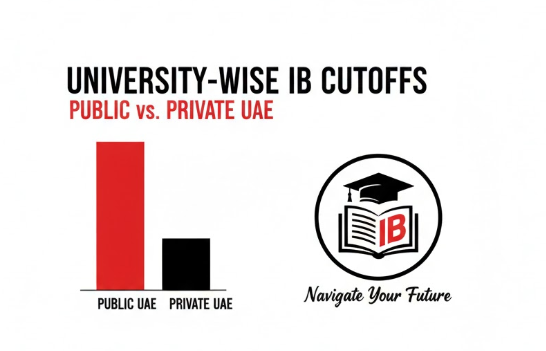
IB students applying to the UAE often hear broad score ranges, but actual admission outcomes depend heavily on the university type. Public and semi-government universities apply fixed IB cutoffs, while private universities work with score bands and conditional flexibility. Understanding these differences at a university-wise level helps students apply strategically and avoid unrealistic choices.
This guide compares typical IB cutoffs across major public and private UAE universities, focusing on how scores are interpreted in practice rather than advertised minimums.
UAE IB Cutoffs at a Glance
University Type | Cutoff Style | Flexibility | Typical IB Range |
Public / Semi-Govt | Fixed cutoffs | Very low | 36–42 |
Private (Top Tier) | Score bands | Moderate | 32–38 |
Private (Broad Access) | Conditional ranges | High | 28–34 |
Public & Semi-Government Universities: IB Cutoffs
Khalifa University
Engineering: 36–40
Science: 35–38
Strong preference for Math AA HL and Physics HL
Very limited flexibility
United Arab Emirates University (UAEU)
Medicine: 40+
Engineering: 36–38
Science & IT: 34–36
Strict MOE equivalency enforcement
Zayed University
Business & Social Sciences: 32–35
Science Programs: 34–36
Foundation pathways rarely used for IB students
Higher Colleges of Technology (HCT)
Applied Engineering & IT: 30–34
Business & Applied Sciences: 28–32
Focus on applied learning and readiness
Private Universities: IB Cutoffs
NYU Abu Dhabi
All Programs: 40–42
Holistic review but extremely competitive
Subject rigor and academic depth critical
American University of Sharjah (AUS)
Engineering: 36–38
Business: 32–35
Foundations not used for IB applicants
University of Birmingham Dubai
Engineering: 34–36
Business: 30–34
Conditional offers common
Heriot-Watt University Dubai
Engineering: 32–34
Business & IT: 28–32
Pathway-friendly
Middlesex University Dubai
Business & Media: 26–30
IT & Psychology: 28–32
Foundations widely available
How to Read These Cutoffs Correctly
Ranges reflect typical successful applicants, not minimums
Subject alignment is assumed within these scores
Scholarships often require higher scores than admission
Subject Requirements Still Override Scores
Even within cutoff ranges:
Medicine requires Chemistry HL
Engineering prefers Math AA HL
Business requires Math AA (SL or HL)
Scores cannot compensate for missing subjects.
Public vs Private: Application Strategy
Profile Type | Best Fit |
Strong HL alignment, high IB | Public / Semi-Govt |
Mid-30s, strong Math | Top-tier Private |
Late planners, uneven scores | Broad-access Private |
Common Mistakes Students Make
Applying to public universities with borderline scores
Ignoring subject requirements
Treating advertised minimums as realistic cutoffs
Overloading applications without fit analysis
Frequently Asked Questions ( FAQs )
1) Are these official cutoffs?
No. These are typical ranges based on recent admission patterns, not guaranteed thresholds.
2) Can private universities accept below these ranges?
Sometimes, via foundations or conditional offers — but progression is not guaranteed.
3) Do public universities ever show flexibility?
Rarely. Subject requirements and cutoffs are tightly enforced.
4) Is NYU Abu Dhabi comparable to other private universities?
No. It operates at a global elite level with US-style holistic review.
5) Should I apply to both public and private universities?
Yes, if your profile spans multiple competitiveness levels.
Final Takeaway
In the UAE, IB cutoffs are not universal. Public universities operate with strict, fixed thresholds, while private institutions assess applicants within flexible score bands. Successful IB applicants match their scores, subjects, and risk tolerance to the right university type — rather than assuming one score fits all.


Comments