Unveiling the Unrest: What Triggered the CJP Protest in Delhi? A Complete Timeline
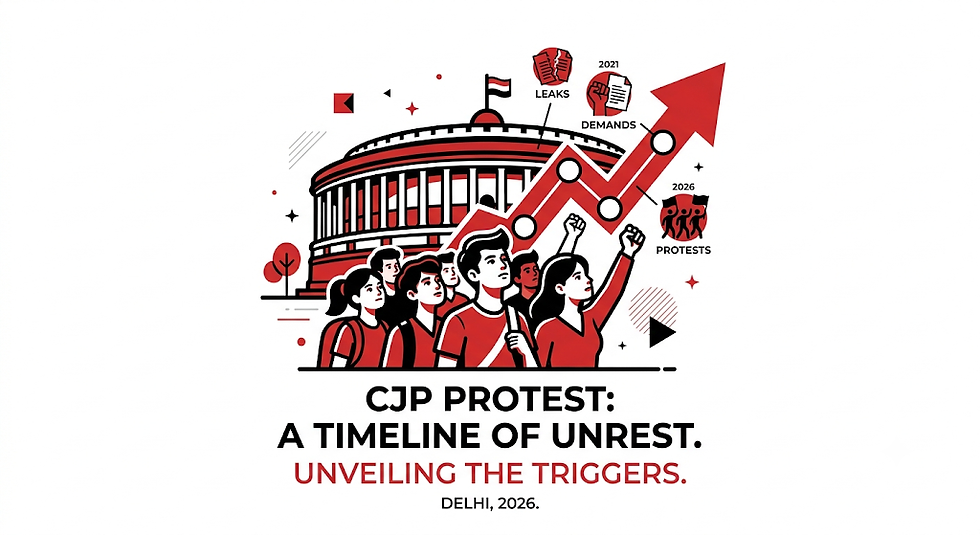
The national capital is witnessing unprecedented political and youth-led unrest. If you have been following the news recently, you have likely seen images of thousands of students, heavy police barricading, and intense standoffs at Jantar Mantar. But what exactly lies beneath this massive escalation? What triggered the CJP protest in Delhi?
This comprehensive, SEO-optimized investigative deep-dive unpacks the origin, the sudden catalysts, and the complete timeline of the Cockroach Janta Party (CJP) movement that has shaken the nation’s administrative core in 2026.
What is the CJP Movement? Decoding the Satirical Revolution
Before diving into the exact sequence of events, it is essential to understand the unique nature of the group leading the charge. The Cockroach Janta Party (CJP) started not as a traditional political faction, but as a highly potent digital satire movement.
The Satirical Origin of "Cockroach"
The movement was conceptualized in mid-May 2026 by digital communications strategist Abhijeet Dipke. The unconventional name was born out of pure retaliation against a controversial statement made during a judicial hearing, where a senior legal authority compared unemployed youth and vocal social media activists to "pests and cockroaches" invading a household.
Instead of backing down, India's online youth weaponized the insult. What began as viral memes quickly morphed into a structured youth-based political movement demanding systemic accountability, better employment opportunities, and complete transparency in national competitive examinations.
What Triggered the CJP Protest in Delhi? The Core Catalysts
While the foundation of the CJP was built on broader frustrations regarding unemployment, the massive physical street demonstrations were sparked by immediate, systemic cracks in India’s educational machinery. If we look closely at what triggered the CJP protest in Delhi, two severe examination-related scandals stand out as the primary breaking points:
1. The 2026 NEET-UG Question Paper Leak
The primary fuse was lit when widespread irregularities and an alleged question paper leak compromised the integrity of the NEET-UG medical entrance examination. Millions of students who had spent years preparing found their futures hanging in the balance, igniting absolute fury among the student community and parenting bodies alike.
2. CBSE On-Screen Marking (OSM) Irregularities
Compounding the medical exam disaster were severe discrepancies found within the Central Board of Secondary Education’s (CBSE) On-Screen Marking and revaluation processes. Thousands of students faced sudden, unexplained anomalies in their scores, leaving them completely stranded during the peak university admission cycle.
The collective failure of these high-stakes academic pillars drove the CJP to transition from digital screens to real-world street politics. They firmly placed the blame on the Ministry of Education, presenting a clear, unyielding ultimatum: the immediate resignation of Union Education Minister Dharmendra Pradhan.
The Complete Timeline of the 2026 Delhi Jantar Mantar Protests
To truly grasp how a digital joke evolved into a historic march towards Parliament, we must analyze the key chronological milestones of this agitation.
The Digital Spark
May 16, 2026
Abhijeet Dipke formally launches the 'Cockroach Janta Party' on social media platforms following controversial public remarks targeting unemployed youth. The handle gains millions of followers within days.
First Street Protest at Jantar Mantar
June 6, 2026
Dipke returns from the United States, landing directly in Delhi to lead the first physical protest. Thousands of youth arrive wearing cockroach masks, holding books and national flags. A 7-day ultimatum is given for the Education Minister's resignation.
The Nationwide Manifesto Campaign
June 11, 2026
CJP launches a pan-India outreach starting at Savitribai Phule Pune University. The group releases a 5-point 'Exam Manifesto' demanding ₹10,000 compensation for leak-impacted students, strict exam guidelines, and transparent evaluations.
The 'Plates and Spoons' Clamor
June 20, 2026
The movement returns to the capital for a second major mobilization. Students gather indefinitely at Jantar Mantar, banging plates and spoons to symbolize the deafening administrative silence regarding their future.
Sonam Wangchuk Joins the Fray
June 28, 2026
Renowned Ladakhi environmentalist and educationist Sonam Wangchuk arrives at Jantar Mantar, offering his alignment and launching an indefinite hunger strike at the venue, drawing senior citizens and diverse civic bodies.
The Hospital Detainment Crackdown
July 18, 2026
Under a newly appointed Delhi Police leadership, authorities forcefully remove a weak Sonam Wangchuk from Jantar Mantar, shifting him to Safdarjung Hospital. CJP brands this an 'illegal detention,' and Dipke begins his own fast in response.
The Parliament March Escalation
July 20, 2026
Coinciding with the start of the Monsoon Session of Parliament, thousands of CJP members attempt the 'Chalo Sansad' march. Delhi Police deploys heavy security, leading to severe standoffs, metro closures, and lathi-charges.
Clashes, Hospitalizations, and the 'Chalo Sansad' Stand-off
The situation reached a critical boiling point in mid-July. Following the forceful removal of Sonam Wangchuk to Safdarjung Hospital on July 18, the emotional and political stakes skyrocketed. From his hospital room, Wangchuk released a stirring message calling the mobilization "India's second freedom movement"—urging the nation to fight for freedom from exam injustice and administrative fear.
In solidarity, CJP founder Abhijeet Dipke immediately initiated his own indefinite hunger strike at Jantar Mantar, surviving purely on water while coordinating a massive, nationwide night vigil on July 19.
The July 20 Parliament March Breakdown
On the morning of July 20, 2026—the opening day of the Monsoon Session of Parliament—central Delhi transformed into a fortress.
Prohibitory Orders: The Delhi Police strictly imposed Section 163 of the Bharatiya Nagarik Suraksha Sanhita (BNSS), banning any assembly of five or more individuals in the New Delhi district.
Metro Shutdowns: Five major transit hubs—Janpath, Patel Chowk, Rajiv Chowk, Central Secretariat, and Seva Teerth—were entirely shut down to impede student flow.
Security Deployments: Massive iron barricades, riot control vehicles, and heavily armed Rapid Action Force (RAF) personnel completely ringed Jantar Mantar and Tolstoy Marg.
Despite these formidable barriers and torrential morning rains, thousands of young students attempted to break through toward Parliament, resulting in sudden, chaotic lathi-charges and physical clashes between youth activists and state security forces.
Core Demands: The 5-Point CJP Exam Manifesto
The CJP’s protest goes far beyond mere structural unrest. The organization has institutionalized its goals into a clear framework to overhaul how public and national recruitments operate.
Serial No. | Demand Metric | Core Target & Mechanism |
01 | Ministerial Accountability | Immediate resignation of Union Education Minister Dharmendra Pradhan over structural examination errors. |
02 | Financial Restitution | A mandatory compensation of ₹10,000 for every single student affected by a paper leak, exam cancellation, or unexpected result delay. |
03 | Independent Audit | Complete independent, third-party forensic audits of the National Testing Agency (NTA) and CBSE evaluation software. |
04 | Fast-Track Legal Redressal | Setting up dedicated fast-track court settings to prosecute paper-leak syndicates under strict national security statutes. |
05 | Standardized Exam Calendars | Strict legal enforcement of a unified, unalterable national exam and declaration timeline to save student academic years. |
Frequently Asked Questions (FAQs)
Q1: What triggered the CJP protest in Delhi initially?
A: If you want to know what triggered the CJP protest in Delhi, it boils down to massive institutional failures in national examinations. Specifically, the widespread 2026 NEET-UG question paper leak and severe CBSE On-Screen Marking irregularities completely jeopardized the academic futures of thousands of students, forcing a satirical online movement to transform into an active physical rebellion.
Q2: Who is the founder of the Cockroach Janta Party (CJP)?
A: The Cockroach Janta Party was founded by digital communications strategist and social media manager Abhijeet Dipke in May 2026. It originally launched as a political satire movement before evolving into a massive student-led pressure group.
Q3: Why is activist Sonam Wangchuk involved in the Delhi protests?
A: Renowned educationist and environmentalist Sonam Wangchuk joined the CJP at Jantar Mantar on June 28, 2026, to offer solidarity against the systemic collapse of the national examination network. His subsequently launched hunger strike amplified the movement globally, drawing massive crowds of concerned citizens.
Q4: Did the CJP obtain legal permission for the July 20 'Chalo Sansad' March?
A: No, the Delhi Police explicitly denied permissions for the 'Chalo Sansad' march, citing strict prohibitory orders under Section 163 of the BNSS to preserve public order during the launch of the Parliament's Monsoon Session.
Stay Updated on India’s Youth Reforms
The escalating standoff between the student community and administrative authorities marks a major turning point in modern democratic accountability. Educational safety nets and recruitment safety are critical to the nation's progress.
To explore more raw on-ground coverage, policy impacts, and ongoing political changes, review these essential resources:


Comments