US Iran Oil Spikes: How Shocks Hit Your Wallet
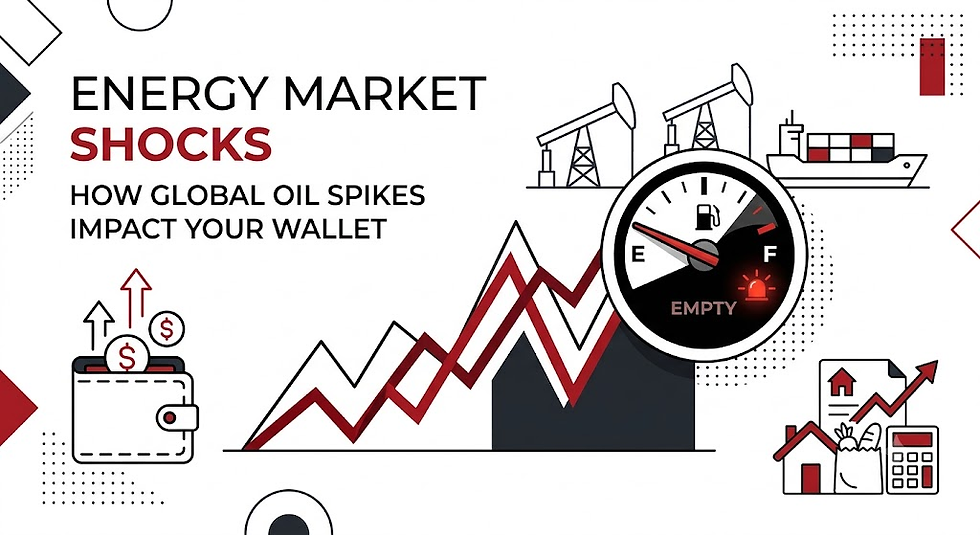
The modern household budget is a delicate balancing act. You calculate your rent or mortgage, account for your weekly groceries, allocate a bit for savings, and hope for a quiet month. But in 2026, a chaotic series of events thousands of miles away has thrown that delicate balance out the window. If you have noticed that your paycheck is not stretching quite as far as it did last winter, you are experiencing the direct financial ripple effects of the current geopolitical standoff.
The volatile US Iran oil spikes of 2026 have proven that what happens in the strategic waterways of the Middle East does not stay there. Instead, it travels directly down the supply chain, landing squarely on your kitchen table, your utility bills, and your local gas station pump.
To understand exactly how these energy shocks are eroding your purchasing power, we have to look at how a localized conflict scales up into a global consumer crisis—and, more importantly, what you can do to protect your money.
The 2026 Energy Catalyst: What is Happening in the Gulf?
To map out the impact on your wallet, we first need to look at the root cause. The global energy ecosystem has faced unprecedented volatility due to the 2026 Iran war and ongoing maritime friction. The crisis reached a boiling point when severe disruptions blockaded the Strait of Hormuz—a narrow choke point responsible for transiting roughly 20% of the world’s petroleum and liquefied natural gas (LNG).
According to data from the International Energy Agency (IEA), these disruptions led to the largest supply disruption in the history of the global oil market, forcing global oil supply to fall by an average of 3.9 million barrels per day in 2026.
The economic landscape has fluctuated violently. Earlier this year, North Sea Dated crude oil prices experienced unparalleled swings, skyrocketing toward a historic $120 to $144 per barrel range before showing temporary signs of retreat. Just as a fragile diplomatic Memorandum of Understanding (MOU) between Washington and Tehran offered a brief window of sanctions relief, renewed attacks on commercial tankers in July 2026 forced the US Treasury Department to swiftly revoke Iran's temporary oil export licenses.
While the United States is heavily insulated by its own record-breaking domestic production—projected by the Energy Information Administration (EIA) to hit 13.8 million barrels per day this year—global oil pricing is a interconnected web. When international benchmarks spike, the domestic market reacts instantly.
The Direct Hit: The Anatomy of Gas Price Hikes
The most immediate and visible consequence of these geopolitical fractures is found at your local gas pump. When crude oil prices surge, the cost of refining and distributing fuel climbs symmetrically.
During the peak of the supply crunch, retail gas prices across the United States experienced daily increases of 5 to 10 cents per gallon, rapidly crossing the $4.00 mark nationwide and approaching $4.50 to $5.00 in high-tax regions.
For the average commuter, the math behind these gas price hikes is simple but painful:
The Baseline: Filling a standard 15-gallon tank at $3.20 per gallon costs $48.00.
The Spike: Filling that same tank at $4.50 per gallon costs $67.50.
The Monthly Toll: If you fill up once a week, that is an extra $78.00 per month vanished entirely into thin air just to commute to work.
This is the baseline "pump shock" of the US Iran oil spikes, but it is only the tip of the economic iceberg.
The Friction Layer: How the US Iran Oil Spikes Bleed Into Your Budget
While a higher cost to fill up your car is annoying, the true danger of global energy volatility lies in its secondary effects. Petroleum is not just a fluid you pump into a vehicle; it is the fundamental logistical baseline of the modern world. When the cost of that baseline goes up, the price of everything traveling across it rises too.
1. The Grocery Store Cascading Effect
Food prices do not exist in a vacuum. Modern agricultural systems rely heavily on petroleum for fertilizers, tractor fuel, and plastics. More importantly, every single apple, box of cereal, and gallon of milk must be transported from farms to processing plants to distribution centers, and finally to your local grocery store shelf.
When freight companies face surging diesel costs, they do not just absorb the loss—they pass it directly down to the retailer, who passes it to you. In 2026, the global food supply chain has felt this pressure intensely, leading to a noticeable inflation of grocery bills.
2. Upward Pressure on Consumer Goods and Delivery Fees
Have you noticed a sudden increase in the "delivery and logistics fee" on your favorite rideshare or food delivery apps? Or perhaps the shipping costs on your online retail orders have crept up? This is direct corporate adaptation to energy shocks. Companies rely on vast networks of delivery drivers, and when fuel costs rise, maintaining profit margins requires shifting that operational weight to the consumer.
3. The Shadow of Sticky Inflation and Interest Rates
Beyond your immediate receipts, energy shocks have broader macroeconomic consequences that alter your long-term financial planning. The Federal Reserve and central banks worldwide monitor inflation metrics closely. Because energy spikes act as a core driver of broader market inflation, the 2026 fuel crisis has complicated monetary policy. Expected interest rate reductions have been repeatedly postponed or reassessed. For you, this means:
Higher interest rates on credit card balances.
More expensive auto loans.
A prolonged period of high mortgage rates, making home buying or refinancing incredibly restrictive.
Defensive Budgeting: Protecting Your Money from Energy Shocks
You cannot control global foreign policy or stabilize maritime trade lanes, but you can build a more resilient household economy. When navigating a year defined by resource volatility, passive budgeting will leave you exposed. Consider implementing these strategic adjustments:
Audit and Optimize Intermittent Travel
If your workplace offers a hybrid model, negotiate your in-office days to minimize high-traffic commuting periods. If you must commute daily, consider leveraging fuel-reward apps or dedicated credit cards that offer cash-back percentages specifically tied to fuel purchases.
Shift to Defensive Meal Planning
With food distribution costs remaining elevated, alter your purchasing habits toward locally sourced items or regional supply chains that require less transport distance. Additionally, buying versatile pantry staples in bulk buffers your wallet against week-to-week price jumps on supermarket shelves.
Construct an "Energy Buffer" in Your Emergency Fund
Traditional financial advice recommends saving three to six months of living expenses. In 2026, it is wise to establish a explicit sub-category within your savings specifically for utility and fuel overages. Dedicating a few hundred dollars to absorb temporary market swings prevents you from needing to rely on high-interest credit cards when energy bills spike.
Frequently Asked Questions
Why do the US Iran oil spikes affect domestic gas prices if the US produces its own oil?
Oil is a globally traded commodity. Even though the US produces a record volume of crude oil domestically, American refiners still buy and sell on an open international market. When global supply drops due to crises in the Middle East, international buyers bid up the price of oil everywhere. American oil producers sell to the highest bidder, meaning domestic prices rise to match global benchmarks.
How long will the current 2026 gas price hikes last?
Market forecasts from institutions like the EIA and J.P. Morgan suggest that while regional tensions have kept prices volatile through the summer of 2026, global oil inventory builds and rising production from non-OPEC nations are expected to gradually outpace demand. Analysts project that shipping lanes may normalize toward the end of the year, which could ease prices significantly heading into 2027.
Can switching to an electric vehicle completely insulate my budget from these shocks?
While an electric vehicle (EV) entirely eliminates your dependence on gasoline, it does not completely shield you from the broader economic impacts of energy crises. A massive disruption in global energy transit also affects natural gas and LNG markets, which can drive up industrial electricity generation costs. Furthermore, the inflationary impact on groceries and consumer goods affects all consumers, regardless of what type of car they drive.
Actionable Next Steps
Navigating an uncertain economic landscape requires proactive financial management. To keep your personal finances secure against macroeconomic volatility, explore these trusted financial planning resources:
Track Regional Fuel Trends: Monitor localized fuel pricing and retail strategies via the U.S. Energy Information Administration (EIA) to anticipate cost shifts before they reach your local pump.
Optimize Household Cash Flow: Utilize structured budgeting frameworks and consumer advocate tools provided by the Consumer Financial Protection Bureau (CFPB) to build an effective emergency buffer.
Evaluate Global Energy Insights: Stay informed on structural shifts in global supply and demand balances by checking the official International Energy Agency (IEA) public market reports.


Comments