West Bengal Elections Phase 2 (April 29): Full Schedule, Seats & Key Constituencies.
- Apr 24
- 4 min read
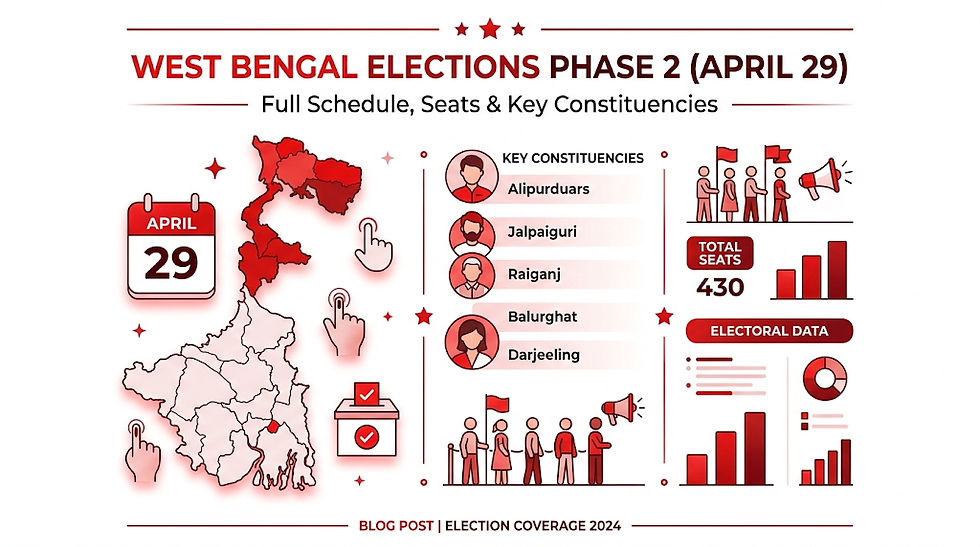
The 2026 West Bengal Legislative Assembly elections have entered a decisive stage, with Phase 2 scheduled for April 29, 2026. After an intense first phase held on April 23, the second phase will determine the political direction of a significant portion of the state.
These elections are being conducted to elect all 294 members of the West Bengal Legislative Assembly, with Phase 2 covering a substantial chunk of constituencies that include urban strongholds, politically sensitive districts, and high-profile battlegrounds.
Phase 2 is particularly crucial because it includes areas where the contest between major parties primarily the Trinamool Congress (TMC) and the Bharatiya Janata Party (BJP) is expected to be intense. The outcome here could heavily influence the final results declared on May 4, 2026.
Phase 2 Overview: Key Highlights
Category | Details |
Phase | Phase 2 |
Polling Date | April 29, 2026 |
Total Seats in Phase 2 | 142 constituencies |
Total Assembly Seats | 294 |
Election Type | Legislative Assembly Election |
Counting Date | May 4, 2026 |
Major Parties | TMC, BJP, Congress, Left Front |
Security Deployment | 2,300+ CAPF companies |
Police Personnel | 38,000+ deployed |
Polling Mode | EVM (Electronic Voting Machines) |
Phase 2 alone accounts for nearly half of the total constituencies, making it a decisive stage in the electoral battle.
West Bengal Elections Phase 2 : Full Schedule for Phase 2
West Bengal Elections Phase 2 : The Election Commission of India (ECI) laid out a detailed timeline for Phase 2 to ensure smooth conduct:
Notification Date: April 2, 2026
Last Date for Nominations: April 9, 2026
Scrutiny of Nominations: April 10, 2026
Last Date for Withdrawal: April 13, 2026
Polling Date: April 29, 2026
Counting of Votes: May 4, 2026
Polling is expected to take place during standard voting hours (generally 7 AM to 6 PM), with strict adherence to election guidelines.
Seats & Regional Distribution
Phase 2 includes 142 constituencies, spanning multiple districts across West
Bengal. These constituencies include:
Urban centers like Kolkata region
Industrial belts such as Hooghly
Politically sensitive districts like East Burdwan
Semi-urban and rural constituencies with diverse voter demographics
The distribution of constituencies ensures representation across:
General seats
Scheduled Caste (SC) reserved seats
Scheduled Tribe (ST) reserved seats
This phase includes constituencies numbered:
AC 77–202 and 259–274, as per official election segmentation.
Key Constituencies to Watch
Phase 2 features several high-profile constituencies that could shape the election narrative:
1. Kolkata & Surrounding Areas
The Kolkata region is politically crucial due to:
High voter density
Strong party presence
Influence on statewide perception
Heavy security deployment (over 27,000 CAPF personnel) reflects its importance.
2. Hooghly District
Known for:
Industrial workforce
Swing voting patterns
Close contests in previous elections
3. East Burdwan
A key battleground due to:
Agricultural economy
Mixed urban-rural voter base
High political engagement
4. South Bengal Constituencies
These regions often witness:
Tight margins
Multi-cornered contests
Strong grassroots campaigning
Security Arrangements & Election Management
Phase 2 is being conducted under unprecedented security measures to ensure free and fair elections.
2,321 companies of Central Armed Police Forces (CAPF) deployed
Over 2.3 lakh security personnel involved overall
38,000+ police staff assisting operations
Special focus on sensitive constituencies and polling booths
The Election Commission has implemented a multi-layered security strategy, including:
Area domination exercises
CCTV surveillance
Micro-observers at polling booths
Strict enforcement of Model Code of Conduct
These measures aim to prevent violence and ensure smooth voting.
Political Significance of Phase 2
Phase 2 is widely seen as a game-changing phase for several reasons:
1. High Number of Seats
With 142 constituencies, this phase alone can significantly tilt the balance of power.
2. Urban + Rural Mix
Unlike Phase 1, Phase 2 includes a balanced mix of:
Urban voters
Industrial workers
Rural communities
This diversity makes outcomes less predictable.
3. Key Political Contest
The election is largely a direct contest between TMC and BJP, with Congress and Left playing supporting roles in certain areas.
4. Impact on Final Results
A strong performance in Phase 2 can:
Establish momentum
Influence voter perception
Affect post-poll alliances
Voter Guidelines for Phase 2
Voters participating on April 29 must follow these guidelines:
Documents Required
Voter ID (EPIC)
Aadhaar Card / Passport / Driving License (as alternative ID)
Do’s
Verify polling booth location in advance
Carry valid ID
Follow queue discipline
Don’ts
Carry prohibited items
Engage in political campaigning near polling booths
Violate election rules
These measures are designed to ensure a smooth and transparent voting process.
What Makes Phase 2 Different?
Phase 2 stands out due to:
Higher concentration of urban constituencies
Stronger media focus
Increased deployment of central forces
Greater political stakes
Compared to Phase 1, this phase is expected to witness:
More strategic voting
Higher political campaigning intensity
Closer contests in multiple seats
Expected Voter Turnout
Phase 1 recorded a very high turnout (close to 90%), indicating strong voter participation.
A similar or slightly lower turnout is expected in Phase 2 due to:
Urban voter patterns
Weather conditions
Political mobilization
However, overall enthusiasm remains high.
Frequently Asked Questions ( FAQs )
1. When is Phase 2 of the West Bengal Elections 2026?
Phase 2 will be held on April 29, 2026.
2. How many seats are included in Phase 2?
A total of 142 constituencies will go to polls in this phase.
3. When will the election results be declared?
Results will be announced on May 4, 2026.
4. Which areas are covered in Phase 2?
Phase 2 includes constituencies across:
Kolkata region
Hooghly
East Burdwan
Several South Bengal districts
5. What security arrangements are in place?
Over 2,300 CAPF companies and 38,000+ police personnel are deployed to ensure safe voting.
6. What documents are required to vote?
Voters must carry a valid ID proof, preferably a Voter ID card.
Final Takeaway
Phase 2 of the West Bengal Elections 2026, scheduled for April 29, is one of the most critical stages of the electoral process. With 142 seats at stake, extensive security arrangements, and key constituencies in play, this phase is likely to shape the overall outcome of the election.
The combination of urban influence, rural dynamics, and intense political rivalry makes Phase 2 a decisive battleground. As voters head to polling booths, all eyes will be on turnout, key contests, and early trends that could hint at the final verdict on May 4.
In short, Phase 2 is not just another voting day it is the turning point that could define West Bengal’s political future for the next five years.


Comments