What Is the ITR Managed Service Provider Penalty? Eligibility, Rules & Impact (2026 Guide)
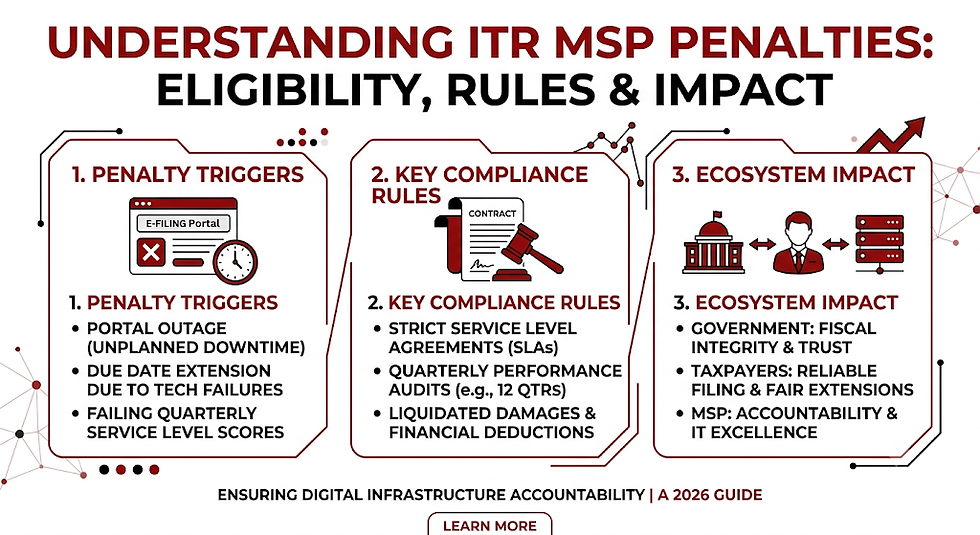
Maintaining tax compliance requires smooth digital infrastructure. When taxpayers log into the Income Tax Department's portal to file their returns, they depend heavily on the Managed Service Provider (MSP) operating the e-filing platform behind the scenes. But what happens when system outages, portal glitches, or server crashes force the government to extend tax deadlines? The government imposes strict financial consequences on the IT vendor. The ITR Managed Service Provider penalty is a regulatory contractual fine imposed on the IT vendor operating the e-filing portal when technical outages or operational failures force deadline extensions or violate service-level benchmarks.
In 2026, as tax filing volumes peak to millions of daily transactions, understanding the mechanics of these MSP penalties, service-level benchmark rules, and their direct impact on individual and corporate taxpayers is critical.
What Is the ITR Managed Service Provider Penalty?
The ITR Managed Service Provider penalty refers to liquidated damages and service-level financial deductions levied by the Central Board of Direct Taxes (CBDT) and the Ministry of Finance on the vendor managing the Integrated e-Filing & Centralized Processing Center (IEC 2.0) portal.
When an IT infrastructure partner signs a contract to run a national tax portal, they agree to strict Service Level Agreements (SLAs) regarding portal uptime, concurrent user handling, security compliance, and processing speed. If the portal experiences prolonged downtime during peak filing periods—forcing the government to issue official deadline extensions—the vendor is penalised under contractual liquidated damage clauses.
┌─────────────────────────────────────────────────────────┐
│              ITR MSP Penalty Framework                 │
└──────────────────────────┬──────────────────────────────┘
                           │
         ┌─────────────────┴─────────────────┐
         ▼                                   ▼
┌──────────────────┐               ┌──────────────────┐
│ Outage Penalties │               │   SLA Benchmarks │
│ (Peak Filing)    │               │  (12 Quarters)   │
└────────┬─────────┘               └────────┬─────────┘
         │                                   │
         └─────────────────┬─────────────────┘
                           ▼
┌─────────────────────────────────────────────────────────┐
│        Government Deductions & Liquidated Damages       │
└─────────────────────────────────────────────────────────┘
Key Clauses Governing MSP Financial Penalties
Mandatory Due Date Extension Penalty: If an extension of the Income Tax Return (ITR) filing deadline or any pre-notified tax compliance date occurs due to technical glitches, the MSP faces a direct penalty.
Liquidated Damages: Financial compensation claimed by the government for operational disruptions caused to millions of taxpayers.
Quarterly Service Level Score Deductions: Performance is evaluated across consecutive quarters; failing to meet threshold scores triggers automatic payout reductions.
Eligibility & Trigger Conditions for Imposing MSP Penalties
The government does not penalise managed service providers arbitrarily. Specific thresholds, contract terms, and operational failures trigger the ITR Managed Service Provider penalty.
1. Extended Due Dates Caused by Technical Failures
Under Ministry of Finance regulations, if the e-filing portal crashes, experiences broken session states, or exhibits database timeouts that prevent taxpayers from filing on time, the government is forced to extend statutory deadlines. Any extension attributable to vendor technical faults automatically triggers liquidated damages against the MSP.
2. Failure to Meet Quarterly Service Level Scores
The operational efficiency of the e-filing infrastructure is measured using a composite Service Level Score evaluated every quarter. Metrics evaluated include:
System Availability / Uptime: Expectation of 99.9% uptime during non-peak hours and 99.99% during peak tax season.
Response Time & Latency: Speed of loading Form 26AS, AIS/TIS downloads, and login authentications.
Concurrency Handling: Ability to maintain stability when millions of users log in simultaneously during peak weeks.
Failure to meet these scores leads to penalty deductions across multiple quarters.
3. Application Outages During Peak Filing Seasons
Peak tax periods see massive traffic spikes. System failures during these critical periods carry the heaviest financial penalties due to their national impact.
Breakdown of Key Penalties and Rules for 2026
To understand how the vendor penalty fits into the broader tax landscape, compare the rules governing the Managed Service Provider with the penal provisions faced by taxpayers for non-compliance under the Income Tax Act.
Penalty Structure: Managed Service Provider vs. Taxpayers
Entity Category | Compliance Parameter | Applicable Penalty / Section | Financial Impact / Rate |
Managed Service Provider (MSP) | Portal outage causing deadline extension | Contractual Liquidated Damages | Direct financial penalties deducted from contract payouts |
Managed Service Provider (MSP) | Failure in Quarterly Service Level Scores | SLA Penalty Provisions | Penalties imposed over multi-quarter audit cycles (e.g., 12 quarters) |
Individual / Corporate Taxpayer | Late filing of ITR (Income > ₹5 Lakh) | Section 234F | Flat ₹5,000 late fee |
Individual / Corporate Taxpayer | Late filing of ITR (Income ≤ ₹5 Lakh) | Section 234F | Reduced ₹1,000 late fee |
Taxpayer with Unpaid Dues | Delay in tax payment | Section 234A | 1% simple interest per month on tax liability |
Taxpayer (Underreporting) | Underreporting of Income | Section 270A | 50% of tax payable on underreported amount |
Taxpayer (Misreporting) | Misreporting of Income | Section 270A | 200% of tax payable on misreported amount |
Comparative Data: Portal Load & Activities (Peak Week Comparison)
The government closely tracks portal usage during peak filing weeks. High server loads demonstrate why infrastructure stability is necessary to avoid penalties.
Activity Type (Peak Period: 8th–14th July) | 2025 Activity Volume | 2026 Activity Volume | Growth Rate (%) |
ITR Filings Completed | ~27.04 Lakh | ~68.60 Lakh | +153.7% |
Portal Logins | ~3.27 Crore | ~5.69 Crore | +74.0% |
Challan Generations | ~8.96 Lakh | ~14.19 Lakh | +58.3% |
Form 26AS Views / Downloads | ~1.55 Crore | ~2.62 Crore | +69.0% |
Total Interacted Portal Activities | ~5.10 Crore | ~9.28 Crore | +81.9% |
Data demonstrates how traffic expansion puts strain on IT infrastructure, reinforcing the need for strict MSP enforcement.
Impact of MSP Penalties on Tax Ecosystem Stakeholders
Enforcing strict penalties on the vendor managing national tax infrastructure yields wide-ranging benefits across the ecosystem.
┌─────────────────────────────────────────────────────────────┐
│                 Ecosystem Impact Cycle                      │
└──────────────────────────────┬──────────────────────────────┘
                               │
         ┌─────────────────────┼─────────────────────┐
         ▼                     ▼                     ▼
┌──────────────────┐  ┌──────────────────┐  ┌──────────────────┐
│  For Taxpayers   │  ┌  For Government   │  ┌   For Vendors    │
│ Fewer Crashes &  │  │ Revenue Flow &   │  │ High Standard of │
│ Timely Filings   │  │ Public Trust     │  │ IT Architecture  │
└──────────────────┘  └──────────────────┘  └──────────────────┘
1. Direct Impact on Individual & Corporate Taxpayers
Minimized Server Downtime: Penalties compel vendors to invest in load balancing, auto-scaling, and cloud optimization to prevent outages during peak periods.
Fair Extension Policies: When technical glitches occur, taxpayers receive formal due date extensions without paying late fees under Section 234F.
Faster Refund Processing: Reliable servers ensure faster automated processing of returns at the Centralized Processing Center (CPC).
2. Impact on Tax Professionals and CAs
Chartered Accountants face intense pressure during tax season. System crashes lead to missed deadlines, client dissatisfaction, and audit delays. Enforcing service-level penalties ensures higher platform reliability during peak audit weeks.
3. Governance and Fiscal Integrity
Enforcing strict contracts ensures public money spent on digital infrastructure yields functional services. Holding third-party vendors accountable builds taxpayer trust in government e-governance systems.
Step-by-Step Rules for Resolving Technical Glitches During ITR Filing
If you encounter technical issues on the e-filing portal, follow this procedural sequence to safeguard against non-compliance penalties:
1.Document the System Error:Step 1.
Take timestamped screenshots of the portal error, including the URL bar, reference error code, and system time. This serves as evidence if late filing notices are issued.
2.Clear Cache and Attempt Alternate Browsers:Step 2.
Log out, clear browser cookies and cache, or try an incognito window. Often, session state errors occur due to local browser caching issues during high-traffic periods.
3.Submit a Formal Grievance on e-Filing Portal:Step 3.
Navigate to e-File > Grievances > Submit Grievance. Categorize the ticket under "e-Filing Application Technical Issues" and attach your error screenshots.
4.Obtain Grievance Reference Number:Step 4.
Save the Grievance Acknowledgement Ticket ID. This ticket acts as official proof that you attempted compliance prior to the deadline but were blocked by portal instability.
Frequently Asked Questions (FAQs)
Q1: What is the primary cause of an ITR Managed Service Provider penalty?
A: An ITR Managed Service Provider penalty is primarily triggered when application outages or operational lapses occur during peak periods, or when technical glitches on the portal force the government to extend official tax filing deadlines.
Q2: Does a portal outage automatically waive taxpayer penalties under Section 234F?
A: No, a portal outage does not automatically cancel taxpayer penalties unless the government issues an official notification extending the ITR due date. If an extension is officially granted due to MSP outages, filings made within the extended window will not incur late fees under Section 234F.
Q3: How are MSP performance levels calculated?
A: The government measures the performance of the e-filing portal vendor through quarterly Service Level Scores. These scores evaluate factors such as uptime percentages, application response times, concurrency handling capacity, and quick resolution of systemic bugs.
Q4: Are penalties imposed on the MSP payable to affected taxpayers?
A: No. The penalties levied on the Managed Service Provider take the form of liquidated damages and SLA deductions collected directly by the Income Tax Department/Ministry of Finance. They are not distributed to individual taxpayers as financial compensation.
Conclusion
Understanding the rules and impact of the ITR Managed Service Provider penalty highlights how critical robust digital infrastructure is to modern tax administration. By enforcing strict quarterly SLAs and demanding compensation for outages, the government ensures that its technology partners maintain high availability for millions of taxpayers. For businesses and individuals, staying informed about these governance measures provides clarity when technical extensions occur during tax filing season.
Quick Reference Links & Next Steps
Primary Focus Keyword: ITR Managed Service Provider Penalty
Target Audience: Taxpayers, CAs, IT Service Managers, Financial Analysts
Compliance Resources: Income Tax Department e-Filing Portal


Comments