What Is the Stock Market? A Complete Beginner’s Guide to Making Smart Investments
- Jun 15
- 7 min read
When you hear the words "stock market," what comes to mind? A chaotic trading floor with people screaming into phones? A high-stakes casino where fortunes are lost overnight? Or maybe a confusing maze of charts and numbers meant only for Wall Street or Dalal Street experts?
If you’ve held back from investing because of these images, you aren’t alone. Many beginners, students, and young professionals view the stock market with a mix of excitement and fear.
But here is the truth for 2026: the stock market is not a casino. When approached with patience and data, it is one of the most powerful tools available to beat inflation and build long-term generational wealth.
This comprehensive stock market for beginners guide breaks down everything you need to know in plain, simple language to help you transition from a spectator to a confident investor.
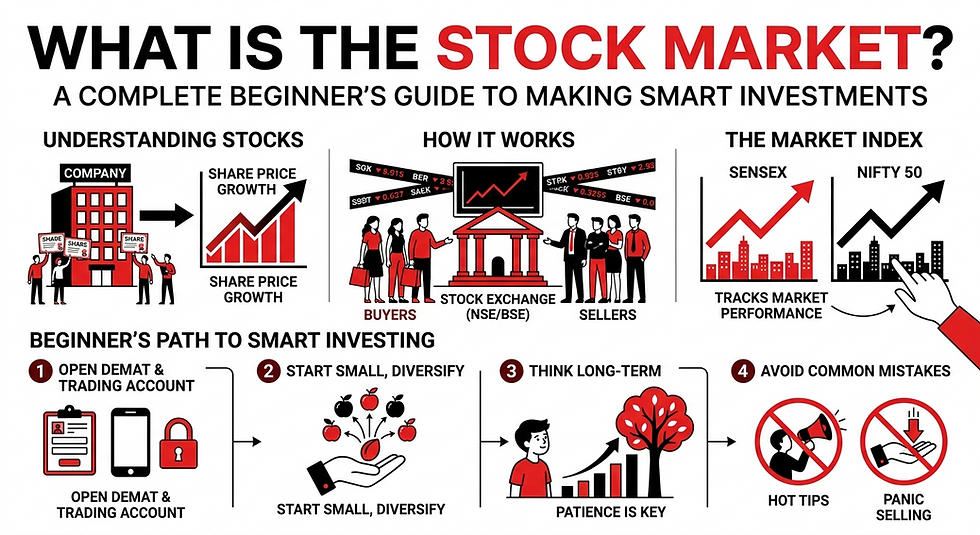
1. What Is the Stock Market?
Think of the stock market like a massive, highly regulated digital supermarket. Instead of buying groceries, however, people buy and sell tiny pieces of real, functioning businesses.
What are Stocks and Shares?
A share (often called a stock) represents a fraction of ownership in a company.
2. How the Stock Market Works
A stock market operates on a simple principle: Demand and Supply.
If a company reports great earnings, launches an innovative product, or the economy looks strong, more people will want to buy its shares. As demand goes up, the stock price increases. Conversely, if a company performs poorly or faces a scandal, investors sell off their shares, causing the price to drop.
To understand the lifecycle of a stock, you need to understand the two places where trading happens:
Primary Market vs. Secondary Market
The Primary Market: This is where a company creates and sells new shares to the public for the exact first time. This process is called an Initial Public Offering (IPO). When a company "goes public," it collects money directly from investors to fund its expansion.
The Secondary Market: Once the IPO is over, those shares trade openly between everyday investors on stock exchanges. When you buy a stock through an app today, you aren’t buying it from the company itself; you are buying it from another investor who wants to sell it.
3. The Indian Stock Market Ecosystem: NSE, BSE, Nifty, and Sensex
If you are looking at how to invest in stocks in India, you will encounter four major terms almost immediately. Let’s demystify them.
                  ┌───────────────────────────────┐
                  │      REGULATOR: SEBI          │
                  └───────────────┬───────────────┘
                                  ▼
         ┌────────────────────────┴────────────────────────┐
         │                                                 │
         ▼                                                 ▼
┌─────────────────┐                               ┌─────────────────┐
│  BOMBAY STOCK   │                               │ NATIONAL STOCK  │
│ EXCHANGE (BSE)  │                               │ EXCHANGE (NSE)  │
└────────┬────────┘                               └────────┬────────┘
         ▼                                                 ▼
┌─────────────────┐                               ┌─────────────────┐
│     SENSEX      │                               │    NIFTY 50     │
│ (Top 30 Stocks) │                               │ (Top 50 Stocks) │
└─────────────────┘                               └─────────────────┘
NSE and BSE Explained
The BSE (Bombay Stock Exchange) is the oldest stock exchange in Asia, established way back in 1875. The NSE (National Stock Exchange) was established in 1992 and introduced modern, electronic screen-based trading to India. Both platforms list thousands of companies and offer identical core functions for buyers and sellers.
What are Sensex and Nifty 50?
Because tracking thousands of individual companies every second is impossible, we use Stock Market Indexes to tell us how the overall market is performing.
Sensex: The benchmark index of the BSE. It tracks the performance of the 30 largest and most financially stable companies listed on the BSE.
Nifty 50: The benchmark index of the NSE. It tracks the performance of the top 50 companies across major sectors of the Indian economy.
When people say "the market is up today," they usually mean the Nifty or Sensex closed higher than the day before.
4. Types of Participants: Investors vs. Traders
Not everyone in the market shares the same goal. Individuals generally fall into one of two categories:
Investors (The Wealth Builders): Investors focus on long-term investing. They buy shares in fundamentally strong companies and hold onto them for years, sometimes decades. They rely on the compounding growth of the business.
Traders (The Fast-Pacers): Traders focus on short-term price movements. They might buy and sell a stock within a few hours (Intraday Trading) or weeks (Swing Trading) to book quick profits. This requires significant time, technical skills, and carries much higher risks.
5. Weighing the Scales: Benefits vs. Risks
Understanding stock market basics requires looking objectively at both the potential rewards and the structural risks.
Benefits of Investing in Stocks
Beat Inflation: Standard savings accounts or fixed deposits (FDs) often fail to keep up with the rising cost of living. Historically, a diversified equity portfolio has delivered returns that outperform long-term inflation.
Compounding Growth: Reinvesting the returns or dividends you earn allows your money to make money on top of itself. Over 10 to 20 years, compounding yields remarkable growth.
Liquidity: Unlike real estate, which can take months to sell, stocks can be converted back to cash within minutes during market hours.
Risks Involved
Market Volatility: Prices fluctuate constantly due to global news, political shifts, or economic changes. Your portfolio value will go down at times; you need the emotional discipline not to panic.
Company-Specific Risk: If a business goes bankrupt or manages its operations poorly, you can lose a substantial portion of the money you invested in that specific stock.
6. Jargon Buster: Essential Terms to Know
Before making your first move, familiarize yourself with these key terms:
Bull Market: A period where stock prices are steadily rising, driven by economic optimism.
Bear Market: A period where stock prices drop consistently (typically 20% or more from recent highs), accompanied by widespread pessimism.
Dividend: A portion of a company's net profit distributed directly back to its shareholders as cash or additional shares.
Portfolio: The collection of all your investments, including stocks, mutual funds, or bonds.
Market Cap (Market Capitalization): The total value of a company's shares ($ Companies are categorized into Large-Cap (stable market leaders), Mid-Cap (growing businesses), and Small-Cap (young, high-growth but highly volatile companies).
7. How to Start Investing in India (Step-by-Step)
Starting your investment journey in India is now entirely digital, paperless, and can be completed right from your smartphone.
1.Get Your Documents Ready:Prerequisites.
Gather your PAN Card, Aadhaar Card (linked to your mobile number for OTP verification), a cancelled cheque, and your bank account details.
2.Choose a Stock Broker:Platform Selection.
Select a SEBI-registered broker. Beginners typically prefer discount brokers (like Zerodha, Groww, or Angel One) due to low brokerage fees and clean digital interfaces.
3.Open a Demat and Trading Account:Digital KYC.
Complete the online application through your broker's app. The broker will automatically open a Trading Account (used to buy/sell) and a Demat Account (a secure digital locker where your shares are safely stored).
4.Link and Fund Your Account:Capital Transfer.
Securely link your bank account to your trading profile via UPI or Net Banking to transfer your initial investing funds.
5.Research and Make Your First Purchase:Execution.
Search for a stable, prominent company you understand well. Start small—even just one share—to see firsthand how the transaction, tracking, and settlement cycle works.
8. Smart Investing Tips for Long-Term Wealth
If your goal is to build an enduring portfolio, focus heavily on these foundational rules:
Invest via Mutual Funds or Index Funds First
If researching individual companies feels overwhelming, you do not have to pick individual stocks. An Index Fund tracks an index like the Nifty 50. By buying one unit of a Nifty 50 index fund, you instantly invest in the 50 largest companies in India simultaneously.
Use SIP (Systematic Investment Plan)
Don't try to time the market by waiting for prices to drop. Instead, invest a fixed, affordable sum of money every single week or month automatically. This practice averages out your purchase cost over time—a concept known as rupee-cost averaging.
Diversify Your Assets
"Don't put all your eggs in one basket."
Spread your investments across multiple sectors (Banking, IT, Pharma, Consumer Goods). If one sector undergoes a temporary downturn, your other investments can help stabilize your portfolio.
9. Common Mistakes Beginners Should Avoid
Chasing "Hot Tips": Never buy a stock simply because an influencer on social media, a friend, or a relative recommended it. Always do your own research.
Investing Rent or Emergency Money: Only invest money that you do not need for the next 3 to 5 years. Never put your emergency cash or everyday survival money into equity markets.
Overreacting to Short-Term Noise: The stock market moves up and down constantly. Checking your app multiple times a day and panicking over minor losses often leads to selling at the absolute worst times.
10.Frequently Asked Questions (FAQs)
Q1 . How much money do I need to start investing in stocks?
You do not need a fortune. You can start with as little as ₹100 or ₹500 via a Mutual Fund SIP, or by purchasing a single share of a company whose current stock price is low.
Q2. Can I lose all my money in the stock market?
While it is technically possible if you invest all your capital into a single fraudulent or bankrupt company, it is exceptionally rare if you hold a diversified portfolio or an index fund tracking the top 50 businesses in the country.
Q3. What is the best time to buy stocks?
The best time to start was yesterday; the second-best time is today. For long-term wealth generation, time in the market matters far more than trying to time the market perfectly.
Q4. Is stock market profit taxable in India?
Yes. If you sell a stock within 1 year of buying, it attracts Short-Term Capital Gains (STCG) tax. If you hold it for more than 1 year before selling, it is classified under Long-Term Capital Gains (LTCG) tax, which features structural exemptions up to a certain financial threshold.
The Golden Rule: Learn Before You Earn
The stock market is not an exclusive club for math geniuses or Wall Street executives. Anyone can succeed if they apply patience, consistent discipline, and continuous learning.
Before committing your hard-earned money, commit your time to understanding how businesses function. Start small, remain consistent, and let time do the heavy lifting for your financial future.
Ready to Start Your Investing Journey?
The best investment you can make today is in your financial knowledge. Explore these trusted resources to learn more:
Learn personal finance and investing concepts:SEBI Investor Education Portal


Comments