WhatsApp Accounts Blocked: Centre Cracks Down on 83,000 Fraud IDs
- 3 hours ago
- 4 min read
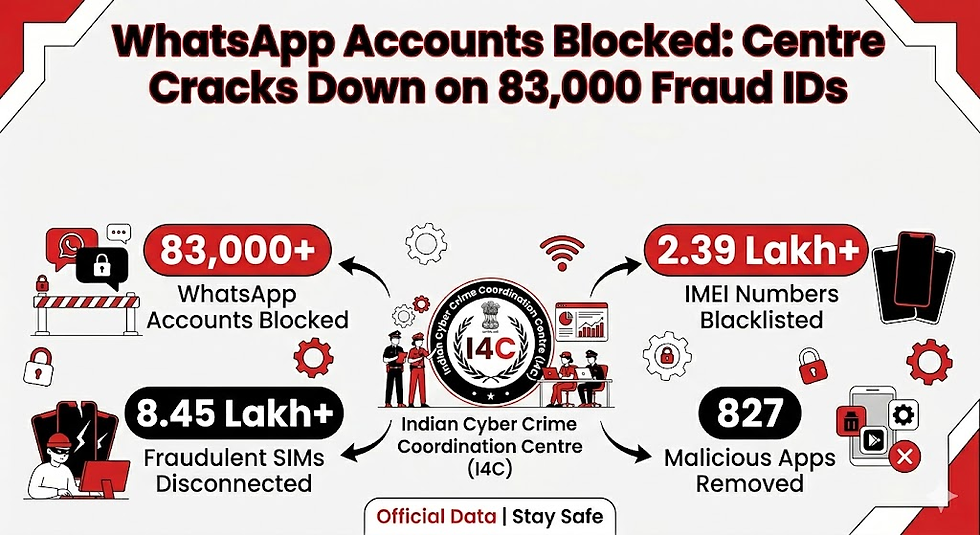
The Ministry of Home Affairs (MHA), through its specialized cyber wing, the Indian Cyber Crime Coordination Centre (I4C), has executed a massive "Digital Strike" against escalating online scams. As of March 2026, the Centre has officially confirmed that over 83,000 WhatsApp accounts blocked were central to executing sophisticated financial frauds and "digital arrest" scams. This operation, conducted in synergy with the Department of Telecommunications (DoT), marks one of the most aggressive steps taken by the government to dismantle the digital infrastructure used by cybercriminals.
WhatsApp Accounts Blocked: The Scale of the 2026 Digital Strike
The recent crackdown isn't just about messaging apps. It is a comprehensive overhaul of India’s digital security perimeter. According to official data released in late March 2026, the authorities have neutralized a staggering amount of fraudulent assets:
WhatsApp Accounts: 83,867 accounts permanently disabled.
Skype IDs: 3,962 IDs blocked for impersonating law enforcement officials.
SIM Cards: Over 8.45 lakh fraudulent SIM cards deactivated.
Mobile Devices: 2.39 lakh IMEI numbers blacklisted nationwide.
Malicious Apps: 827 fraud-linked mobile applications removed from ecosystem.
This move follows a surge in "Digital Arrest" cases, where fraudsters pose as CBI, Customs, or Police officers via video calls to intimidate victims into transferring massive sums of money. By targeting the WhatsApp Accounts Blocked in this cycle, the government is cutting off the primary communication channel used for these high-stakes deceptions.
Understanding the Cyber Fraud Crackdown Mechanism
To achieve such high-volume results, the Centre has leveraged the Sanchar Saathi Portal and the National Cybercrime Reporting Portal (NCRP). These platforms allow for real-time tracking of suspicious activities. When a user reports a scam call or message, the system uses AI-driven risk scoring to identify the source.
The Role of the I4C and Sahyog Portal
The I4C acts as the central hub for coordinating with state police forces and telecom service providers. In 2026, the focus shifted toward a "Victim-Centric" model. The newly implemented Standard Operating Procedure (SOP) ensures that for financial frauds under ₹50,000, banks can now process refunds more swiftly, often without the lengthy wait for court orders.
Furthermore, the Sahyog Portal was utilized to take down over 1.11 lakh pieces of suspicious online content, ranging from fake investment advertisements to phishing links disguised as government schemes.
How to Protect Yourself from Digital Arrest and Investment Scams
With the rise of WhatsApp accounts blocked, it is clear that scammers are constantly shifting tactics. In 2026, "Agentic AI" and "Deepfakes" have become common tools for cybercriminals to mimic the voices and faces of trusted authority figures.
Key Safety Protocols for 2026
Verify via Sanchar Saathi: Use the official portal to check how many SIM cards are registered in your name and report any unauthorized connections immediately.
The 1930 Helpline: In case of financial fraud, every second counts. Calling the National Cybercrime Helpline (1930) immediately can help freeze the stolen funds before they are moved out of the banking system.
Identify "Digital Arrest" Tactics: Remember, no government agency or law enforcement official will ever ask for money or a "security deposit" over a WhatsApp video call.
Check App Genuineness: Only download apps from verified sources. The government has already identified and blocked 827 malicious apps that were designed to steal OTPs and personal data.
Analyzing Official Data: Why 83,000+ WhatsApp Accounts Blocked?
The decision to target WhatsApp specifically stems from its end-to-end encryption, which scammers frequently exploit to hide their identity. However, by tracking the mobile numbers linked to these accounts through the Citizen Financial Cyber Fraud Reporting and Management System (CFCFRMS), authorities are now able to identify patterns of "Bulk Messaging" and "Fraudulent Signaling."
Category | Action Taken (2025-2026) |
WhatsApp Accounts Blocked | 83,867 |
Malicious Content Removed | 1,11,000+ |
Fraudulent SIMs Disconnected | 8.45 Lakh |
IMEI Numbers Blacklisted | 2.39 Lakh |
Conclusion
The 2026 crackdown representing over 83,000 WhatsApp accounts blocked is a testament to the government's commitment to a "Cyber-Safe India." While the "Digital Strike" has successfully dismantled thousands of fraud networks, the responsibility of digital hygiene remains with the user. By staying updated with official advisories and utilizing portals like Sanchar Saathi, citizens can effectively contribute to the nationwide effort against cybercrime.
Frequently Asked Questions (FAQs)
Q1: Why were so many WhatsApp accounts blocked recently?
A: The Centre initiated the block on 83,867 WhatsApp accounts blocked because they were found to be the primary tools for executing "Digital Arrest" scams and fraudulent investment schemes. These accounts were identified through thousands of victim complaints on the NCRP portal.
Q2: What should I do if I receive a suspicious call on WhatsApp?
A: Do not engage or share any personal details. You should report the number immediately on the Sanchar Saathi "Chakshu" facility and the WhatsApp "Report" feature. If you have lost money, dial 1930 instantly.
Q3: Can a blocked WhatsApp account be recovered?
A: If an account is blocked as part of a government-led cyber fraud crackdown, it is usually based on evidence of fraudulent activity. Recovery is unlikely unless the user can prove the number was used without their consent via a formal grievance process.
Q4: How does the government identify these fraud apps?
A: Through a combination of AI monitoring on the Sahyog Portal and user reports, the MHA identifies apps that request unnecessary permissions or exhibit phishing behavior. In the latest drive, 827 such apps were removed.
CTA
Report Cybercrime: National Cybercrime Reporting Portal (Official)
Check Your SIM Connections: Sanchar Saathi Portal
MHA Official Updates: Ministry of Home Affairs


Comments