Why Instrumentation Engineering is the Best Course Choice in 2026: Scope & Future
- Feb 5
- 4 min read
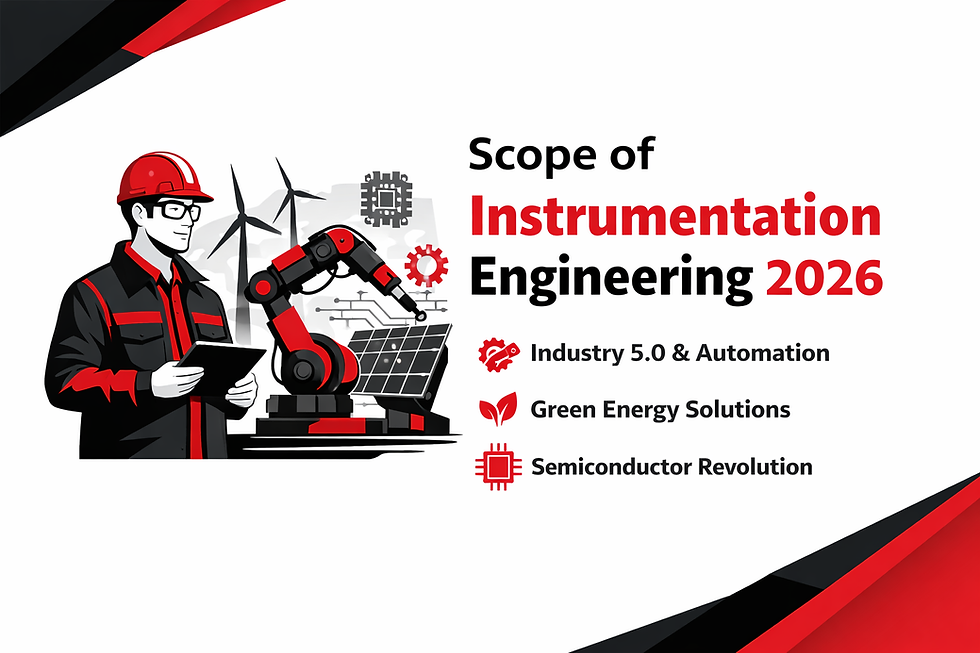
In the rapidly evolving academic landscape of 2026, students are moving beyond traditional branches to embrace specialized fields that bridge the gap between hardware and intelligence. Among these, the scope of instrumentation engineering 2026 has emerged as a powerhouse. This stream is no longer just about measuring pressure or temperature; it is the backbone of "Smart Manufacturing" and "Industry 5.0," where human-machine collaboration defines the new standard of production.
If you are a student looking for a course that integrates electronics, computer science, and mechanical systems, this guide breaks down why this stream is the ultimate choice for your undergraduate studies.
What is Instrumentation Engineering? (2026 Perspective)
Instrumentation Engineering is a specialized branch of engineering that focuses on the principle and operation of measuring instruments used in design, configuration, and automated systems. In 2026, the curriculum has shifted from simple analog sensors to Intelligent Cyber-Physical Systems.
As a student in this stream, you don't just learn how to measure; you learn how to make systems "feel" and "react." Whether it’s a robotic arm in a Tesla factory or a glucose monitor in a wearable patch, instrumentation is the technology behind the sensing.
Core Curriculum & Stream Details: What You Will Study
The B.Tech or B.E. in Instrumentation Engineering is a four-year journey. By 2026, the syllabus in top Indian institutes (like IITs, NITs, and COEP) has been modernized to include AI and IoT as core modules rather than electives.
1. The Foundational Years
During the first two years, students focus on the "Core Triad":
Engineering Mathematics: Linear Algebra, Calculus, and Numerical Methods.
Signals and Systems: Understanding how data travels through electronic circuits.
Electrical Circuits & Machines: The physics of power and movement.
2. Specialized Subjects (Years 3 & 4)
This is where the scope of instrumentation engineering 2026 truly shines. The curriculum now heavily features:
Industrial IoT (IIoT): Connecting factory sensors to the cloud.
Control Systems & Process Control: Learning how to automate complex chemical or mechanical processes.
Biomedical Instrumentation: Designing equipment like MRI machines and advanced prosthetics.
Smart Sensors & Transducers: Studying Nano-sensors and MEMS (Micro-Electro-Mechanical Systems).
Note: Many colleges have now introduced "Industry 5.0 Modules" which teach students how to design systems that prioritize environmental sustainability and human-centric automation.
Why the Scope of Instrumentation Engineering 2026 is Booming
The "Best Career Choice" label isn't just marketing; it's backed by real-world data from the 2026 industrial sector.
1. Transition to Industry 5.0
While Industry 4.0 was about automation, Industry 5.0 focuses on the collaboration between humans and robots. Instrumentation engineers are the architects of this interface. They ensure that machines can detect human presence and work safely alongside them.
2. The Green Energy Revolution
India’s push for Green Hydrogen and Solar Power requires massive "Precision Monitoring." You cannot run a nuclear plant or a hydrogen fuel cell without high-level instrumentation. This has led to a 40% increase in specialized course seats across private and government colleges.
3. Semiconductor Mission India
With India becoming a global hub for semiconductor manufacturing by 2026, the demand for "Cleanroom Instrumentation" is at an all-time high. Students who specialize in this stream are finding themselves at the center of the "Make in India" semiconductor ecosystem.
Top Colleges Offering Instrumentation Engineering in India (2026)
If you are looking to enroll, these are the top-rated institutions based on the 2026 NIRF rankings and infrastructure:
College Name | Location | Entrance Exam |
IIT Delhi / IIT Madras | Delhi/Chennai | JEE Advanced |
COEP Technological University | Pune | MHT-CET / JEE Main |
Jadavpur University | Kolkata | WBJEE |
NIT Trichy / NIT Silchar | Various | JEE Main |
AISSMS Institute of IT | Pune | MHT-CET |
Vishwakarma Institute of Technology (VIT) | Pune | MHT-CET |
Admission Requirements for 2026
To enter this stream, students typically need:
Academic Qualification: 10+2 with Physics, Chemistry, and Mathematics (PCM) with a minimum of 50-60% aggregate.
Entrance Exams: JEE Main is the standard, while states like Maharashtra rely on MHT-CET.
Lateral Entry: Diploma holders in Instrumentation or Electronics can enter directly into the second year (3rd semester) of the degree course.
FAQ: Scope of Instrumentation Engineering 2026
Q1: What is the scope of Instrumentation Engineering 2026 for higher studies?
The scope of instrumentation engineering 2026 is excellent for higher studies. Graduates can pursue an M.Tech in Robotics, AI, or Biomedical Engineering, or an MS abroad in Mechatronics.
Q2: Is Instrumentation harder than Electronics and Communication (ECE)?
It is more focused on "Process Control" and "Automation." While ECE deals with communication and VLSI, Instrumentation is more multidisciplinary, involving mechanical and chemical process knowledge.
Q3: Can I switch to Software Engineering after this course?
Yes. Since the 2026 curriculum includes extensive Python, C++, and PLC programming, many students easily transition into Embedded Systems and Software Development roles.
Q4: Are there government job opportunities for this stream?
Absolutely. Organizations like BARC, ISRO, DRDO, and ONGC have dedicated wings for Instrumentation and Control engineers.
Final Thoughts: Should You Choose This Stream?
If you are someone who loves to see "Science in Action"—where a line of code moves a massive turbine or a sensor saves a life in a hospital—then Instrumentation Engineering is the best course for you in 2026. It offers the stability of core engineering with the excitement of cutting-edge tech like AI and IoT.
The scope of instrumentation engineering 2026 ensures that you aren't just an engineer; you are a specialist in a world that is becoming increasingly automated every single day.


![Best Printing Engineering Reference Books for 2026 [Updated List]](https://static.wixstatic.com/media/095999_12dfac2cf88348b5be710f12fc40508b~mv2.png/v1/fill/w_980,h_653,al_c,q_90,usm_0.66_1.00_0.01,enc_avif,quality_auto/095999_12dfac2cf88348b5be710f12fc40508b~mv2.png)
Comments