10th SSC Science 1 Chapter Wise Weightage 2026: Physics & Chemistry Marks Distribution
- Feb 24
- 4 min read

If you are a student appearing for the Maharashtra State Board (MSBSHSE) 2026 exams, you know that Science and Technology Part 1 (Physics & Chemistry) can be the difference between a good score and a great one. With the curriculum emphasizing conceptual understanding over rote learning, staying ahead requires a strategic approach.
Stop studying blindly! Our 2026 marking scheme breakdown tells you exactly which Science 1 chapters to master for a 40/40 score. By aligning your preparation with the official Science 1 Chapter Weightage 2026, you can focus your energy on high-value topics and ensure you don’t leave any easy marks on the table.
Understanding the Science 1 Exam Blueprint for 2026
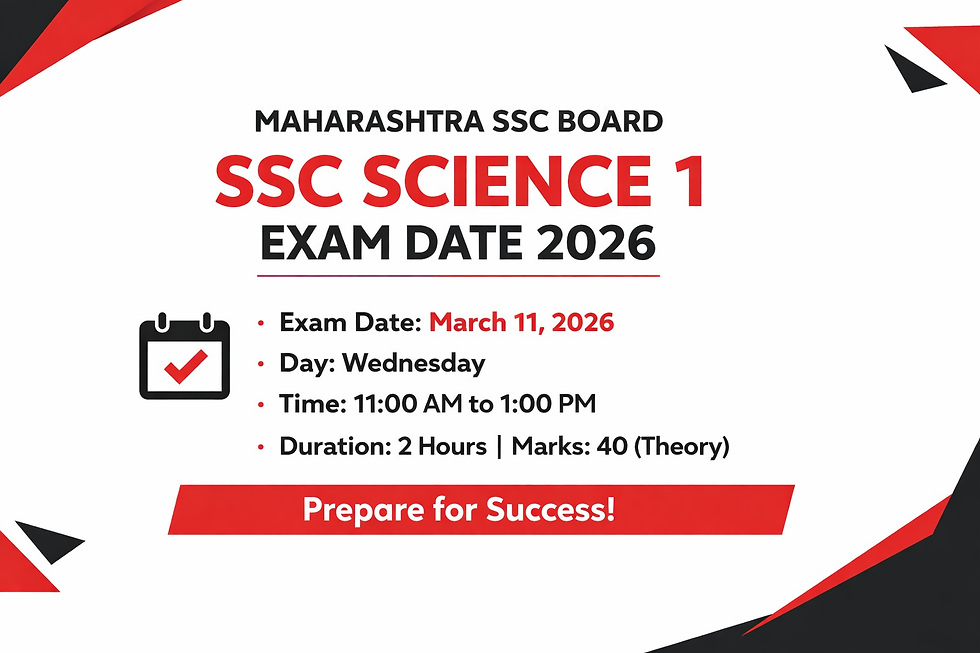
The Science and Technology Part 1 paper is a 40-mark theory exam that must be completed in 2 hours. While the total marks for Science are 100, they are split into Science 1 (40 marks), Science 2 (40 marks), and Internal Assessments (20 marks).
To achieve perfection, you need to look at the marks "with options." In a 40-mark paper, the board actually provides questions worth 60 marks, giving you the flexibility to choose. Knowing the Science 1 Chapter Weightage 2026 helps you decide which "option" questions to prioritize during your revision.
Science 1 Chapter Wise Weightage 2026 Table
Chapter Name | Marks (Without Options) | Marks (With Options) |
Gravitation | 3 | 5 |
Periodic Classification of Elements | 4 | 6 |
Chemical Reactions and Equations | 4 | 6 |
Effects of Electric Current | 5 | 7 |
Heat | 3 | 5 |
Refraction of Light | 5 | 7 |
Lenses | 4 | 6 |
Metallurgy | 4 | 6 |
Carbon Compounds | 5 | 7 |
Space Missions | 3 | 5 |
Total | 40 | 60 |
High-Scoring Chapters: Where to Focus?
According to the latest 2026 data, three chapters stand out with the highest weightage (7 marks with options). These are the pillars of your Science 1 score:
1. Carbon Compounds (Chemistry)
This is often considered the most challenging yet rewarding chapter. In 2026, Carbon Compounds remains a top priority. Focus on saturated and unsaturated hydrocarbons, functional groups, and nomenclature. Since it carries 7 marks with options, expect a long-answer question (5 marks) or a combination of 3-mark conceptual questions from this unit.
2. Effects of Electric Current (Physics)
A staple in the Physics section, this chapter covers Fleming's Right-Hand Rule, Electric Motors, and Generators. Practice the diagrams carefully. This chapter frequently features in the 3-mark and 5-mark sections of the paper.
3. Refraction of Light (Physics)
Understanding the laws of refraction and the refractive index is crucial. This chapter is highly scoring because the questions are often direct and involve ray diagrams that, if drawn correctly, guarantee full marks.
Pro Tip: Don't ignore "Space Missions" just because it has a lower weightage. It is one of the easiest chapters to finish in a single sitting, providing a "guaranteed" 3 to 5 marks with minimal effort.
Chemistry vs. Physics: The 2026 Balance
The Science 1 paper is meticulously balanced between Physics and Chemistry.
Chemistry Power-ups: Focus on Periodic Classification and Chemical Reactions. Ensure you can write balanced chemical equations. For the 2026 exam, examiners are looking for precision in chemical formulas.
Physics Essentials: Lenses and Heat are conceptually heavy. For Lenses, ensure you know the sign conventions and can solve the numericals without error.
Why the 2026 Marking Scheme Matters
The Science 1 Chapter Weightage 2026 isn't just a list of numbers; it’s your roadmap. Students who follow this blueprint can identify "low-hanging fruit"—chapters that take less time but offer high marks. For instance, Metallurgy is a process-oriented chapter. Mastering the extraction of Aluminum can almost certainly land you a 3-mark or 5-mark question.
Important Strategy for 40/40 in Science 1
Objective Mastery: The first 10 marks (Q1.A and Q1.B) are purely objective. These include MCQs and "find the odd man out" or "true/false." Scoring 10/10 here builds the momentum needed for the rest of the paper.
Scientific Reasons: Q2.A asks for scientific reasons. Use keywords and bullet points. For example, when explaining why elements are in the same group, explicitly mention "valence electrons."
Diagram Accuracy: In Physics, a neat ray diagram for Refraction or Lenses is worth its weight in gold. Use a sharpened pencil and a ruler—presentation matters in 2026!
Check Out More Resources: > If you're looking for more specialized guidance, check out the 12th HSC CS-1 Important Questions 2026. While it's for 12th grade, her strategy on handling technical subjects is legendary for all board students.
FAQs on Science 1 Chapter Weightage 2026
Q1: Which chapter has the highest weightage in Science 1 for 2026?
The Science 1 Chapter Weightage 2026 indicates that Effects of Electric Current, Refraction of Light, and Carbon Compounds carry the highest weightage, each offering up to 7 marks with options.
Q2: Are numericals compulsory in the Science 1 paper?
Yes, numericals from chapters like Gravitation, Heat, and Lenses are usually included in the 2-mark and 3-mark sections. While there are options, skipping numericals entirely makes it very difficult to score a perfect 40/40.
Q3: Can I skip the 'Space Missions' chapter?
We recommend against it. It carries a weightage of 3 to 5 marks. Since the content is mostly descriptive and easy to memorize, it is a high-return chapter for the time invested.
Q4: Is the 2026 syllabus different from previous years?
The core syllabus remains consistent with the revised Maharashtra State Board curriculum, but the 2026 paper pattern emphasizes application-based "HOTS" (Higher Order Thinking Skills) questions more than previous years.
Final Thoughts for SSC 2026 Aspirants
Success in the SSC boards is 40% hard work and 60% smart work. By utilizing the Science 1 Chapter Weightage 2026, you are already ahead of thousands of students who are just reading the textbook cover-to-cover. Focus on the big hitters like Carbon Compounds and Refraction, but don't lose the easy marks in Gravitation or Metallurgy.


Comments