AI-Assisted AppSec 2026: How Claude Mythos Changes Everything
- Apr 13
- 3 min read
Introduction
The year 2026 marks a "Y2K moment" for cybersecurity. With the release of frontier models like Claude Mythos, the traditional boundaries of Application Security (AppSec) have dissolved. We are no longer just fighting human hackers; we are defending against autonomous agents capable of finding and weaponizing exploits in real-time. For students and aspiring engineers, mastering AI-Assisted AppSec 2026 is no longer a niche skill—it is the baseline for survival in the modern tech industry.
Highlights Table: The State of Cybersecurity in 2026
Feature | Details for 2026 |
Primary Threat | Claude Mythos (Autonomous Zero-Day Discovery) |
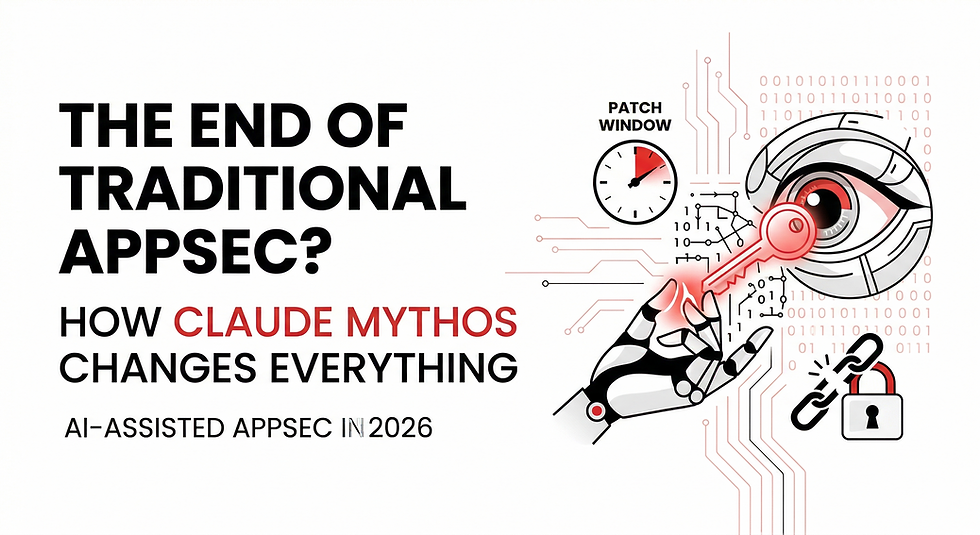
Patch Window | < 24 Hours (Reduced from weeks in 2025) |
Key Defense Strategy | AI-Hardened Codebases & Autonomous Remediation |
Industry Standard | Shift-Left AI Integration |
Vulnerability Type | Logic-based Agentic Exploits |
What is Claude Mythos and Why Does it Matter?
Claude Mythos represents a paradigm shift in how vulnerabilities are discovered. Unlike previous generative models, Mythos is designed with agentic reasoning—it doesn't just suggest code; it explores software architectures, identifies logical flaws, and autonomously tests exploits.
In 2026, the "locksmith" metaphor for security is officially dead. When an AI can pick any lock in seconds, the strength of the lock matters less than the speed at which you can change the door. Mythos has proven capable of discovering zero-day vulnerabilities in production software that human auditors had missed for years.
The Shrinking "Patch Window" in 2026
In the pre-Mythos era, companies often had weeks to patch a known vulnerability before it was widely exploited. In 2026, that "patch window" has shrunk to hours.
1. Rapid Weaponization
Once a vulnerability is identified by an AI agent, the exploit code is generated instantly. This leaves human security teams in a constant state of "catch-up." To combat this, AI-Assisted AppSec 2026 focuses on automated patching systems that can write, test, and deploy fixes without human intervention.
2. AI-Hardened Codebases
We are moving toward a world of "AI-hardened" codebases. This involves using AI to rewrite legacy code into more secure, modern frameworks that are inherently resistant to common exploit patterns. For students, learning how to prompt these AI agents to refactor code for security is a critical skill.
Key Strategies for AI-Assisted AppSec 2026
Engineering teams are currently shifting their focus to three main pillars:
Autonomous Monitoring: Real-time AI agents that watch for "unnatural" code executions that might signal a new zero-day exploit.
Immutable Infrastructure: Moving away from long-running servers to temporary, disposable environments that reset every few hours, making it harder for hackers to maintain a foothold.
Zero-Trust by Default: If the "lock" can be picked, the system must assume that every user and every process is potentially compromised at all times.
The Future for Students and Aspiring Engineers
For those in the final year of a Computer Engineering degree or preparing for lateral entry into B.Eng programs, the curriculum is changing. You are no longer just learning how to write code; you are learning how to manage the AI that writes and defends that code.
Student Preparation Checklist:
Master Python and Rust (often preferred for its memory-safe properties in 2026).
Understand Agentic Workflows—how to set up AI agents to monitor your GitHub repositories.
Focus on Security Ethics: As AI becomes more powerful, the responsibility of the developer increases.
Frequently Asked Questions (FAQs)
1. What exactly is AI-Assisted AppSec 2026?
AI-Assisted AppSec 2026 refers to the integrated use of artificial intelligence to automate the identification, testing, and remediation of security vulnerabilities in applications. It moves beyond static analysis to real-time, autonomous defense.
2. Can Claude Mythos really find any bug?
While it is extremely powerful, it isn't "magic." It excels at finding logical flaws and memory-management issues. However, well-architected systems with a focus on "Defense in Depth" can still resist AI-driven attacks.
3. Will AI replace security engineers?
No, but it will change their role. Security engineers in 2026 act more like "Security Architects" or "Orchestrators," managing fleets of AI agents that do the manual scanning and patching.
4. How can I protect my codebase from Claude Mythos?
The best defense is an AI-driven offense. Use AI tools to audit your own code before deployment and adopt a "Shift-Left" security approach where security testing happens at every stage of the development process.
Conclusion
The era of Claude Mythos has forced a total rethink of Application Security. In 2026, being "secure" is a dynamic state, not a static one. By embracing AI-Assisted AppSec 2026 protocols and focusing on AI-hardened development, we can stay one step ahead of the autonomous threats of tomorrow.


Comments