AI Powered Smart Homes in 2026: Next-Gen Innovations Transforming Everyday Living
- Jul 25
- 7 min read
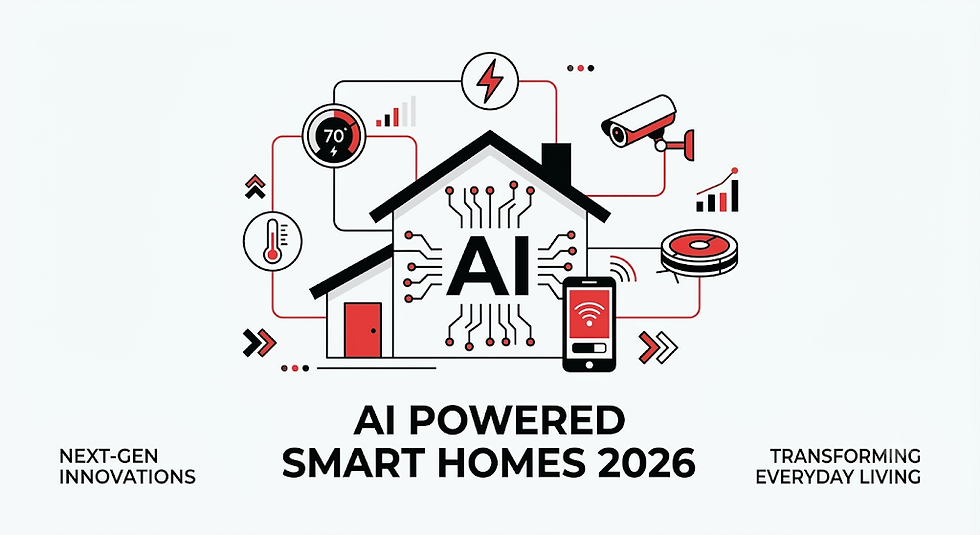
Remember when having a "smart home" meant shouting at a tabletop speaker to play a playlist or manually setting a digital thermostat to lower the temperature at night? Those early days of fragmented apps and basic voice controls feel distant now. In 2026, residential automation has undergone a massive paradigm shift. We have moved beyond simple, reactive connected devices and entered the era of ambient intelligence, where AI powered smart homes dynamically learn, adapt, and predict human needs without requiring constant manual prompts.
Driven by advancements in edge processing, generative artificial intelligence, and unified connectivity standards like Matter 1.5, residential automation is no longer about novelty—it is about practical utility, sustainable energy management, and seamless daily living. According to recent industry research, the global smart home market reached $180.12 billion in 2026, with projections estimating growth past $800 billion over the next decade as homeowners replace legacy systems with predictive AI infrastructure.
Whether you want to lower energy bills, enhance physical security, or automate everyday chores, understanding the state of home automation in 2026 is essential. In this comprehensive guide, we unpack the groundbreaking technologies, unified ecosystems, and proactive capabilities defining modern living spaces this year.
The Shift to Ambient Intelligence: From Reactive Commands to Proactive Living
For over a decade, home automation relied entirely on reactive triggers: if a motion sensor detects movement, then turn on a light. While helpful, this model required homeowners to spend hours configuring rigid rule engines that broke whenever daily routines changed.
In 2026, AI powered smart homes operate on the principle of ambient intelligence. Rather than waiting for explicit voice commands or pre-programmed schedules, modern AI platforms continuously analyze multi-modal sensor data—including ambient lighting, localized occupancy, weather forecasts, time-of-day behavioral trends, and biometric cues—to anticipate what occupants need before they ask.
Predictive Behavioral Modeling
Today's central home controllers do not just log when you adjust the thermostat; they correlate temperature preferences with humidity, barometric pressure, recent physical activity, and sleep patterns. If the system notices that you lower the bedroom temperature after evening workouts, it automatically initiates a gradual cooling cycle 15 minutes before you typically enter the room.
Generative Voice and Natural Language Interaction
Robotic responses from legacy voice assistants are officially obsolete. Generative AI models integrated into home ecosystems now support fluid, multi-turn conversations with contextual memory. Instead of issuing micro-commands ("Set lights to 30%, close blinds, turn on TV"), you can simply say, "We’re getting ready for family movie night." The system instantly evaluates room occupancy, lowers motorized shades, adjusts color-temperature lighting based on circadian rhythms, and primes the home theater sound bar automatically.
Matter 1.5 and Interoperability: The Universal Language of Connected Ecosystems
Building a comprehensive smart home previously felt like navigating a battlefield of proprietary platforms. Homeowners were forced to choose between Apple HomeKit, Google Home, Amazon Alexa, or Samsung SmartThings—often ending up with isolated "walled gardens" that refused to communicate.
The maturation of the Matter standard (specifically Matter 1.4 and Matter 1.5) has permanently dismantled these barriers. The release of Matter 1.5 introduced standardized protocol definitions for real-time video streaming, advanced security cameras, environmental sensors, solar microgrids, residential battery storage, and smart heat pumps.
Because of this cross-industry alignment, homeowners can seamlessly pair a Thread-enabled sensor with an Apple Home Hub and trigger automated responses across Samsung smart appliances without custom code or cloud bridges.
Key benefits delivered by the current Matter standard include:
Zero-Touch Onboarding: NFC-based and multi-device QR provisioning allows users to tap a new device against their smartphone to instantly add it to their local Thread mesh network.
Local Processing: Commands and automations execute locally across Thread border routers, eliminating latency and ensuring your climate control works even during internet outages.
Unified Energy Clusters: Matter-certified appliances report real-time energy draw directly to main electrical panels, giving AI engines complete visibility over household power dynamics.
Key Pillars of AI Powered Smart Homes in 2026
The convergence of artificial intelligence with advanced hardware has given rise to extraordinary innovations across energy, physical chores, and personal security. Let's examine the three core pillars driving modern residential transformations.
1. Next-Gen Home Energy Management Systems (HEMS)
With rising utility costs and volatile power grids, smart home technology in 2026 is heavily anchored in eco-optimization. Modern Smart Home Energy Management Systems (HEMS) act as digital controllers for household power consumption.
Solid-state smart circuit panels have replaced traditional breaker boxes. Driven by predictive AI, these panels monitor electricity pricing in real time through dynamic utility tariffs. During peak rate hours, the AI automatically shifts energy consumption away from the grid, powering key loads using stored electricity from home solar batteries or electric vehicle (EV) bi-directional charging setups.
Furthermore, predictive HVAC maintenance uses machine learning algorithms to monitor operational acoustics and thermal decay rates. If an air conditioning compressor exhibits minor mechanical vibrations, the AI diagnoses potential component failure weeks before a breakdown occurs, protecting homeowners from costly emergency repairs.
2. Autonomous Physical Robotics
In-home robotics have evolved far beyond basic disc-shaped vacuums that get stuck under dining tables. The flagship home robotics of 2026 feature articulated limbs, multi-camera visual spatial AI, and 3D LiDAR mapping.
Devices like advanced stair-climbing robotic vacuums (such as the Roborock Saros Rover) seamlessly navigate multi-story homes without human intervention. Meanwhile, aquatic robotics like the Mammotion SPINO S1 Pro handle outdoor pool maintenance, featuring self-charging shore landing and autonomous debris sorting.
Indoor autonomous companions powered by multimodal AI perform routine physical checks around perimeters, identify liquid spills, escort visitors to specific guest rooms, and wirelessly monitor elderly family members for potential falls.
3. Ambient Health Monitoring and Biometric Security
Security systems in 2026 have shifted from reactive alarms to preventive physical intelligence. Door locks now incorporate optical wireless power transfer—such as Lockin’s aura-charging technology—eliminating battery swaps entirely while enabling instant palm-vein and facial biometric unlock sequences.
Concurrently, non-invasive health monitoring is standard in ambient living spaces:
Millimeter-Wave (mmWave) Radar: Ceiling-mounted radar sensors track micro-movements, respiration rates, and heart rate variability without requiring invasive cameras or wearable bands.
Acoustic Edge Analytics: On-device audio processing models (like Samsung’s EdgeAware AI) run continuously inside local hub hardware to identify high-stress events like glass breakage or distress vocalizations without sending audio streams to cloud servers.
Edge AI Computing and On-Device Data Security
As homes become hyper-connected data collection nodes, privacy concerns have moved to the forefront of consumer consciousness. Transmitting video feeds, voice recordings, and daily routine schedules to remote cloud servers creates unacceptable security risks.
In response, 2026 marked a decisive transition toward Edge AI computing.
Architecture Overview: Modern smart hubs feature dedicated Neural Processing Units (NPUs) capable of running compressed Large Language Models (LLMs) and vision transformers locally.
By keeping biometric processing, video analytics, and natural language understanding strictly on local hardware, modern smart homes deliver lightning-fast response times (sub-10 milliseconds) while maintaining strict zero-trust privacy boundaries. Local AI processing eliminates unnecessary cloud logging, ensuring personal telemetry remains completely encrypted and contained inside your physical residence. External cloud connectivity is restricted to firmware updates and optional remote access, protecting sensitive telemetry from data breaches.
Strategic Roadmap: Upgrading to AI Powered Smart Homes Today
Upgrading your living space to leverage modern smart capabilities does not require knocking down walls or spending tens of thousands of dollars overnight. Following a phased, strategic approach yields the best results.
Phase | Core Objective | Key Hardware & Components | Estimated Timeline |
Phase 1: Foundation | Establish unified network & standard | Matter-certified Thread border router, Wi-Fi 7 mesh access points | Weeks 1–2 |
Phase 2: Climate & Energy | Reduce utility waste & optimize loads | AI smart thermostat, smart circuit monitors, smart plugs | Weeks 3–4 |
Phase 3: Ambient Intelligence | Implement predictive automation | mmWave presence sensors, edge AI hubs, smart lighting | Month 2 |
Phase 4: Physical Automation | Deploy autonomous robotics & safety | Biometric smart locks, AI robotic cleaners, HEMS integration | Months 3+ |
Step 1: Upgrade Your Network Infrastructure
A robust local network is non-negotiable. Ensure your home is equipped with a Wi-Fi 6E or Wi-Fi 7 mesh system alongside a dedicated Thread border router. This guarantees low-latency communication across hundreds of connected devices without network congestion.
Step 2: Prioritize Interoperable Matter Devices
When purchasing sensors, switches, or lighting, insist on Matter certification. Selecting Matter 1.4/1.5 hardware protects your investments from vendor lock-in and ensures long-term software compatibility across all major ecosystems.
Step 3: Implement Localized Automation Hubs
Select a central hub that prioritizes local processing (such as Home Assistant Yellow, Apple Home Hub, or Samsung SmartThings Station with local Edge Drivers). Avoid platforms that rely exclusively on cloud computing for basic rule execution.
Frequently Asked Questions (FAQs)
What makes AI powered smart homes different from traditional home automation?
Traditional home automation relies on manual user inputs, simple voice prompts, and rigid "if-this-then-that" rules. In contrast, AI powered smart homes leverage machine learning, contextual sensor data, and ambient intelligence to proactively predict user needs, adapt to shifting routines, and optimize energy consumption automatically without requiring manual scheduling.
Do I need to replace all my existing smart devices to use Matter 1.5?
No. Many major hardware manufacturers have released firmware updates that upgrade existing hubs, smart bulbs, and sensors to support Matter and Thread protocols. However, legacy devices using older proprietary protocols may require a Matter-compatible bridge to integrate into updated home networks.
How do AI powered smart homes protect user privacy and data security?
Modern AI powered smart homes protect user privacy by executing sensitive tasks—such as voice parsing, facial recognition, and health monitoring—directly on local edge hardware rather than sending raw data to external cloud servers. Combined with Matter's mandatory end-to-end encryption and Thread's secure mesh architecture, personal telemetry remains contained inside your physical residence.
Will an AI smart home significantly reduce monthly electricity bills?
Yes. By integrating smart circuit panels, predictive HVAC scheduling, and real-time utility tariff tracking, AI home energy management systems reduce overall household energy expenses by 15% to 30% annually. Systems automatically shift energy usage to solar power or battery storage during peak electricity rate hours.
What happens to AI smart home automations if the internet goes out?
Because current Matter-certified systems and edge AI hubs rely on local Thread mesh networks and on-device processing, core home automations continue functioning seamlessly during internet outages. Switches, presence sensors, local climate controls, and security routines remain operational without an active external cloud connection.
Transform Your Living Space with Next-Gen Smart Innovations
The era of complex, frustrating home automation is officially over. By embracing ambient artificial intelligence, edge privacy, and open interoperability standards, modern homeowners can build living environments that actively save energy, enhance personal security, and simplify everyday life.
Ready to design your intelligent living space? Explore the official Connectivity Standards Alliance Matter Specifications for certified hardware, or review the US Department of Energy Smart Home Automation Guidelines to optimize your residential energy footprint today!


Comments