Biggest Market Fall in 2 Years: Causes, Impact & Future Outlook
- Mar 19
- 8 min read
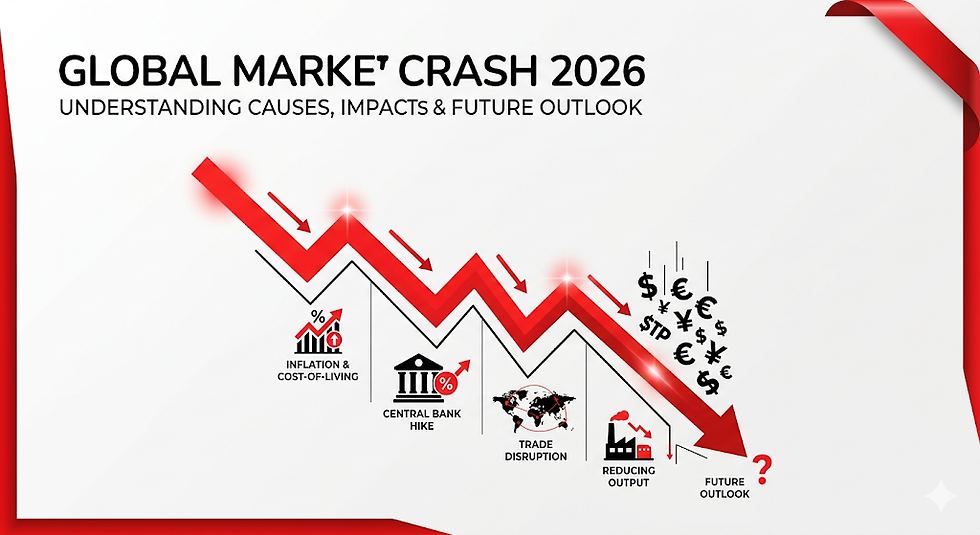
The global financial landscape has been rocked by the biggest market fall in 2 years, a seismic event that has sent shockwaves through economies, affected millions of investors, and raised serious questions about the future of global growth. For many, this correction—or perhaps, the start of a more sustained downturn—feels like a sudden and harsh awakening after a period of relative stability. But for those paying close attention, the warning signs have been flickering for some time. This blog post will delve deep into this significant market event, analyzing its root causes, assessing its immediate and potential long-term impacts, and offering a forward-looking perspective on what investors and businesses can expect in the months and years ahead, using the latest data and relevance for 2026.
The Anatomy of a Collapse: Understanding the Causes
The biggest market fall in 2 years wasn't triggered by a single isolated event, but rather by a confluence of powerful factors that had been simmering beneath the surface. To understand the collapse, we must dissect these interconnected causes:
1. The End of Cheap Money and Rising Interest Rates: For years, the global economy benefited from historically low-interest rates, a policy designed to stimulate growth in the wake of previous crises. This environment of "cheap money" fueled borrowing, investment, and significant asset price inflation, particularly in tech and real estate. However, in 2025 and accelerating into 2026, central banks, led by the U.S. Federal Reserve, were forced to aggressively hike interest rates to combat stubborn, multi-decade high inflation. This "quantitative tightening" has had a profound and immediate effect. It increased the cost of borrowing for businesses and consumers, squeezed profit margins, and, crucially, made less-risky assets like bonds more attractive relative to stocks. The sudden withdrawal of liquidity was a primary catalyst for the sell-off.
2. Persistent and Sticky Inflation: While central banks have been raising rates, inflation has proven to be far more persistent than initially anticipated. Supply chain vulnerabilities exposed by previous global disruptions, coupled with ongoing geopolitical tensions affecting energy and commodity prices, have kept costs high. In 2026, we are seeing the "wage-price spiral" in effect, where workers demand higher wages to keep up with the cost of living, which in turn drives up production costs and prices further. This persistent inflation erodes consumer purchasing power and creates immense uncertainty for businesses, a environment hostile to stock market growth.
3. Geopolitical Instability and Deglobalization: The geopolitical landscape in 2026 remains highly volatile. Ongoing conflicts, particularly in Eastern Europe and lingering tensions in East Asia, have disrupted global trade, sent energy prices on a rollercoaster, and fostered a deep sense of uncertainty. Furthermore, the trend toward deglobalization—characterized by increased protectionism, friend-shoring, and the fracturing of global supply chains—is accelerating. This process is inherently inflationary and inefficient, adding significant costs and risks to global commerce and making it difficult for multinational corporations to forecast profits accurately.
4. A Slowdown in Global Economic Growth (The Recession Dragon): All the factors above are culminating in a significant and synchronized slowdown in global economic growth. In 2026, major economies, including the U.S., China, and the Eurozone, are either in a technical recession or teetering on the brink. Corporate earnings, the fundamental driver of stock prices, are under immense pressure as consumer spending weakens and input costs rise. The market, which had previously priced in a "soft landing," is now rapidly adjusting to the reality of a "hard landing"—a full-blown recession.
5. Bursting Asset Bubbles and Excessive Leverage: The prolonged period of low-interest rates inevitably led to the formation of asset bubbles. In 2026, we are witnessing the deflation of these bubbles. The high-growth, high-multiple tech sector, which dominated the previous bull market, has been particularly hard hit as investors re-evaluate valuations in a higher-rate environment. Furthermore, excessive leverage, both at the corporate and consumer levels, has magnified the downward pressure. As asset prices fall, forced liquidations by over-leveraged investors accelerate the panic and the sell-off.
Understanding the Global Market Fall: A Direct Impact Assessment
The immediate impact of the biggest market fall in 2 years has been profound, affecting every corner of the global economy. Let's explore the key areas of impact:
1. Massive Wealth Destruction and Consumer Confidence Hit: The most direct and visible impact has been the trillions of dollars in paper wealth evaporated from global stock markets. This has a direct "wealth effect" on consumer spending. When people see their retirement funds and investment portfolios shrink, they feel less secure and tend to pull back on discretionary spending. Given that consumer spending is the primary engine of growth in many developed economies, this contraction is a major negative for the overall economic outlook in 2026.
2. Tighter Financial Conditions and a Credit Crunch: As the market falls and uncertainty reigns, banks and other financial institutions become far more cautious. They raise lending standards, increase the cost of credit, and reduce the overall availability of loans. This "credit crunch" makes it harder for businesses to borrow money for operations, expansion, or innovation, and for consumers to get mortgages or auto loans. This tightening of financial conditions acts as an additional brake on economic activity.
3. Corporate Retrenchment: Layoffs, Capex Cuts, and M&A Deferral: Faced with a hostile market and a slowing economy, corporations are entering a period of retrenchment. In 2026, we are seeing an uptick in layoff announcements, particularly in the tech and financial sectors, as companies look to protect their bottom lines. Capital expenditure (Capex) plans for long-term projects are being slashed or deferred, and merger and acquisition (M&A) activity has ground to a near-halt as companies focus on conserving cash and navigating the storm.
4. Emerging Market Vulnerability and Capital Flight: The market fall has hit emerging markets particularly hard. As investors panic, they rush to the perceived safety of the U.S. dollar, causing emerging market currencies to plunge. This capital flight makes it more expensive for these nations to service their dollar-denominated debt and exacerbates their own domestic inflationary pressures. The resulting economic distress in key emerging markets can have spillover effects on the global economy.
5. Pension Fund Strains and Long-Term Retirement Security: The sharp downturn poses significant challenges for pension funds, many of which were already underfunded. The fall in asset values means that many pension funds may struggle to meet their long-term obligations, raising concerns about the future retirement security of millions of workers and potentially creating a long-term fiscal burden for governments.
The Road Ahead: Future Outlook and Navigation Strategies
While the current situation is undoubtedly challenging, it is crucial for investors and businesses to maintain a long-term perspective. Here is a look at the future outlook and key strategies for navigating this new reality.
1. A Prolonged Period of Volatility and Adjusting to a New Normal: Investors should prepare for a prolonged period of volatility. The factors that caused the biggest market fall in 2 years are not going to disappear overnight. Inflation may prove to be a multi-year challenge, and the geopolitical landscape will likely remain unstable. Central banks will be walking a tightrope, trying to tame inflation without causing a deep and prolonged recession. This suggests that the era of low-interest rates and predictable, steady market returns may be over for the foreseeable future.
2. The Inevitable Flight to Quality and Value: In this environment, the "growth at any price" mentality is a thing of the past. The focus is shifting dramatically toward quality and value. We believe that companies with strong balance sheets, sustainable earnings, clear competitive advantages, and the ability to pass on rising costs to consumers will be the outperformers. Understanding the Global Market Fall means recognizing that sectors like consumer staples, utilities, healthcare, and certain high-quality energy companies, often considered "defensive," are becoming increasingly attractive as investors seek shelter from the storm.
3. The Critical Role of Diversification: Now, more than ever, the importance of true diversification cannot be overstated. A well-allocated portfolio that spans different asset classes (equities, bonds, real estate, commodities, and perhaps a small allocation to alternative investments), geographic regions, and sectors can help to mitigate risk. A key lesson from 2026 is that when correlations between different equities tighten during a crash, being diversified beyond just stocks is paramount.
4. The Value of Active Management and Patience: In a volatile and differentiating market, the case for active management is significantly strengthened. Active managers who can fundamentally analyze individual companies, identify mispriced assets, and manage risk dynamically can potentially add significant value. For individual investors, patience and discipline are key. While it is tempting to panic-sell, historically, the most significant gains often follow periods of intense market stress. Staying invested and adhering to a long-term plan is crucial.
5. Looking for Long-Term Structural Trends: Even in a downturn, there are always long-term structural trends that present opportunity. Understanding the Global Market Fall also involves looking beyond the current cyclical noise. Trends like the energy transition, the digital transformation of industries (including the ongoing development of AI, albeit at a more sustainable pace), and the restructuring of global supply chains will continue to reshape the economy. Companies that are key enablers or beneficiaries of these trends still hold significant long-term promise.
Conclusion
The biggest market fall in 2 years is a defining event that has dramatically altered the financial and economic landscape of 2026. While the causes are complex and the impacts are being felt globally, it's essential not to succumb to panic. Instead, by Understanding the Global Market Fall's root causes, we can make informed decisions. This is a time for active management, rigorous fundamental analysis, and a renewed commitment to long-term financial principles. While the road ahead will be volatile, it will also create significant opportunities for those who are patient, disciplined, and prepared.
FAQ Section
Q1: Is the Biggest Market Fall in 2 Years the Start of a Depression?
A: It is highly unlikely that this is the start of a 1930s-style depression. While a significant recession in 2026 is either underway or highly probable, the global economy has powerful institutional backstops and policy tools that did not exist in the 1920s. Central banks and governments, while constrained by inflation, have the capacity to provide liquidity and support to prevent a total systemic collapse. The current downturn is more likely to be a challenging cyclical correction and a necessary deleveraging process rather than a multi-decade depression.
Q2: How is understanding the global market fall important for an average investor?
A: For the average investor, Understanding the Global Market Fall is crucial for making informed, non-emotional financial decisions. Understanding that the fall is driven by fundamental factors like rising interest rates and inflation, rather than a single, unknowable event, helps to demystify the market's behavior. This knowledge can prevent panic-selling at the bottom and instead encourage a review of portfolio diversification and a focus on long-term goals.
Q3: Which sectors are likely to recover first, and which should be avoided in 2026?
A: History shows that "defensive" sectors like utilities, consumer staples, and healthcare often recover first or outperform during the early stages of a market bottom as their earnings are less sensitive to economic cycles. We expect high-quality, cash-rich companies with strong competitive advantages to lead the recovery. Conversely, highly-leveraged companies, those in the most cyclical industries (like high-end consumer discretionaries), and tech stocks with excessively high valuations and no clear path to profitability should be approached with extreme caution.
Take Control of Your Financial Future in 2026
The market landscape is more challenging than it has been in years, but that is also when opportunity knocks for the prepared. Don't let market volatility dictate your financial future. Whether you are a seasoned investor or just starting out, taking proactive steps is essential.
Deepen Your Knowledge: For in-depth, real-time market analysis and institutional-grade insights, subscribe to the Bloomberg Terminal.
Expert Guidance: Speak with a certified financial advisor to review and rebalance your portfolio. A professional can provide personalized advice tailored to your goals. Consider firms like Vanguard or Fidelity.
Stay Informed: For reliable, free financial news and education, make a habit of reading Investopedia and CNBC's Markets section.


Comments