BITSAT 2026 Physics Work and Energy Important Topics: Complete Guide for High Scores
- Mar 9
- 5 min read
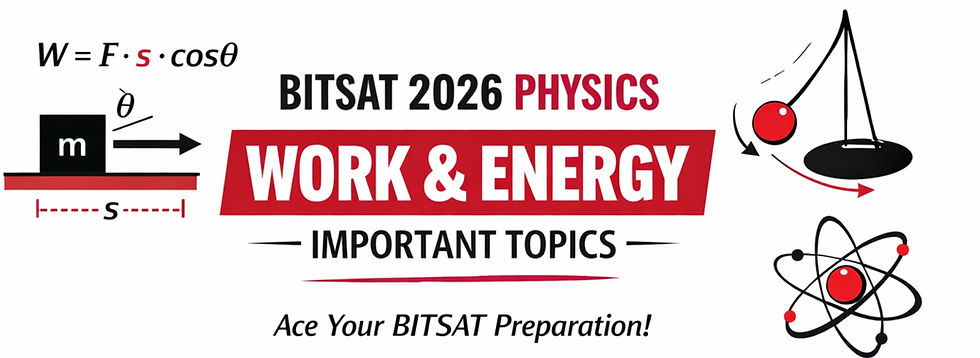
Preparing for BITSAT requires a strong understanding of fundamental Physics concepts, especially from mechanics. Among these, the chapter Work, Energy, and Power plays a crucial role in solving numerical problems quickly and accurately. In the BITSAT 2026 Physics section, questions from this chapter are commonly asked and often appear in conceptual as well as formula-based formats.
In this guide, we will explore the BITSAT 2026 Physics Work and Energy Important Topics, the expected weightage, formulas, preparation tips, and strategies that can help students score better in the exam.
BITSAT 2026 Physics Exam Overview
Before understanding the chapter, it is important to know how the Physics section is structured in the exam.
The BITSAT exam consists of 130 questions across Physics, Chemistry, Mathematics/Biology, English, and Logical Reasoning. The Physics section contains 30 questions carrying 90 marks, with +3 marks for correct answers and −1 mark for incorrect answers.
The syllabus of BITSAT Physics is based on Class 11 and Class 12 NCERT concepts, including mechanics, electricity, magnetism, optics, and modern physics.
Among these topics, Work, Energy and Power contributes around 3–6% of the Physics questions, making it a moderately important scoring chapter.
What is the Chapter “Work, Energy and Power”?
The chapter Work, Energy, and Power focuses on the relationship between force, motion, and energy transfer. It explains how energy changes form when work is performed by a force.
This chapter is essential because many advanced topics such as rotational motion, collisions, and oscillations use the same concepts of energy conservation.
The BITSAT 2026 Physics Work and Energy Important Topics mainly revolve around:
Work done by a force
Kinetic energy
Potential energy
Work–energy theorem
Power
Conservation of mechanical energy
Conservative and non-conservative forces
These concepts frequently appear in numerical questions and conceptual MCQs in the exam.
BITSAT 2026 Physics Work and Energy Important Topics
1. Work Done by a Force
Work is defined as the product of force and displacement in the direction of the force.
Formula:
W=F⋅s⋅cosθW =
Where:
F = applied force
s = displacement
θ = angle between force and displacement
Students must understand:
Work done by constant force
Work done by variable force
Work done by gravity
Work done in circular motion
Questions may also involve graph-based problems, especially force vs displacement graphs.
2. Kinetic Energy
Kinetic energy is the energy possessed by an object due to its motion.
Important subtopics include:
Change in kinetic energy
Relation between work and kinetic energy
Kinetic energy in rotational systems
Many BITSAT questions involve calculating velocity using energy relationships instead of traditional kinematic equations.
3. Work Energy Theorem
The Work Energy Theorem states that the work done by the net force acting on a body equals the change in its kinetic energy.
This concept is extremely important because it simplifies complex motion problems.
Common BITSAT questions include:
Block sliding on a rough surface
Objects moving on inclined planes
Motion under gravity
Mastering this theorem allows students to solve problems faster in MCQ exams.
4. Potential Energy
Potential energy is the stored energy due to position or configuration.
Two major types appear in BITSAT questions:
Gravitational Potential Energy
PE = m g h PE = m g h PE = m g h
Elastic Potential Energy
Students should also understand:
Energy stored in springs
Change in potential energy
Potential energy in conservative systems
5. Conservative and Non-Conservative Forces
This concept is frequently tested conceptually in BITSAT.
Conservative Forces
Work done is path independent
Mechanical energy is conserved
Examples:
Gravitational force
Elastic force
Non-Conservative Forces
Work depends on the path
Mechanical energy is not conserved
Example:
Friction
Understanding this difference is essential for solving energy conservation problems.
6. Conservation of Mechanical Energy
The Law of Conservation of Mechanical Energy states that the total mechanical energy of an isolated system remains constant.
KE+PE= constant KE + PE = constant KE+PE =constant
Applications include:
Motion of a pendulum
Roller coaster problems
Free fall motion
Many BITSAT numerical problems use this principle because it reduces complex calculations.
7. Power
Power represents the rate at which work is done.
Average Power
P=W/t
Instantaneous Power
P=F⋅v
Students should also understand:
Units of power
Efficiency of machines
Mechanical power problems
Expected Weightage in BITSAT 2026
The BITSAT 2026 Physics Work and Energy Important Topics usually contribute around 2 questions in the exam, depending on the shift and difficulty level.
Approximate weightage:
Topic | Expected Weightage |
Work, Energy & Power | 3–6% |
Questions in exam | 1–2 |
Although the weightage may seem small, these questions are usually formula-based and scoring.
Preparation Tips for BITSAT 2026 Physics Work and Energy
1. Focus on Conceptual Clarity
BITSAT questions are usually conceptual and require quick problem solving. Students should focus on understanding the physical meaning behind formulas.
2. Practice Numerical Problems
Solve:
Previous year BITSAT questions
JEE Main level MCQs
Timed practice tests
Regular practice improves speed and accuracy.
3. Revise Formulas Regularly
Make a short formula sheet for Work, Energy, and Power and revise it daily during the last months of preparation.
4. Learn Shortcuts for MCQs
Energy conservation methods often allow solving problems in one or two steps instead of long calculations.
5. Combine with Other Mechanics Chapters
The chapter connects strongly with:
Newton’s Laws of Motion
Rotational Motion
Gravitation
Understanding these relationships helps solve advanced questions.
Common Mistakes Students Should Avoid
Many students lose marks in this chapter due to small conceptual mistakes.
Common errors include:
Ignoring the direction of force in work calculation
Confusing kinetic and potential energy formulas
Forgetting friction in energy conservation problems
Incorrect unit conversions
Avoiding these mistakes can significantly improve your score.
FAQs on BITSAT 2026 Physics Work and Energy Important Topics
What are the BITSAT 2026 Physics Work and Energy Important Topics?
The BITSAT 2026 Physics Work and Energy Important Topics include work done by a force, kinetic energy, potential energy, work-energy theorem, conservation of mechanical energy, conservative forces, and power.
Is the BITSAT 2026 Physics Work and Energy Important Topics chapter difficult?
No. The BITSAT 2026 Physics Work and Energy Important Topics chapter is considered moderately easy if students understand the formulas and practice numerical problems regularly.
How many questions come from BITSAT 2026 Physics Work and Energy Important Topics?
Typically 1–2 questions may appear from the BITSAT 2026 Physics Work and Energy Important Topics in the Physics section depending on the exam shift.
How should I prepare BITSAT 2026 Physics Work and Energy Important Topics quickly?
To prepare the BITSAT 2026 Physics Work and Energy Important Topics, students should revise formulas, practice MCQs, study energy conservation methods, and solve previous year questions.
Conclusion
The chapter Work, Energy, and Power is one of the foundational topics in mechanics and plays an important role in the BITSAT Physics section. Even though the weightage is moderate, questions from this chapter are generally scoring and require clear conceptual understanding.
Students preparing for BITSAT 2026 should focus on mastering the BITSAT 2026 Physics Work and Energy Important Topics, memorizing key formulas, and practicing MCQ-based problems regularly. With proper revision and problem-solving practice, this chapter can become an easy source of marks in the exam.
Official Resources:
BITSAT Official Website: https://www.bitsadmission.com
BITSAT Syllabus and Exam Details: https://www.bitsadmission.com/bitsat


Comments