Broadcom vs NVIDIA: Which AI Chip Stock Has More Upside in 2026?
- Apr 11
- 4 min read
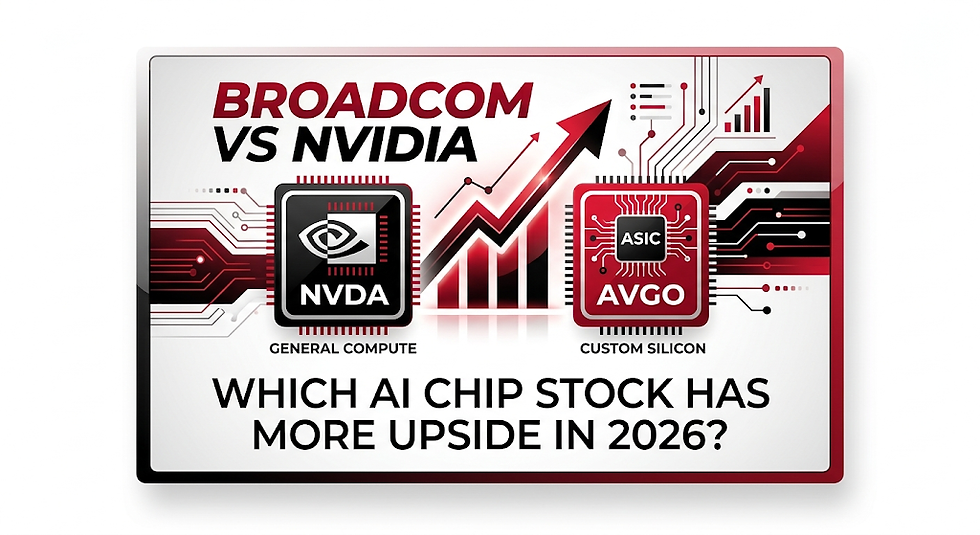
The artificial intelligence revolution has transitioned from a speculative frenzy into a high-stakes infrastructure race. As we navigate through 2026, the question for investors is no longer just "Who makes the chips?" but "Who owns the most efficient architecture?" The two undisputed titans at the center of this battle are NVIDIA (NVDA) and Broadcom (AVGO).
While NVIDIA remains the poster child for the AI boom with its dominant GPUs, Broadcom has quietly emerged as the architect of the "Custom Silicon" era. In this deep dive, we compare these two semiconductor giants to determine which AI chip stock offers the most significant upside for your portfolio this year.
The 2026 Landscape: Generative AI and the Infrastructure Shift
By early 2026, the AI market has matured. We have moved past the initial "training" phase where companies were buying every GPU they could get their hands on. Today, the focus has shifted toward inference—the process of actually running AI models—and customization.
NVIDIA’s H100s and newer Blackwell B200 architectures are the gold standard for raw power. However, hyperscalers like Google, Meta, and ByteDance are increasingly looking for ways to lower their Total Cost of Ownership (TCO). This is where the battle for the best AI chip stock gets interesting.
NVIDIA: The Undisputed King of General-Purpose Compute
NVIDIA enters 2026 with a fiscal revenue profile that was once unimaginable. In its latest reports, NVIDIA posted a staggering $215.9 billion in total revenue, with the Data Center segment alone accounting for roughly $193.7 billion.
Why NVIDIA Still Has Upside
The CUDA Moat: NVIDIA’s software ecosystem, CUDA, remains the industry standard. Most developers and AI researchers are locked into this environment, making it incredibly difficult for competitors to displace NVIDIA’s hardware.
Full-Stack Solutions: NVIDIA doesn't just sell chips; they sell entire AI "factories." This includes the Spectrum-X networking platform and NVLink interconnects, which allow thousands of GPUs to work as a single, massive brain.
Valuation Compression: Surprisingly, despite its massive growth, NVIDIA's stock has often traded at a more attractive PEG (Price/Earnings-to-Growth) ratio than its peers. In 2026, with a forward P/E hovering around 22x to 24x, many analysts argue it remains undervalued relative to its 50%+ growth rates.
Broadcom: The Master of Custom Silicon and Networking
If NVIDIA is the "off-the-rack" luxury suit, Broadcom is the "bespoke tailor." Broadcom specializes in ASICs (Application-Specific Integrated Circuits). These are chips designed for one specific task—like running Google’s Gemini or Meta’s recommendation algorithms.
Why Broadcom Could Outperform in 2026
Efficiency and Cost: Custom chips (XPUs) designed by Broadcom can be 40% to 60% more efficient than general-purpose GPUs. For a hyperscaler spending billions on electricity, this efficiency is the difference between profit and loss.
The 3nm Revolution: Broadcom has successfully moved its major partners (Google, Meta, and ByteDance) to the 3nm node. This technological lead in custom AI accelerators has pushed their AI semiconductor revenue to over $8.2 billion per quarter.
VMware Synergy: Beyond hardware, Broadcom’s acquisition of VMware is now fully integrated, providing a high-margin software cushion that NVIDIA lacks. This makes Broadcom a more diversified play on both AI hardware and enterprise cloud infrastructure.
Financial Comparison: By the Numbers (2026 Projections)
Metric | NVIDIA (NVDA) | Broadcom (AVGO) |
Annual Revenue (Est) | $215.9 Billion | $65 - $70 Billion |
Data Center / AI Mix | ~90% | ~45% - 50% |
Gross Margin | ~71% | ~60% - 62% |
Forward P/E Ratio | ~24x | ~31x |
Dominant Product | Blackwell GPUs / CUDA | Custom ASICs / Ethernet Switching |
Broadcom vs NVIDIA: Key Differentiators for 2026
When choosing an AI chip stock, you must decide between flexibility and efficiency.
1. GPU vs. ASIC
NVIDIA’s GPUs are flexible. You can use them for training a new LLM today and medical imaging tomorrow. Broadcom’s ASICs are rigid but hyper-optimized. As AI models stabilize, the industry is moving toward these optimized "hard-wired" solutions to save on power and cost.
2. Networking Dominance
You cannot build an AI cluster without networking. NVIDIA uses InfiniBand, which is proprietary and high-performance. Broadcom is the leader in Ethernet, the open-standard networking technology that many data centers prefer for its scalability and lower cost. As AI clusters grow to millions of chips, Broadcom’s Jericho3-AI and Tomahawk 5 switches are becoming indispensable.
Risk Factors to Consider
Customer Concentration: Both companies rely heavily on a handful of "Big Tech" spenders (Microsoft, Google, Meta). If these companies cut their CAPEX, both stocks will feel the pain.
Geopolitical Tensions: Export controls on high-end chips to China continue to be a wild card for both firms, though Broadcom's co-development deals (like the one with ByteDance) have shown resilience through architectural workarounds.
Supply Chain: Both are fabless, meaning they rely on TSMC for manufacturing. Any bottleneck in Taiwan impacts both equally.
FAQ: Investing in AI Chip Stocks
Is NVIDIA or Broadcom a better buy for 2026?
It depends on your goal. NVIDIA is the growth leader with a massive moat in software and general-purpose compute. Broadcom is the efficiency leader, dominating the custom chip market and high-speed networking. Many experts suggest holding both to cover different segments of the AI value chain.
What is the best AI chip stock for long-term growth?
While NVIDIA has higher historical returns, Broadcom’s pivot to custom 3nm silicon and its software integration with VMware make it a very strong contender for long-term stability and growth.
How does networking affect AI chip performance?
AI chips don't work in isolation; they must communicate. Broadcom’s Ethernet technology and NVIDIA’s NVLink/InfiniBand are the "highways" that allow these chips to exchange data. Without top-tier networking, even the fastest chip is useless.
The Verdict: Which Stock Has More Upside?
In 2026, NVIDIA remains the high-beta, high-reward play. If the world continues to demand more training for even larger models (like GPT-6 or Llama 4), NVIDIA will win.
However, if you believe the market is shifting toward cost-optimization and inference, Broadcom has the higher relative upside. With its smaller market cap compared to NVIDIA and its pole position in the $50 billion custom silicon market, Broadcom could realistically see more "multiple expansion" over the next 12 months.
Stay Ahead of the Market
Ready to build your AI-focused portfolio? Check out our latest resources:


Comments