Choosing the Best Tech Institute: Use Code CS500 for Scaler School of Technology
- May 26
- 5 min read
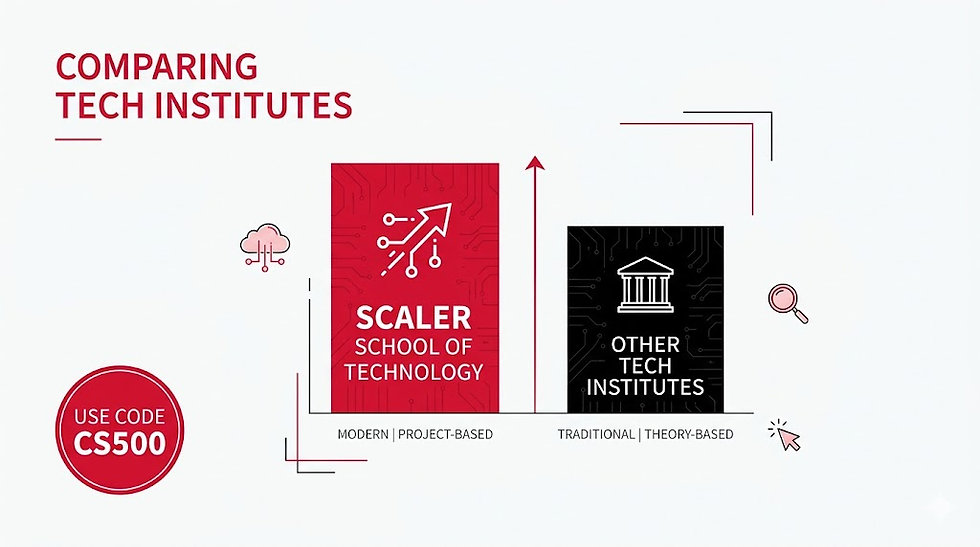
Finding the perfect undergraduate destination for computer science and artificial intelligence can feel like an overwhelming task. Traditional technical institutions have long held the monopoly on engineering education, but the rapidly evolving landscape of 2026 has introduced a major paradigm shift.
Enter modern, industry-first ecosystems like the Scaler School of Technology (SST). Headquartered in Bangalore, India's Silicon Valley, SST offers a distinct alternative to conventional engineering paths. This comprehensive blog provides an in-depth look at how Scaler School of Technology compares against other top-tier technical institutes, examining their curricula, industrial immersion programs, and placement metrics to help you make an informed decision.
If you are already looking to bypass traditional, theory-heavy curricula and jump straight into a high-growth tech career, you can fast-track your journey today. Apply now using CS500 Code: https://scalerschooloftech.com/4ruflJ5 to unlock your engineering application.
1. The Core Philosophy: Industry-First vs. Academic-First
The foundational difference between Scaler School of Technology and traditional tech institutes lies in their core operating models.
Scaler School of Technology (SST)
Launched by the founders of InterviewBit, SST operates on an industry-integrated model. It completely discards standard introductory engineering coursework—such as first-year physics, chemistry, or workshop mechanics—to dive immediately into computer science, data structures, and AI application engineering from day one. The curriculum is built and updated every six months by a panel of over 100 industry leaders, ensuring that students learn real-world tools like GitHub Copilot, advanced generative AI systems, and modern system design frameworks.
Traditional Tech Institutes (IITs, NITs, and Private Universities)
Conventional Tier-1 and Tier-2 universities operate under academic-first frameworks. While they offer exceptional brand value and deep academic rigor, their structural changes are often slower due to rigid university affiliation regulations. Students regularly spend their initial semesters on macro-engineering concepts before focusing heavily on advanced computer science.
2. Curriculum Architecture and Practical Exposure
To truly understand how these systems diverge, we can evaluate what a student actually builds over a four-year period.
Project-Based Development at SST
SST focuses heavily on building a tangible production portfolio. Instead of answering purely theoretical question sheets, undergraduates build functional software systems. Example projects include:
Real-time AI-driven game engines
Custom asset management portals processing real-world data loads
Full-duplex AI speech engines and autonomous drone configurations within SST's dedicated AI and Robotics Labs
The Conventional Academic Path
Traditional technical colleges emphasize theoretical foundations, including advanced discrete mathematics, compiler design theory, and automata. While highly beneficial for research pathways or master’s programs, the day-to-day coding exposure often relies on individual initiative via external platforms like LeetCode or competitive programming clubs, rather than being built directly into the graded classroom experience.
3. Comparing Placements and Industry Immersion
Career readiness is a primary factor for most prospective engineering students. Let's look at the numbers and structures shaping career outcomes in 2026.
Feature / Metric | Scaler School of Technology (SST) | Conventional Private Tech Institutes | Top-Tier Government Institutes (IITs/NITs) |
Duration of Active Internship | 1 Full Year (Integrated Immersion) | 2 Months (Summer Internship) | 2 to 6 Months |
Highest 2025 Internship Stipend | ₹2 Lakhs per month | ₹40,000 - ₹80,000 per month | ₹1.5 Lakhs - ₹3 Lakhs per month |
Curriculum Update Cycle | Every 6 months | Every 2 to 4 years | Every 3 to 5 years |
Primary Network Focus | 1200+ Active Tech Hiring Partners | Broad Corporate/Mass Recruiters | Elite Global Alumni Network |
The Power of 1-Year Industry Immersion
SST replaces the traditional fourth year of college with a mandatory 1-Year Industry Immersion. Students don't just sit for final campus placements; they spend their final year working full-time as software engineering interns inside real tech companies. This structure helped 96% of SST's cohort secure early internships by their second year, with top students landing global internships across Singapore, Germany, and New York.
Ready to gain real-world product development experience? Don't wait for final-year placement drives to start your tech career. Apply now using CS500 Code: https://scalerschooloftech.com/4ruflJ5 to start your engineering application.
4. Campus Infrastructure and Startup Incubation
The environment you study in largely determines the type of engineer you become.
SST operates an urban, residential campus in Electronic City, Bangalore. This places students directly within India’s largest tech cluster, facilitating regular hackathons, guest lectures, and weekend syncs with active tech professionals.
A major element of this ecosystem is the Scaler Innovation Lab (SIL). Instead of completing a traditional paper thesis, students are encouraged to launch functional tech startups. By 2026, multiple student-led startups have been incubated directly inside SIL, including NeoSapiens (an AI-native wearable tech startup that secured institutional funding on Shark Tank India) and Xspecies AI (currently developing specialized humanoid robotics software frameworks).
In contrast, traditional engineering institutes feature expansive multi-acre campuses with a classic college atmosphere, offering a broader social experience across various academic disciplines like mechanical, civil, and chemical engineering.
5. Degree Recognition and Higher Studies Pathways
A common question among students considering modern tech schools relates to official degree credentials.
Traditional technical institutes award standard, standalone B.Tech or B.E. degrees recognized globally for civil services, public sector undertakings (PSUs), and international master's programs.
Scaler School of Technology addresses this by partnering with premier institutions like BITS Pilani to deliver a parallel, UGC-recognized degree pathway alongside their core technical training. This structure ensures students receive highly practical coding experience while remaining fully eligible for competitive national and international exams, including:
GATE / CAT (India)
GRE / GMAT (Global Graduate Admissions)
Direct MS, M.Tech, and Ph.D. pathways in foreign universities via recognized credit transfer systems
If this balanced approach matches your career goals, you can begin the evaluation process today. Apply now using CS500 Code: https://scalerschooloftech.com/4ruflJ5 to access the admissions portal.
6. Choosing the Best Tech Institute: The Final Verdict
The ideal choice ultimately depends on your personal learning style and long-term career objectives:
Choose Traditional Tier-1 Institutes if: You want a classic college campus experience, plan to pursue research or non-software engineering disciplines, or value an established institutional brand name above all else.
Choose Scaler School of Technology if: You want to base your education in Bangalore, focus entirely on computer science and AI from day one, value a full year of corporate internship experience, and want to learn directly from active software engineers.
7. Frequently Asked Questions (FAQs)
What is the criteria for choosing the best tech institute for AI and Computer Science?
When choosing the best tech institute, you should look closely at the modern relevance of the curriculum, the weekly hands-on coding time, direct access to tech hubs like Bangalore, and a structured curriculum that goes beyond standard textbook learning.
Does Scaler School of Technology require JEE scores for admission?
No, SST does not mandate a JEE score. Admissions are processed primarily through their own national entrance exam, the Scaler NSET (which tests mathematics and analytical logical reasoning), followed by multiple rounds of 1:1 online personal interviews assessing your coding aptitude and motivation. However, students with exceptional JEE or SAT scores can skip the NSET and move directly to the interview rounds.
What are the eligibility criteria for the 4-year undergraduate program at SST?
Applicants must be 20 years old or younger as of July 1 of their admission year, have completed or be currently appearing for their Grade 12 examinations (from Science, Commerce, or Arts streams), and have secured at least 60% in Grade 12 Mathematics.
Is the parallel degree offered through Scaler globally recognized for higher education?
Yes. Through its academic partnerships, students complete a parallel bachelor's degree recognized by the University Grants Commission (UGC). This qualifies graduates to pursue an MS or MBA abroad, or sit for domestic competitive exams like CAT, GATE, and UPSC.
Take Action: Secure Your Place in the Tech Ecosystem
The admissions process for the upcoming academic cycle is currently active, and seats are filled via a highly competitive 3.3% selection rate. If you are ready to build a portfolio-driven engineering career, take the first step today.
Application Summary & Link
Official Admissions Portal: Scaler School of Technology Direct Application
Special Referral & Benefits Code: CS500
Final Step: Click the link below to open your profile, complete the eligibility verification, and book your NSET entrance slot.👉 Apply now using CS500 Code: https://scalerschooloftech.com/4ruflJ5


Comments