Mumbai Pune Expressway Route Status: What Went Wrong with the ₹7,000-Crore Missing Link Bypass?
- Jul 8
- 7 min read
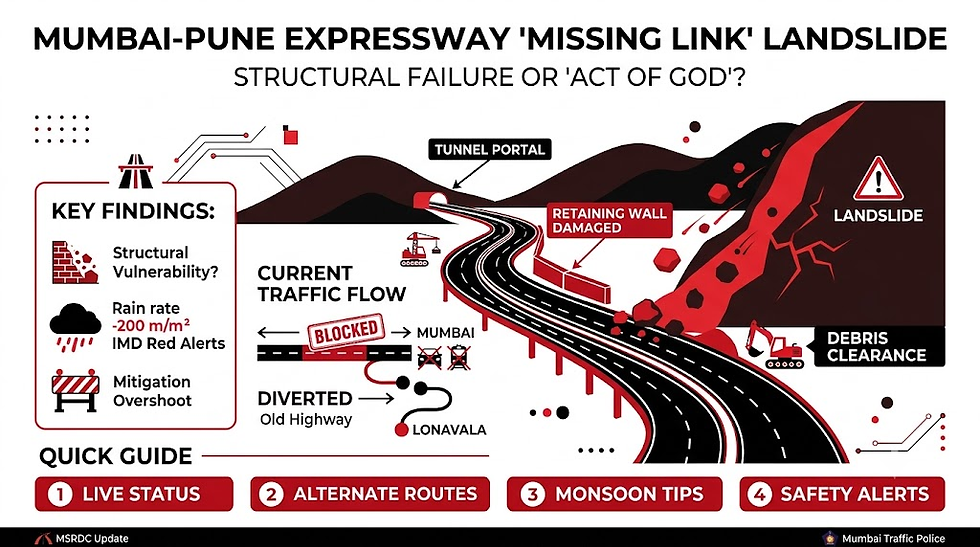
The highly anticipated Mumbai-Pune Expressway "Missing Link" project was hailed as an engineering marvel when it was officially inaugurated on May 1, 2026. Built at a massive cost of approximately ₹6,695 crore (frequently cited as part of a broader ₹7,000-crore structural overhaul), this 13.3-kilometer bypass was designed to permanently solve the region's worst traffic bottleneck: the treacherous, accident-prone Khandala Ghat section. By bypassing the hairpin turns, the Missing Link promised to shorten the travel distance between Maharashtra's two premier cities by 6 kilometers and slash travel times by nearly 25 to 30 minutes.
Yet, just nine weeks after opening to public traffic, nature delivered a severe blow. On July 6, 2026, relentless monsoon rains triggered a massive landslide near the exit of Tunnel 2 on the Pune-to-Mumbai carriageway. The resulting deluge of mud, loose shale, and heavy boulders damaged the newly constructed retaining wall, forced an immediate emergency closure, and sent shockwaves through the thousands of commuters who depend on this corridor daily.
As thousands of stranded motorists scramble for real-time answers, searching for terms like "Mumbai Pune expressway clear today" and "Missing link route status", serious structural and environmental questions are surfacing. What exactly went wrong with India's most advanced engineering project so soon after its launch, and how can you navigate the current travel disruptions safely?
The Genesis of the Missing Link: An Engineering Triumph
To understand what failed, one must understand the unprecedented scale of the Missing Link project. For nearly three decades, the 19.8-kilometer Khandala Ghat section between Khopoli and Sinhgad Institute has been a major operational headache for the Maharashtra State Road Development Corporation (MSRDC). The heavy inclines, sharp curves, and vulnerability to seasonal rockfalls made it a high-risk zone, particularly during peak monsoon months.
Approved in 2017 with construction beginning in 2019, the Missing Link alignment was engineered to slice straight through the rugged Sahyadri hills using high-speed viaducts, a 183-meter cable-stayed bridge over Tiger Valley (the tallest of its kind in India), and two ultra-modern tunnels. The longer of the two, an 8.9-kilometer engineering feat, was excavated nearly 180 meters beneath Lonavala Lake using the globally recognized New Austrian Tunnelling Method (NATM).
When Chief Minister Devendra Fadnavis cut the ribbon in May 2026, the project was celebrated as a permanent solution to seasonal travel disruptions. Motorists were treated to a smooth, truck-free zone allowing a sedate speed limit of 80 to 100 km/h, traversing the Western Ghats in a fraction of the time.
Anatomy of a Failure: What Went Wrong on July 6, 2026?
The success was short-lived. In early July 2026, the India Meteorological Department (IMD) issued severe red alerts across Mumbai, Thane, Raigad, and Pune districts, warning of heavy to very heavy localized rainfall.
Around 3:30 AM on Monday, July 6, 2026, the intense, continuous overnight downpour compromised the hillside overlooking the exit of Tunnel 2 on the Pune-bound-to-Mumbai side. A massive section of the mountain gave way. Boulders and mud cascaded down, shattering a portion of the newly erected concrete retaining wall and damaging the false frame—the external structural arch built to reinforce and protect the edges of tunnel portals.
The "Act of God" vs. Structural Design Debate
In the immediate aftermath of the partial collapse, the MSRDC defended the structural integrity of the bypass, categorizing the incident as an unavoidable natural calamity. MSRDC Vice Chairman Anilkumar Gaikwad and other senior officials publicly described the infrastructure damage as an "act of God," noting that the project’s contractor had adhered to all prescribed safety protocols.
According to MSRDC, rockfall mitigation systems—including specialized rock-bolting steel mesh vetted by IIT-Bombay—were active and completely intact up to a height of 15 meters above the tunnel portal. However, the boulders that broke loose during the July 6 landslide originated from a staggering height of roughly 150 meters up the mountain slope, far beyond the zone covered by the protective mesh. When thousands of tons of rock gain momentum from that altitude, engineering barriers can only do so much to absorb the impact.
Preceding Warning Signs: Bitumen Potholes and Binders
The landslide was not the only issue that raised eyebrows that week. Just days prior to the collapse, commuter videos went viral on social media showing pothole-like patches surfacing on the newly laid bitumen surface of the Missing Link, leading to sharp political blowbacks.
MSRDC engineers attributed these localized surface defects to an inadequate bonding layer between the bitumen wearing course and the main concrete base structure. They also noted that heavy rainfall, combined with vehicular fuel and motor oil leakages, acted as a solvent that dissolved the hydrocarbon binders in the bitumen. This caused the pavement to loosen under heavy traffic loads. While these surface defects were distinct from the geological failure at the tunnel exit, they fueled public concern over overall construction quality and monsoon preparedness.
Current Travel Impact: Railway and Roadway Paralysis
The landslide triggered a domino effect across Maharashtra's primary transport arteries, bringing travel between Mumbai and Pune to a near-standstill.
Roadway Status: The State Highway Police completely shut down the Pune-to-Mumbai carriageway of the Missing Link at 4:00 AM on July 6 as a precautionary safety measure. Debris removal, structural testing of the remaining retaining wall, and clearing operations have been ongoing. Conversely, the Mumbai-to-Pune carriageway remained largely functional but experienced extreme gridlock due to rubbernecking and localized waterlogging.
Railway Vulnerability: Commuters looking to switch to train travel faced similar blockades. Heavy rainfall simultaneously triggered landslides near Thakurwadi and between the Khandala and Monkey Hill ghat sections. Central Railway was forced to cancel over 16 major express trains and divert multiple long-distance routes, severing both primary transit options simultaneously.
Live Alternate Route Guide: Navigating the Traffic Realities
With clearing operations underway and safety audits being rushed, keeping track of the live Mumbai Pune Expressway route status is paramount for anyone needing to commute. If your travel is non-essential, authorities strongly advise postponing it until the peak monsoon surge passes. If you must travel, use these route guides:
1. The Old Mumbai-Pune Highway (NH-48) via Lonavala
With the Mumbai-bound Missing Link closed, traffic is being diverted back to the traditional, older highway stretch.
The Route: Vehicles exiting Pune are rerouted through Lonavala town and down the classic Khandala Ghat incline, merging back onto the main expressway near Khopoli.
Traffic Condition: Expect severe bumper-to-bumper delays. The sudden influx of thousands of vehicles into Lonavala has created multi-hour bottlenecks. Furthermore, watch out for localized waterlogging near the old Amrutanjan Bridge and the Khalapur Toll Plaza.
2. The Trans-Harbor / Pen-Khopoli Route (For South/Central Mumbai)
For light vehicles looking to bypass the main expressway gridlock entirely, an alternative western loop is viable.
The Route: From Pune, travel down towards the old highway, then take the diversion towards Khopoli-Pen Road, connecting through to Navi Mumbai via the Atal Setu (MTHL) or the Sion-Panvel Expressway.
Traffic Condition: This route is longer in terms of raw mileage but can save hours if the Lonavala Ghat section becomes completely blocked by stranded heavy trucks.
Essential Safety Checklist for Monsoon Commuters
If you are currently searching "Mumbai Pune expressway clear today" before heading out, ensure you take these immediate safety precautions:
Switch AC to Internal Recirculation: Commuters driving through the opened segments of the 8.9 km Missing Link tunnel have noted heavy vehicular exhaust buildup. Keep your cabin air on "Recycle" to prevent acrid fumes from entering your vehicle.
Avoid Shoulder Parking: Do not stop your vehicle on the high-speed viaducts or near tunnel openings to take photos or reels of the rain-shrouded valley. It severely compromises safety under low-visibility conditions.
Monitor Official Traffic Handles: Before crossing the Talegaon or Khalapur toll plazas, check the official X (formerly Twitter) handles of the Maharashtra State Highway Police and MSRDC for active diversion alerts.
Frequently Asked Questions (FAQs)
Q1: Is the Mumbai Pune Expressway route status clear for travel today?
A1: The Mumbai-to-Pune carriageway is currently open, though traffic is moving slowly due to heavy rainfall and waterlogging near the Khalapur toll plaza. However, the newly opened Missing Link bypass on the Pune-to-Mumbai side remains partially closed or heavily restricted near Tunnel 2 due to landslide clearance. Vehicles traveling towards Mumbai are being systematically diverted via the old highway through Lonavala. Always verify live updates from the State Highway Police before departing.
Q2: Why did the ₹7,000-crore Missing Link suffer a landslide just 9 weeks after opening?
A2: According to MSRDC, the structural engineering within the tunnel remained uncompromised. The landslide was triggered by extreme, continuous monsoon rainfall that destabilized loose rocks and soil roughly 150 meters up the mountain slope. Because the active rockfall mitigation mesh only extended to a height of 15 meters above the tunnel portal, the falling boulders overshot the safety barriers, damaging an external retaining wall and the tunnel's decorative false frame.
Q3: How long will it take to clear the debris and restore normal traffic?
A3: Debris clearance operations are being carried out on an war footing by emergency crews. While partial traffic flow is restored within 19 to 24 hours of major slides, complete restoration and the lifting of diversions depend heavily on structural safety audits. MSRDC plans to conduct an immediate post-landslide geological assessment to determine if rock-bolting safety nets need to be extended further up the mountain.
Q4: Are trains running between Mumbai and Pune right now?
A4: Train operations through the Bhor Ghat section have faced severe disruptions. Concurrent landslides near Thakurwadi and Monkey Hill have forced Central Railway to cancel or divert multiple express trains. If you plan to travel by rail, check the live National Train Enquiry System (NTES) app before arriving at the station.
Live Travel Traffic Resources & Assistance
Stay updated with real-time route notices, traffic disruptions, and emergency response services across Maharashtra:
Live Highway Alerts & Traffic Police Updates: Keep track of emergency route notifications and closure timelines via the Maharashtra State Highway Police Official Portal.
Project Status & Official MSRDC Statements: Review structural updates, monsoon safety steps, and official transit advisories directly on the Maharashtra State Road Development Corporation (MSRDC).
Indian Railways Live Train Running Status: If road routes are gridlocked, check active train cancellations, delays, and rail diversions via the National Train Enquiry System (NTES).


Comments