Class 11 vs Class 12 in MHT CET: Why Most Students Get the Ratio Wrong
- Jun 14
- 9 min read
Every year, thousands of brilliant engineering aspirants walk into the MHT CET exam hall confident that they will crush it, only to walk out a few hours later completely blindsided. When the results drop, they stare at their percentiles in disbelief.
As a mentor who has guided thousands of students through the grueling Maharashtra State Common Entrance Test (MHT CET) landscape, I hear the same heartbreaking story every season: "Sir, I knew every single Class 12 formula by heart. I didn’t expect those specific questions to drag my rank down so badly!"
The culprit behind this yearly tragedy isn't a lack of hard work. It is a fundamental, widespread misunderstanding of the balance between Class 11 vs Class 12 MHT CET preparation.
Students usually fall into two extreme traps. The first group treats Class 11 like a distant, irrelevant memory, assuming that a massive focus on Class 12 will easily carry them across the finish line. The second group gets so bogged down trying to master every single line of the vast Class 11 syllabus that they burn out before even touching their high-stakes senior-year topics.
Getting this ratio wrong is the fastest way to ruin your chances of getting into premier institutes like COEP, VJTI, or ICT. Let’s break down the actual blueprint of the exam, expose the mistakes that trip up most aspirants, and build a bulletproof preparation roadmap.

What Is the Actual Class 11 vs Class 12 Weightage in MHT CET?
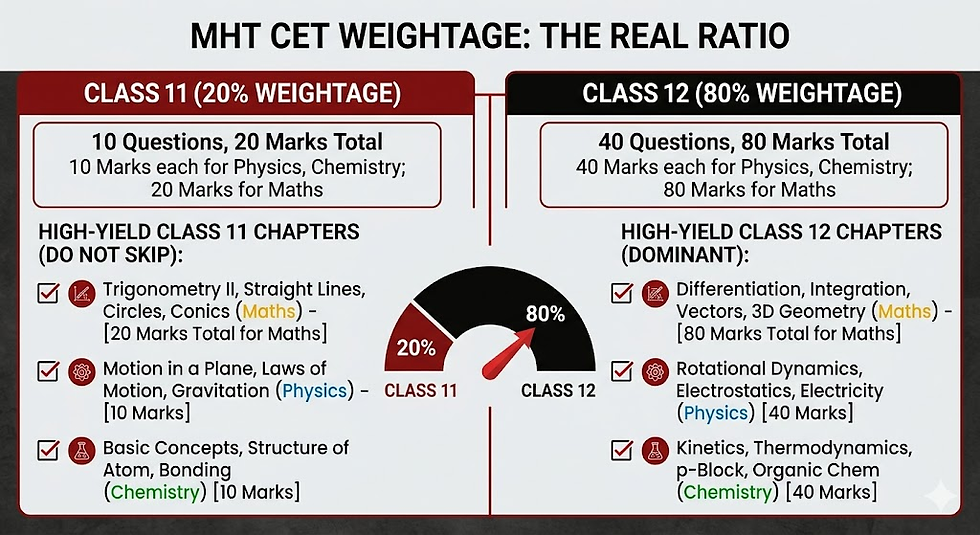
Let’s clear the air with concrete numbers provided by the Maharashtra State CET Cell. The blueprint for designing the MHT CET question papers follows a strict structural division:
Class 12 Curriculum: 80% of the total questions.
Class 11 Curriculum: 20% of the total questions.
In a standard 100-mark Physics and Chemistry paper (50 questions each) and a 100-mark Mathematics paper (50 questions), the distribution looks like this:
Mathematics: 40 questions come from Class 12 (worth 80 marks), and 10 questions come from Class 11 (worth 20 marks).
Physics: 40 questions come from Class 12 (worth 40 marks), and 10 questions come from Class 11 (worth 10 marks).
Chemistry: 40 questions come from Class 12 (worth 40 marks), and 10 questions come from Class 11 (worth 10 marks).
The Biggest Mistakes Students Make While Planning Their Preparation
Through years of mentoring, I have observed three massive, recurring strategic blunders that derail an otherwise solid preparation plan.
1. The "Class 12 Only" Illusion
Because Class 12 dictates 80% of the paper, students convince themselves that ignoring Class 11 entirely still leaves room for an 80% raw score. What they forget is competitive exam dynamics.
MHT CET is a relative grading system (percentiles), not an absolute one. When lakhs of students compete, a single mark can shift your rank by thousands of positions. Leaving out 20% of the paper before you even sit down means your absolute maximum ceiling is an 80% score—assuming you make zero silly mistakes, encounter no tough questions, and experience no exam anxiety in the Class 12 section. It's a high-stakes gamble that almost never pays off.
2. Blind Spot on Foundational Dependencies
You cannot build a skyscraper on a muddy foundation. Many complex Class 12 chapters are structurally dependent on basic concepts taught in Class 11.
For example, trying to solve Class 12 Calculus (which dominates the math paper) without a crystal-clear understanding of Class 11 Trigonometry or Functions is an exercise in frustration. Students often blame their struggle with Class 12 Integration on the chapter itself, when the real issue is that they never mastered Class 11 compound angles or factorization formulas.
3. Over-Engineering the Class 11 Syllabus
On the opposite end of the spectrum are the perfectionists. These students spend weeks solving complex JEE Advanced-level problems for Class 11 topics, memorizing obscure exceptions and lengthy derivations.
MHT CET is primarily a test of speed, accuracy, and core conceptual clarity. The Class 11 questions asked in CET are generally straightforward, direct applications of formulas. Over-studying these topics wastes valuable time that should be spent mastering high-weightage Class 12 units.
Subject-Wise Breakdown: Class 11 vs Class 12 Topics
To help you map out your schedule, here is a comparative overview of how the topics stack up across the two tiers, their expected weightage, and how you should prioritize them during revision.
Subject & Class Level | Crucial Chapters / Focus Areas | Expected Weightage (Approx) | Difficulty Level | Importance for Revision |
Maths (Class 11) | Trigonometry II, Straight Lines, Circles, Conics, Probability, Functions | 20 Marks (10 MCQs) | Moderate | High (Direct formulas, high accuracy potential) |
Maths (Class 12) | Differentiation, Integration, Vectors, 3D Geometry, Matrices | 80 Marks (40 MCQs) | High | Critical (The ultimate rank decider) |
Physics (Class 11) | Motion in a Plane, Laws of Motion, Gravitation, Thermal Properties, Semiconductors | 10 Marks (10 MCQs) | Easy to Moderate | Medium (Focus on basic definitions and direct formulas) |
Physics (Class 12) | Rotational Dynamics, Oscillations, Electrostatics, Current Electricity, KTG & Radiation | 40 Marks (40 MCQs) | High | Critical (Requires heavy numerical and concept application) |
Chemistry (Class 11) | Basic Concepts, Structure of Atom, Chemical Bonding, Redox Reactions, Basic Organic Chemistry | 10 Marks (10 MCQs) | Easy | High (Highly scoring, direct textbook lines) |
Chemistry (Class 12) | Chemical Thermodynamics, Electrochemistry, Kinetics, p-Block, Aldehydes & Ketones | 40 Marks (40 MCQs) | Moderate | Critical (Textbook-intensive, massive scoring potential) |
Can You Score 99+ Percentile by Studying Only Class 12?
Let's address this directly: No, it is practically impossible for 99.9% of students.
To hit a 99+ percentile in MHT CET, your target score typically needs to cross the 150–160+ out of 200 threshold, depending on the difficulty of your specific shift.
If you completely skip Class 11, you instantly forfeit 40 marks. Even if you score 100% perfectly on every single Class 12 question, your maximum score is capped at 160. In reality, no matter how prepared you are, a few extremely tricky questions, calculation mistakes, or time management issues in the Class 12 section will easily drop another 15–20 marks. Suddenly, your score plunges into the 130s or 140s, landing you squarely in the 95–97 percentile bracket.
While a 96 percentile is a respectable effort, it will not get you into computer science or electronics engineering streams at top-tier colleges. The Class 11 portion acts as your safety net. Because these questions are often less complex than the Class 12 ones, they provide the easiest path to secure those extra 25–30 marks needed to push your score past the 99+ percentile mark.
Tailored Preparation Strategy Based on Your Timeline
Your approach to balancing Class 11 vs Class 12 MHT CET topics depends heavily on how much time you have left before exam day.
Strategy A: If You Have 6+ Months Remaining
You are in the ideal preparation window. This is the time to build a structured, comprehensive approach.
The 80:20 Weekly Rule: Dedicate 5 days of your week entirely to covering your ongoing Class 12 syllabus. Reserve your weekends exclusively to systematically clear out Class 11 chapters.
Sequential Learning: Align your Class 11 revision with what you are learning in Class 12. If your coaching class or self-study schedule is tackling Class 12 Calculus, spend your weekend mastering Class 11 Functions and Trigonometry.
Documentation: Build a concise formula notebook for Class 11 chapters. Jot down key equations, basic properties, and standard shortcuts so you don't have to re-read whole textbooks later.
Strategy B: If You Have 3 Months Remaining
Time is tightening, and you need to pivot to a high-yield, high-efficiency model.
The Parallel Track: Do not stop your Class 12 preparation. Instead, allocate exactly 1 hour every single day to Class 11.
Cherry-Pick High-Weightage Chapters: Do not try to read every Class 11 chapter from scratch. Prioritize high-yield chapters like Trigonometry, Probability, Straight Lines, Laws of Motion, and Basic Principles of Organic Chemistry.
PYQ-First Approach: For Class 11 topics, skip long video lectures. Open a book of past years' questions (PYQs) from the last 5 years, look at the patterns of questions asked, and study only the specific formulas required to solve them.
Strategy C: If You Have Less Than 1 Month Remaining
You are in the final countdown phase. Do not try to learn any new complex concepts now.
Lock in Class 12: Ensure your Class 12 formulas, textbook reactions, and theorem applications are completely rock-solid. This is where 80% of your points live.
The Formula-Only Class 11 Scan: Spend just 2–3 hours a week scanning formula sheets for Class 11 topics. Focus heavily on Chemistry (e.g., Redox reactions or structure of atom trends) and Physics formulas (e.g., Gravitation relations), as these often show up as simple, direct questions.
Mock Test Extraction: Take full-length mock tests. When you review your test results, carefully analyze the Class 11 questions you missed. If it was just due to a forgotten formula, write it down and memorize it immediately.
Expert Tips to Balance Study Time Between Class 11 and 12
Use the Maharashtra State Board Textbooks as Your Holy Grail: MHT CET is tightly bound to the official state board textbooks. For Class 11 Chemistry and Physics, reading the summary blocks, solved examples, and back-of-chapter exercises is often more than enough to handle exam questions.
Master the Core "Gatekeeper" Chapters First: If you are short on time, ensure you do not skip Trigonometry II (Maths), Laws of Motion (Physics), and Basic Principles of Organic Chemistry (Chemistry). These three act as foundational blocks for a massive portion of the Class 12 syllabus.
Leverage Free Strategic Tools: Don’t guess where you stand. Use an AI Counselling Platform to look up cutoffs and realistic target scores for your dream colleges. Knowing the exact scores required at VJTI or COEP helps you understand exactly how many Class 11 marks you need to secure to clear those competitive thresholds.
Moving Beyond the Exam: Planning Your Next Steps
Securing a 99+ percentile by masterfully balancing your preparation ratio is only the first half of the battle. The true culmination of your hard work happens during the centralized admissions process (CAP rounds).
Once the exam concludes, navigating option forms, branch choices, and reservation matrices can get incredibly complex. To ensure you don't waste a phenomenal CET score, it helps to plug into structured admission guidance early. Aspiring engineers looking for comprehensive, step-by-step guidance through the state quota lines can explore the Maharashtra Engineering Admission Counselling 2026. If you are also appearing for exams like JEE Main and looking to explore broader institutional options across the country, keeping track of the All India Engineering Admission Counselling 2026 can save you from missing critical institutional application deadlines.
Final Takeaways
The secret to cracking the Class 11 vs Class 12 MHT CET ratio isn't about working yourself to exhaustion; it’s about strategic prioritization. Treat Class 12 as your primary engine for bulk points, and treat the selected Class 11 chapters as your precision rank booster. Stop viewing them as two separate worlds. Integrate them, focus on their shared foundational connections, and execute your plan with consistency. Go map out your schedule, open those textbooks, and secure the engineering seat you deserve!
Frequently Asked Questions (FAQs)
Q1: What is the official Class 11 and Class 12 weightage split in MHT CET?
The official marking blueprint sets a clear 80% weightage for the Class 12 syllabus and a 20% weightage for the Class 11 syllabus across all three subjects (Physics, Chemistry, and Mathematics).
Q2: Is Class 12 more important than Class 11 for MHT CET?
Yes, mathematically it is more important because it accounts for 160 out of the total 200 marks. However, Class 11 is crucial for building foundational concepts and securing the competitive edge needed for a top-tier percentile.
Q3: Can I skip Class 11 chapters entirely and still score well?
Skipping Class 11 caps your maximum possible score at 160 marks. Given exam stress and inevitable minor errors, dropping all Class 11 topics makes it highly unlikely that you will hit a 99+ percentile.
Q4: Which Class 11 topics carry the highest weightage and value?
In Mathematics, focus on Trigonometry II, Probability, Straight Lines, and Conics. In Physics, prioritize Laws of Motion and Gravitation. In Chemistry, focus heavily on Basic Principles of Organic Chemistry and Chemical Bonding.
Q5: How should I divide my daily preparation time between the two classes?
If you have months to prepare, use an 80:20 weekly rule (weekdays for Class 12, weekends for Class 11). If you are down to the final few months, spend a dedicated 1 hour daily doing rapid formula revisions and PYQs for Class 11 topics.
Q6: Can I get a 99 percentile without completing the entire syllabus?
Yes, you can. If you achieve flawless accuracy in the Class 12 syllabus and master at least 60-70% of the high-weightage Class 11 chapters, you can comfortably cross the 150+ mark threshold required for a 99+ percentile.
Q7: Which subjects have the most critical Class 11 contribution?
Mathematics has the most critical contribution because its Class 11 concepts (like Trigonometry and Functions) act as absolute prerequisite gatekeepers for high-weightage Class 12 Calculus topics.
Q8: What should I prioritize in the final month before the exam?
In the final month, prioritize full-length mock tests, rapid Class 12 formula revision, textbook intensive reading for Chemistry, and fixing simple formula application errors across your Class 11 topics.
For a detailed video breakdown of the high-weightage chapters and a strategic subject-wise roadmap, check out this comprehensive MHT-CET Syllabus & Weightage Guide. This video provides excellent visual insights from top educators explaining the exact marking scheme shifts and core chapters to prioritize for a 99+ percentile.


Comments