Cloud & Open-Source: Why Global IT Strategy Growth Markets Are Pivoting
- 6 days ago
- 6 min read
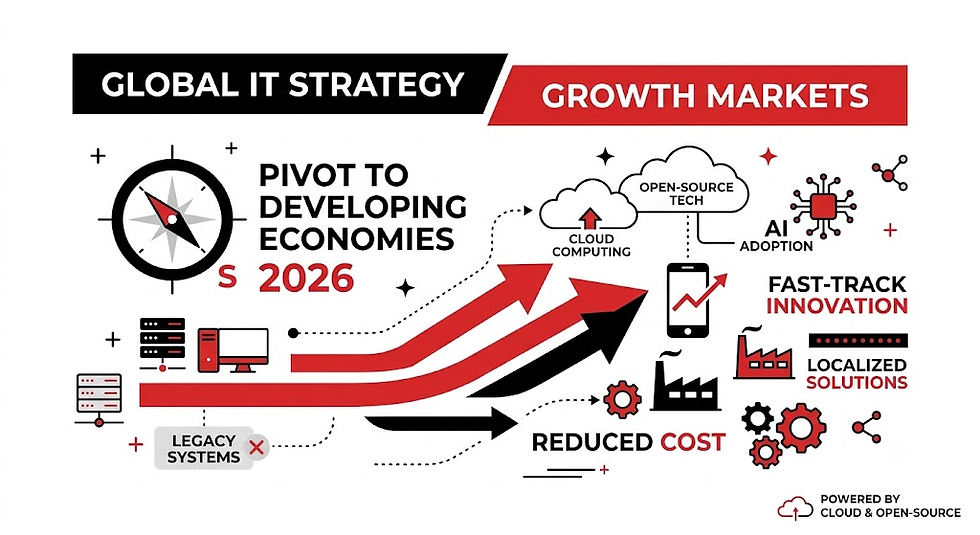
For decades, enterprise technology adoption followed a familiar playbook. Emerging economies routinely inherited legacy hardware, monolithic systems, and second-tier software releases long after Western markets had optimized them.
That script has been completely flipped.
In 2026, developing growth markets—across Southeast Asia, Latin America, South Asia, and Africa—are no longer trailing behind global technology trends. Instead, they are actively defining the next frontier of enterprise architecture. Pushed by rapid economic expansion, young digital-native demographics, and severe cost pressures on legacy systems, multinational enterprises and regional unicorns are orchestrating a massive structural pivot.
At the center of this pivot is the combination of cloud computing and open-source technology. Together, these tools serve as the foundation for modern enterprise innovation, allowing companies to leapfrog legacy infrastructure altogether.
Understanding why global IT strategy growth markets are becoming the primary catalyst for modern technology architecture reveals how open-source platforms and decentralized cloud networks are redefining competitive advantage worldwide.
1. The Death of Legacy Debt: Why Growth Markets Leapfrog Traditional IT
In mature markets like North America and Western Europe, enterprise technology spending is often hampered by "technical debt." Multi-billion-dollar corporations remain tethered to mainframe databases, proprietary legacy software, and physical data centers built over decades. Migrating these systems to cloud-native platforms is a slow, costly process.
Developing growth markets face no such baggage.
Much like how developing economies bypassed landline telecommunications in favor of mobile networks, enterprises in growth markets are skipping traditional on-premises infrastructure altogether. They are building straight onto cloud-native architectures powered by open-source platforms.
This clean-slate advantage allows businesses in Southeast Asia, Latin America, and India to deploy modern, microservice-based applications at a fraction of the cost and time required by their Western counterparts.
2. Market Dynamics & The 2026 Shift: By The Numbers
The global technology spending landscape is undergoing a massive realignment. According to Gartner's 2026 forecasts, overall worldwide IT spending is projected to reach $6.37 trillion, growing at an incredible 14.2% year-over-year.
                                GLOBAL IT SPENDING GROWTH (2026 FORECAST)

  Data Center Systems      ██████████████████████████████████████████████  +62.5% ($822B)
  IaaS (Cloud Infra)       ███████████████████████  +29.3% ($287B)
  Software                 ███████████  +15.5% ($1,468B)
  Overall IT Spending      ████████  +14.2% ($6,369B)
                           └─────────┴─────────┴─────────┴─────────┴─────────┘
                           0%        15%       30%       45%       60%
This surge is driven primarily by data center infrastructure and Infrastructure as a Service (IaaS). However, the growth rate in emerging regions significantly outperforms mature economies:
Cloud Expansion: The global cloud computing market is expanding rapidly, reaching over $905 billion in 2026. Emerging markets represent the highest compound annual growth rates (CAGR) as digital adoption spreads across retail, banking, and government sectors.
Open-Source Acceleration: The open-source services market is projected to surge past $64 billion in 2026, with community-driven frameworks providing the core underlying stack for cloud-native AI development and enterprise platforms.
Hyperscaler Investments: Major cloud providers—including AWS, Google Cloud, and Microsoft Azure—are pouring billions into localized data center regions in countries like India, Indonesia, Brazil, and Saudi Arabia to fulfill localized data residency requirements and reduce latency.
3. Five Core Drivers: Why Global IT Strategy Growth Markets Are Pivoting to Cloud & Open Source
Why are executive leaders redirecting capital and technology footprints toward these markets? The shift rests on five key strategic pillars:
I. Cost Efficiency and Capital Elasticity
Emerging economies operate in cost-sensitive environments. High license fees for proprietary enterprise software impose heavy financial strains on growing mid-market companies.
Open-source tools (such as Kubernetes, PostgreSQL, Linux, and Apache Kafka) eliminate steep upfront licensing fees. Combined with cloud computing’s pay-as-you-go operational expense (OpEx) model, businesses can scale up infrastructure dynamically during demand surges without making massive capital expenditure (CapEx) commitments.
II. Sovereign Cloud Demands and Data Governance
Governments across Latin America, Africa, and Asia are enacting strict data localization laws requiring citizen data to remain within national borders.
Relying purely on centralized global cloud hubs is no longer viable. By pairing open-source orchestrators with localized edge datacenters and multi-cloud architectures, global companies ensure total compliance with regional regulations while maintaining unified control over their code.
III. Mitigating Vendor Lock-in
Enterprise leaders have grown wary of proprietary cloud lock-in. Open-source software serves as a crucial abstraction layer. When applications are containerized using open standards, workload migration across AWS, Google Cloud, Azure, or local cloud providers becomes simple.
This flexibility grants enterprises strong pricing leverage and guards against price hikes.
IV. Decentralized Talent and Open Innovation
Developing markets are home to some of the fastest-growing developer communities on Earth. Regions like India, Brazil, Vietnam, and Nigeria produce millions of engineering graduates every year who build skills directly on open-source platforms.
Leveraging open-source technologies allows global companies to tap directly into these vibrant developer talent pools without forcing teams to learn proprietary legacy tools.
V. Scaling Generative AI at Lower Costs
As AI infrastructure becomes the largest enterprise expenditure of the decade, the combination of cloud compute and open-source models (such as Llama, Mistral, and DeepSeek variants) is democratizing machine learning.
Developing markets are deploying localized AI agents on open-source frameworks, training smaller, specialized models tailored to regional languages and business needs at a fraction of the cost of proprietary AI APIs.
4. Key Comparative Analysis: Proprietary Stack vs. Open Cloud Stack in Emerging Markets
To understand why this technological pivot is happening so quickly, we can compare how traditional proprietary architecture measures up against the cloud and open-source model:
Evaluation Metric | Legacy/Proprietary Stack | Open-Source & Cloud Stack | Strategic Impact in Growth Markets |
Capital Requirements | High CapEx (Hardware & Licenses) | Low CapEx, Elastic OpEx | Enables rapid scaling for startups and SMEs |
Vendor Dependency | High (Proprietary Lock-in) | Zero (Portability-first) | Gives local enterprises full stack control |
Localization & Compliance | Rigorous, Slow Updates | Instant (Configurable Code) | Meets strict data sovereignty guidelines |
Innovation Velocity | Dependent on Vendor Roadmaps | Continuous Community Updates | Accelerates time-to-market for new digital services |
AI Integration | Expensive API Subscriptions | Self-Hosted Open Models | Makes enterprise AI accessible at scale |
5. Strategic Roadmap: How Enterprise CTOs Should Navigate the Pivot
Aligning a global IT strategy growth markets roadmap around cloud and open-source systems requires a structured, security-first plan.
1.Audit Legacy Workloads and Identify Opportunities:Prerequisite Phase.
Evaluate current application dependencies across regional offices. Classify systems into candidates for lift-and-shift, cloud-native refactoring, or open-source database replacement.
2.Establish Hybrid Multi-Cloud Infrastructure:Architecture Design.
Partner with hyperscalers alongside local data center operators to build hybrid environments. This ensures compliance with regional data residency requirements while keeping latency under 15ms.
3.Deploy Open-Source Standard Orchestration:Platform Standardization.
Standardize core workloads around Kubernetes, open-source API gateways, and standardized databases. Building an open stack prevents cloud provider lock-in and simplifies team onboarding.
4.Implement FinOps and Governance Controls:Cost & Security Management.
Unmonitored cloud deployments can lead to budget overruns. Implement cloud financial management (FinOps) tools early to track usage metrics and manage cloud spending across regions.
Frequently Asked Questions (FAQs)
Q1: What makes a global IT strategy growth markets initiative successful when deploying open source?
A successful global IT strategy growth markets initiative relies on balancing cost reduction with strong enterprise security. Organizations must pair open-source software with managed cloud support, maintain unified governance across global regions, and invest in upskilling local talent to manage cloud-native environments securely.
Q2: Is open-source software secure enough for core enterprise cloud infrastructure?
Yes. Today’s major open-source projects—such as Linux, Kubernetes, and PostgreSQL—are backed by robust global communities and enterprise sponsors. When paired with automated vulnerability patching, zero-trust cloud architectures, and strict compliance monitoring, open source offers security equal to or exceeding proprietary alternatives.
Q3: How do data sovereignty laws impact cloud strategy in developing markets?
Data sovereignty laws mandate that sensitive citizen data be stored and processed within national borders. To comply, global companies deploy hybrid and multi-cloud strategies, using local edge data centers for sensitive user data alongside open-source platforms to keep control over data governance.
Q4: Why are hyperscaler cloud providers investing heavily in developing growth markets?
Hyperscalers are making heavy investments because emerging regions represent the fastest-growing demand for cloud infrastructure. High internet penetration, expanding middle-class populations, and rapid digital transformation make developing growth markets the top revenue driver for cloud platforms over the coming decade.
Empower Your Global Tech Transformation Today
Navigating complex cloud-native architectures, open-source integrations, and multi-region deployments requires the right technical expertise and strategic roadmap.
Whether you are scaling operations in emerging markets, optimizing cloud spending, or modernizing legacy enterprise platforms, modern digital transformation solutions help you move faster with confidence.
Looking to modernize your infrastructure? Connect with enterprise cloud experts at Avenga Cloud Strategy Solutions for end-to-end guidance.
Exploring open-source software integration? Read the latest industry research on the IMARC Open Source Services Market Report to discover market benchmarks and technology trends.
Planning data center expansion? Explore insights from Gartner Research to optimize your global IT investment roadmap.


Comments