Common MHT CET Myths Every Student Should Stop Believing
- Jun 17
- 6 min read
Preparing for the Maharashtra Common Entrance Test (MHT CET) is an intense journey that tests a science student's determination, academic capacity, and strategic skills. (MHT CET Myths) Historically, this state-level entrance exam has been the gateway to premier technical and medical science institutes across Maharashtra. As we navigate through 2026, the stakes are higher than ever, driven by massive career transformations. The modern industrial landscape has become highly interdisciplinary, where artificial intelligence (AI), automated robotic logistics, and advanced data analytics are deeply embedded within both engineering pipelines and pharmaceutical clinical trials.
Unfortunately, many aspirants remain trapped by outdated assumptions and misinformation passed down by senior generations. These misconceptions often result in misallocated study hours, exam-hall panic, and poor preference lists during the Centralized Admission Process (CAP) rounds.
To help you approach your preparation with factual precision, we are systematically debunking the most destructive illusions surrounding the exam. It is time to replace speculation with data-driven reality.
1. The "Only Class 12 Syllabus Matters" Fallacy
One of the most widespread traps that students fall into is ignoring their Class 11 textbooks. Because the Higher Secondary Certificate (HSC) board exams focus exclusively on the Class 12 curriculum, many candidates naturally assume that the entrance exam operates the same way.
The 2026 Reality
The State Common Entrance Test Cell, Maharashtra, explicitly mandates a structural 80/20 weightage split:
80% of the questions are drawn directly from the Class 12 standard syllabus.
20% of the questions are structurally sourced from the Class 11 curriculum.
While 20% might sound modest at first glance, it translates to roughly 40 marks out of a 200-mark PCM or PCB question paper. In a competitive landscape where fractions of a percentile determine whether you secure a seat at top-tier institutions like the College of Engineering Pune (COEP) or VJTI Mumbai, completely abandoning Class 11 topics is academic suicide.
Foundational units like Trigonometric Functions and Conic Sections in Mathematics, or Electrostatics and Semiconductors in Physics, serve as direct prerequisites for mastering advanced Class 12 engineering and clinical science concepts.
2. The Illusion of No Penalty: "Leaving It to Luck"
Every aspirant quickly learns that the exam features no negative marking. While this is structurally true, a critical psychological trap causes students to misinterpret this rule. Many believe that because there is no penalty for wrong answers, they can rely on random guessing or blind luck during the final minutes of their session.
The 2026 Reality
The exam is a Computer-Based Test (CBT) that relies on a sophisticated normalization and percentile-matching method across multiple shifts. When tens of thousands of students attempt the exam across different days, raw scores lose their standalone meaning. Instead, your performance is calculated relative to everyone else who took that exact same paper.
Because there is no negative marking, the baseline score for the entire student population shifts upward. Guessing randomly does not give you an edge; instead, calculated elimination and rapid accuracy are what set top-ranking students apart. True competitive advantage stems from systematic elimination, managing your time carefully, and ensuring your conceptual baseline is robust enough to minimize errors altogether.
3. The Rote Memorization Myth vs. Conceptual Depth
Because MHT CET is historically anchored in the Maharashtra State Board textbooks, a dangerous narrative persists that the exam merely tests your ability to memorize text line by line. Students often believe that if they can simply reproduce textbook derivations and definition phrases, they will easily clear the threshold.
The 2026 Reality
The contemporary exam papers highlight a sharp shift toward application-based testing. The State CET Cell has consistently elevated the difficulty curve, bringing technical questions to a conceptual par with national-level examinations like JEE Main for the engineering stream and NEET for the pharmacy stream.
While long, descriptive theoretical derivations are no longer asked, the questions are heavily focused on formula precision, calculation speed, and analytical problem-solving.
Mathematics (50% weightage in PCM): Demands profound fluency in calculus, vectors, and three-dimensional geometry. You cannot memorize a complex integration pathway; you must understand the underlying logic.
Physics: Features calculation-heavy, single-concept application questions. Mismanaging unit conversions or experiencing formula-recall delays are the leading reasons why students lose marks.
Chemistry & Biology: While highly theory-focused and scoring, the modern question patterns weave multiple concepts together. This requires deep conceptual clarity rather than superficial, passive reading.
4. Engineering vs. Pharmacy: The Outdated "Gender and Stability" Bias
An old, systemic myth suggests that the engineering landscape is inherently cutthroat, highly volatile, and exclusively suited for analytical, tech-driven personalities, whereas the pharmacy stream is a passive, domestic backup choice reserved for those seeking quiet stability.
The 2026 Reality
This rigid separation has been completely dismantled by modern technological growth. As outlined in comprehensive industry surveys, both domains have evolved into interdisciplinary powerhouses that demand exceptional cognitive versatility:
Operational Metric | The Engineering Stream | The Pharmacy Stream |
Core Academic Anchor | Mathematics, Physics, Logic, Computational Code | Biology, Organic Chemistry, Human Anatomy |
Primary Skill Orientation | Algorithmic thinking, system design, data architecture | Clinical accuracy, patient interaction, regulatory compliance |
Entry-Level Market Velocity | Accelerated starting packages (Top tech tiers routinely scale from ₹10 to ₹20 LPA) | Stable, moderate starting packages (Specialized global corporate roles scale past $110,000) |
Long-Term Industry Risk | Susceptible to rapid tech obsolescence; requires constant re-skilling | Highly insulated against economic downturns; recession-proof |
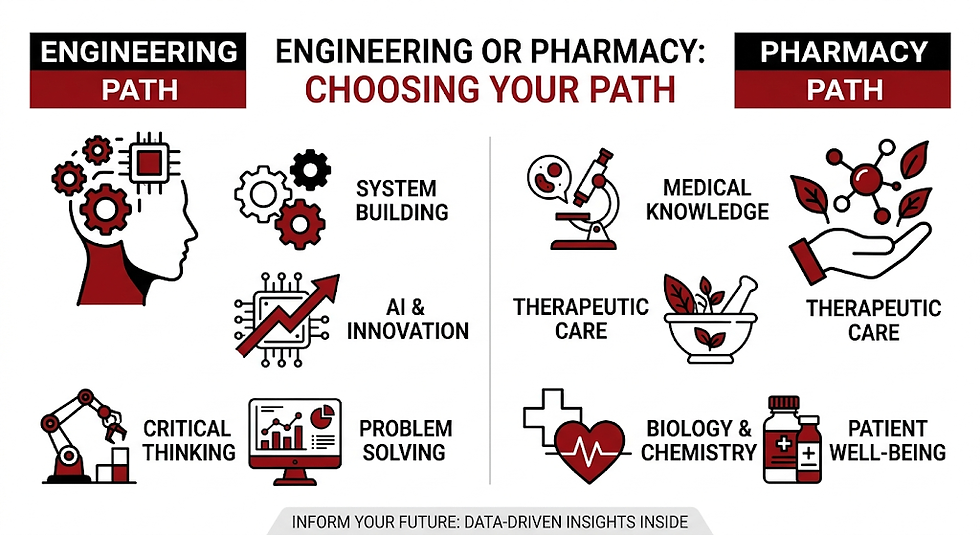
Choosing between these paths is not about seeking a "gender-appropriate" or "easier" option. It is a matter of checking if your natural mindset aligns with building physical or software frameworks versus contributing to therapeutic care and medical sciences.
5. The Dangerous Assumption: "NCERT Textbooks Alone Are Enough"
Because national exams like JEE Main and NEET rely heavily on the Central Board of Secondary Education (CBSE) framework, many high-achieving aspirants assume that mastering NCERT textbooks will automatically guarantee a 99+ percentile in MHT CET.
The 2026 Reality
While the foundational concepts across CBSE and the Maharashtra State Board are quite similar, the specific syllabus scope, terminology, and highlighted topics differ noticeably. The MHT CET paper pattern is explicitly constructed around the curriculum prescribed by the State Council of Educational Research and Training, Maharashtra.
For instance, certain chapters or specific reactions in organic chemistry, sub-topics in plant physiology, or theorem subsets in geometry exist in the state board volumes but are absent or framed differently in NCERT books. Relying solely on NCERT can create unexpected blind spots during your exam. To maximize your score, your primary preparation must remain firmly grounded in the official Maharashtra State Board textbooks, using NCERT strictly as a supplementary reference for deeper conceptual insights.
Strategic Mock Test Adaptation for 2026
To help visualize how the exam structures its time and marking metrics, review the operational breakdown below:
                     ┌───────────────────────────────────────┐
                     │          MHT CET Exam Pattern         │
                     └───────────────────────────────────────┘
                                         │
                  ┌──────────────────────┴──────────────────────┐
                  ▼                                             ▼
      ┌───────────────────────┐                     ┌───────────────────────┐
      │       PCM Group       │                     │       PCB Group       │
      └───────────────────────┘                     └───────────────────────┘
                  │                                             │
         [ Total Marks: 200 ]                          [ Total Marks: 200 ]
         [ Time: 180 Minutes ]                         [ Time: 180 Minutes ]
                  │                                             │
         ┌────────┴────────┐                           ┌────────┴────────┐
         ▼                 ▼                           ▼                 ▼
 ┌───────────────┐ ┌───────────────┐           ┌───────────────┐ ┌───────────────┐
 │   Section 1   │ │   Section 2   │           │   Section 1   │ │   Section 2   │
 │   Physics &   │ │  Mathematics  │           │   Physics &   │ │    Biology    │
 │   Chemistry   │ │  (50 Qs /   │           │   Chemistry   │ │  (100 Qs /  │
 │  (100 Qs /    │ │   100 Marks)  │           │  (100 Qs /    │ │   100 Marks)  │
 │   100 Marks)  │ └───────────────┘           │   100 Marks)  │ └───────────────┘
 └───────────────┘                             └───────────────┘
Note: A strict 90-minute lockout system applies to each section. You cannot switch back and forth between sections during the exam.
Common MHT CET Myths Prep Guide FAQ
What are the most common MHT CET myths regarding exam strategy?
The most damaging myth is that because there is no negative marking, accuracy takes a back seat to speed. Due to the normalization process across multiple test shifts, maintaining a high accuracy rate on moderate-to-difficult questions is vital for securing a top percentile. Another common misconception is assuming that Class 11 chapters can be completely skipped, whereas they actually dictate 20% of the entire question pool.
Is there any section lock or time restriction between subjects?
Yes. The 180-minute exam is split into two non-transferable 90-minute blocks. For the PCM group, you must solve Physics and Chemistry together in the first 90 minutes. Once that timer ends, the portal permanently locks those sections, and you must spend the remaining 90 minutes on Mathematics. You cannot save time from one section to use on another.
Can an engineering aspirant switch to pharmaceutical technology programs via CAP rounds?
Absolutely. The modern pharmaceutical sector relies heavily on biomanufacturing engineers, automated logistics coordinators, and data scientists who design AI models for drug discovery. Students who qualify through the PCM track can apply for specialized B.Tech programs in Biotechnology or Pharmaceutical Technology at participating state universities.
Secure Your Future: Strategic Portals and Next Steps
Debunking these common myths is the first step toward building a highly effective, stress-free study routine. Your next priority is ensuring that your preparation, chosen colleges, and application procedures line up with the latest state updates and national education standards.
Use these official, authorized portals to audit your academic choices and verify your curriculum guidelines:
Audit Exam Formats & Schedules: Track authentic notifications, normalization guidelines, and real-time exam circulars directly through the State Common Entrance Test Cell, Maharashtra.
Verify Technical & Engineering Degrees: Discover accredited colleges, regional engineering branches, and structural course approvals via the All India Council for Technical Education (AICTE).
Review Pharmacy Licensing & Standards: Verify institutional recognition, course terms, and official regulatory mandates through the Pharmacy Council of India (PCI).
Explore Global Technical Accreditation: For students aiming to work or study internationally, look into global engineering and technology program benchmarks on the ABET Accreditation Portal.


Comments