Complete Guide to Transcript of Marks in 2026: Everything Engineering Students Must Know
- Dec 22, 2025
- 6 min read
Focus Keyword: Transcript of Marks

Introduction:-
In the competitive world of engineering education and careers, the transcript of marks is one of the most critical documents you’ll encounter. Whether you’re applying for undergraduate or graduate programs, internships, professional roles, scholarships, or international opportunities in 2026, your transcript serves as a verified reflection of your academic performance, technical capabilities, and readiness for the next stage of your journey.
This comprehensive guide dives into what a transcript of marks is, why it’s essential, what it typically contains, how to secure and submit it, and how engineering students and professionals can maximize its impact in today’s digital and data-driven era.
What Is a Transcript of Marks?
A transcript of marks is an official academic record issued by an educational institution that details your performance in various subjects or courses across semesters or years of study. It includes marks, grades, GPA/CGPA, credit hours, and sometimes even class rank and academic awards.
In 2026, transcripts have evolved from simple printed pages to digitally authenticated documents with secure verification features such as QR codes, blockchain records, and online API validation — making them more reliable and tamper-proof than ever.
Why the Transcript of Marks Matters in Engineering
For engineering students and professionals, a transcript of marks is more than just a formality — it is a foundational document that impacts virtually every academic and career milestone
Transcript of Marks: 1. Admission to Engineering Programs
Universities and colleges use transcripts to assess:
Your academic consistency
Technical course strengths
Prerequisite fulfillment for advanced programs
For competitive engineering master’s and PhD programs, a strong transcript often determines whether your application advances in the review process.
2. Internships and Job Applications
Employers in software, civil, mechanical, electrical, and aerospace sectors often request transcripts during shortlisting. They evaluate:
Your performance in core courses
GPA trends
Hands-on laboratory or project grades
In 2026, AI-powered Applicant Tracking Systems (ATS) can even parse transcripts to match candidates with job requirements.
3. Scholarships and Financial Aid
Top scholarships — academic excellence, industry-sponsored awards, and government funding — require transcripts as proof of merit. A high GPA or ranking can qualify you for substantial financial support.
4. International Mobility and Licensing
For engineering professionals seeking work abroad or professional licensing (e.g., FE/EIT, PE), transcripts are mandatory to verify educational credentials. Digital and verified transcripts accelerate background checks and licensure evaluations.
What Does a Transcript of Marks Include?
A typical transcript of marks for engineering students in 2026 includes:
Student Information
Full name
Student ID/registration number
Date of birth
Program/degree title (e.g., B.Tech in Computer Engineering)
Academic Details
List of courses/subjects by semester
Credit hours per course
Marks or grades per subject
GPA/CGPA per semester and cumulative
Special project or thesis grade if applicable
📌 Institutional Details
University/college name
Logo and official seal
Date of issue
Registrar’s signature or digital authentication
📌 Verification Features (Digital Era)
QR code for instant verification
Blockchain hash or secure digital certificate
Verification URL or API lookup
Digital signature
These technological features help ensure authenticity and are widely accepted by institutions globally.
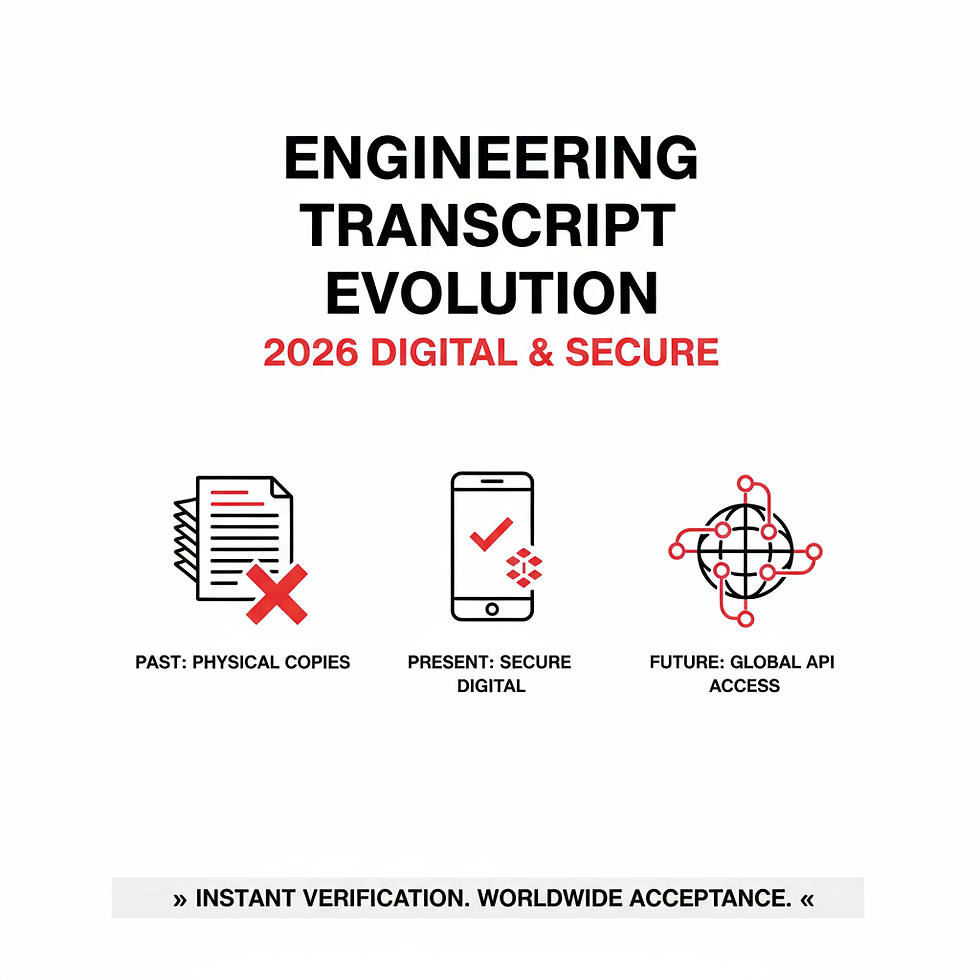
How Transcripts Have Evolved in 2026
🔹 Digital First Repositories
Instead of waiting weeks for physical copies, most universities in 2026 issue digital transcripts instantly via email or secure portals.
🔹 Real-Time Verification
Transcripts now often include verification QR codes, digital signatures, or blockchain-based validation — enabling employers and admissions officers to confirm legitimacy within seconds.
🔹 API Access
Many institutions offer API endpoints that third-party organizations (like employers or credential evaluators) can hit to fetch transcript data securely.
This evolution has made transcript handling faster, more secure, and more reliable — critical in high-stakes engineering admissions and hiring.
How to Request Your Transcript of Marks
The process may differ slightly between institutions, but the general steps in 2026 include:
Step 1: Log Into Your Academic Portal
Use your university login to access the student dashboard or records section.
Step 2: Navigate to Transcript Request
Look for options such as:
Issue transcript
Download transcript of marks
Certified academic record
Step 3: Choose Delivery Format
Select:
Digital transcript (preferred)
Hard copy (if needed)
Step 4: Pay Fees (if applicable)
Some institutions may charge a nominal fee for transcript processing.
Step 5: Submit Request
Confirm your request and preferred delivery method.
📧 Step 6: Receive and Verify
Once issued, download and verify your transcript. Look for:
Correct personal details
Accurate course listings and grades
Secure verification features
Key Tips for Engineering Students
✔ Maintain a Strong GPA
Focus on GPA/CGPA — many organizations set minimum cutoff criteria.
✔ Take Core Engineering Courses Seriously
Performance in core courses such as:
Mathematics
Physics
Programming
Circuit design
Fluid mechanics…often carries more weight during evaluations.
✔ Keep Records of Electives and Labs
Labs and project-based courses are significant in specialized fields like AI,
robotics, and embedded systems.
✔ Review and Correct Errors Promptly
Verify your transcript as soon as it’s issued. Errors in names, grades, or courses can delay admissions or job processing.
Transcript and Credential Evaluation
If you plan to study or work abroad, countries such as Canada, Germany, the UK, or Australia often require a credential evaluation through services like:
World Education Services (WES)
ECE (Educational Credential Evaluators)
IQAS (International Qualifications Assessment Service)
These organizations convert your transcript credentials to the host country’s academic standards.
Common Challenges and How to Solve Them
❗ Missing Records
If a semester or course is missing, contact your university registrar’s office immediately.
❗ Verification Issues
If the QR code or digital verification link fails:
Ensure you have the latest issued transcript
Contact support at your institution
❗ Delays in Processing
Request your transcript well ahead of application deadlines (often 6–8 weeks in peak seasons).

Transcript vs. Marksheet vs. Grade Card
Understanding the differences is important:
Document | Contains | Use Case |
Marksheet | Details per subject marks | Shows individual performance |
Transcript of Marks | Full academic record with GPA/CGPA | Used for admissions and hiring |
Grade Card | Grades for specific semester | Often used internally by students |
In 2026, transcripts remain the gold standard document recognized internationally for academic verification.
Transcript of Marks in Engineering Job Applications
📌 Why Employers Ask for It
Engineering employers review transcripts to:
Verify academic performance
Review relevant coursework
Confirm technical competencies
📌 Transcript Insights Recruiters Look For
GPA trends (improving or consistent performance)
Strength in technical subjects
Capstone projects and thesis work
Some recruiters even use AI parsing tools to automatically match transcript subjects with job requirements.
❓ FAQ — Transcript of Marks
Q1: What is a transcript of marks and why is it essential for engineering students in 2026?
A transcript of marks is an official academic document that details a student’s course performance, grades, and GPA/CGPA. In 2026, it’s essential for admissions, internships, jobs, scholarships, credential evaluation, and professional licensing in engineering.
Q2: How can I get my transcript of marks quickly?
Most universities offer digital transcript delivery instantly via secure portals. Ensure your details are correct in your academic profile, pay any required fees, and request the transcript online.
Q3: What verification features should I look for in a digital transcript?
Look for features like:
QR codes
Secure digital signatures
Blockchain hashes
Online verification URLsThese help institutions and employers confirm authenticity.
Q4: Can I use a transcript of marks for international applications?
Yes. Most top universities and employers worldwide accept secure digital transcripts. For countries that require credential evaluation, services like WES can translate your transcript into local academic equivalents.
Q5: What should I do if there’s an error in my transcript of marks?
Contact your university registrar or examination office immediately. Errors can delay applications and background verifications, so correct them well before submission deadlines.
📌 Best Practices for Managing Your Transcript
🗂 Store Copies Securely
Keep:
Digital backups (cloud storage)
Hard copies
Verified copies on secure platforms
🔐 Share Only When Necessary
Send transcripts only through official channels to protect personal information.
📆 Track Validity
Some organizations may require transcripts to be issued within a recent time frame (e.g., last 3 months).
Conclusion
In 2026, a transcript of marks is far more than a simple academic document—it is a verified, digital proof of your engineering knowledge, consistency, and readiness for global opportunities. From university admissions and scholarships to internships, job applications, and international licensing, this single document plays a decisive role in shaping your academic and professional future.
As engineering education becomes increasingly data-driven and globally connected, institutions and employers now rely on secure digital transcripts with QR codes, blockchain verification, and real-time authentication to make faster and more accurate decisions. Understanding what your transcript includes, how to request it, and how to manage it responsibly gives you a strong advantage in competitive selection processes.
For engineering students and professionals alike, maintaining a strong academic record, verifying transcript accuracy, and planning ahead for credential evaluations are essential best practices. By treating your transcript of marks as a strategic asset rather than a formality, you position yourself for smoother applications, greater credibility, and long-term success in an evolving global engineering landscape.
📣 Call to Action (CTA)
Are you ready to secure and optimize your transcript of marks for engineering success in 2026?
🔗 Download Free Transcript Checklist & Templates:👉 https://yourengineeringdocs.com/transcript-checklist
📄 Get Your Transcript Reviewed by Experts:👉 https://yourengineeringdocs.com/review
🎓 Explore Engineering Admissions & Career Support:👉 https://yourengineeringdocs.com/career-support
Secure your future with accurate, verified, and powerful academic documentation today!


Comments