Crashing the Market: Rising Crude Oil Prices and Indian Stocks in 2026
- Mar 19
- 9 min read
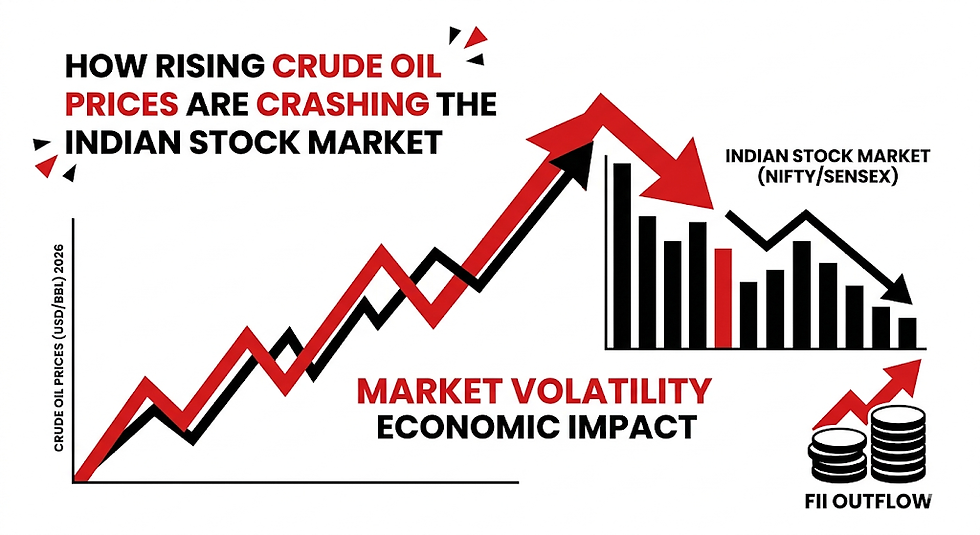
The Indian stock market began 2026 with a spectacular rally, driven by optimistic corporate earnings and a sense of macroeconomic stability. However, by the second quarter, the mood had shifted dramatically. The culprits were not an unforeseen domestic political shift or a global health crisis, but rather an old, familiar nemesis: skyrocketing international crude oil prices. Within just two weeks of March 2026, Indian investors saw a wealth erosion of nearly ₹20 lakh crore as the benchmark indices, the Nifty 50 and the BSE Sensex, suffered their sharpest weekly decline in four years. This event, which sent shockwaves through the financial community, was a stark reminder of the unique vulnerability of the Indian economy to the volatile global energy market. To understand why this occurred and how to navigate such volatility, we must delve into the deep, multi-layered relationship between rising crude oil prices and Indian stocks in 2026.
The Core Vulnerability: India's Unavoidable Dependency
India's economic growth is fueled by energy, and its energy landscape is dominated by fossil fuels. The fundamental disconnect that leaves the Indian economy exposed to international shocks is that while the country is among the world's fastest-growing energy consumers, it has very limited domestic production capabilities. As of early 2026, India continues to import over 85% of its crude oil requirements. This is not a choice, but a geographical reality that every Indian policymaker, economist, and stock market investor must constantly monitor. In 2026, India's crude oil imports are projected to reach an average of 5.1 million barrels per day (mbpd), a 4% increase from 2025, reflecting the nation's unstoppable industrial and infrastructural expansion.
When global crude prices rise, it is not merely a number on a screen; it is a direct and massive increase in India's national input cost. The macroeconomic ripple effect is immediate and all-encompassing.
1. The Widening Trade Gap: The Dollar Drain
The most direct impact of rising crude oil prices and Indian stocks in 2026 is through the Current Account Deficit (CAD). Since India must pay for its imported oil in US dollars, higher prices lead to a significant surge in the dollar outflow. In March 2026, with Brent crude hitting an eighteen-month high of $108 per barrel, India's trade deficit ballooned. Economists estimate that for every $10 increase in the price of crude oil per barrel, India's annual import bill swells by approximately $14 billion to $16 billion. This enormous increase in the dollar demand relative to supply puts immense pressure on the rupee.
2. The Weaker Rupee and Rising Input Costs
This dollar dependency makes the rising crude oil prices and Indian stocks in 2026 scenario doubly painful. A weaker rupee, which hit an all-time low of ₹92.15 to the dollar in March 2026, means that every other commodity or service India imports—from essential medicines and electronic components to defense equipment and fertilizers—becomes significantly more expensive. This phenomenon is known as imported inflation. It affects the profitability of countless Indian companies across diverse sectors, even those that have no direct connection to the oil industry, as they struggle to maintain margins while paying more for their imported raw materials.
Rising Crude Oil Prices and Indian Stocks in 2026: Sectoral Implications
The overall decline of the market indices often masks the differential impact on various sectors. While some industries are immediately crushed, others face a slow and painful margin squeeze, and a few can even emerge as winners. The connection between rising crude oil prices and Indian stocks in 2026 becomes crystal clear when analyzing the performance of different sectors during the oil price surge.
The Immediate Victims: Sectors with High Oil Sensitivity
Several key Indian industries are directly dependent on petroleum products, either as a primary energy source or as a raw material. For these sectors, the spike in crude oil prices is not a 'macroeconomic factor'—it is a 'cash flow crisis.'
1. Aviation: Squeezed at 35,000 Feet
The Indian aviation sector, already known for its cut-throat competition and low margins, is perhaps the most visible victim of a crude oil rally. Aviation Turbine Fuel (ATF) accounts for nearly 40% of an airline's total operating cost. The correlation is near-perfect: as the price of crude oil goes up, the price of ATF follows. With crude trading above $105 per barrel in mid-2026, major Indian carriers saw their stock prices plunge by 15-20% in just two weeks. This forced them to implement steep fuel surcharges, which in turn threatened to dampen air travel demand, creating a vicious cycle of falling load factors and shrinking profits.
2. Paints, Chemicals, and Lubricants: Input Price Pressure
A vast array of Indian manufacturing companies, including paint makers, chemical producers, and lubricant manufacturers, rely heavily on crude oil derivatives like monomers, solvents, and base oil. These inputs make up a significant portion of their total raw material cost. Companies like Asian Paints and Berger Paints found it challenging to pass on a 20-30% rise in their raw material prices to consumers in a competitive market, especially when consumer sentiment was already fragile. As their input costs rose while their product prices remained relatively stable, their profit margins were severely compressed, leading to a significant derating of their stock prices.
3. Automobile and Logistics: A Double-Edged Sword
The automobile sector faces a dual challenge. First, the cost of manufacturing vehicles rises due to higher prices of imported components, steel, and plastics (all of which can be linked back to energy costs). Second, and more importantly, the demand for vehicles, especially in the entry-level segment, is highly sensitive to running costs. As petrol and diesel prices at the pump crossed critical levels in early 2026, potential car and two-wheeler buyers deferred their purchases. This slowdown in sales volume, combined with input cost pressure, created a challenging environment for automotive companies, leading to a broad-based correction in their stock prices. Similarly, the logistics and transportation sector, which depends on diesel, saw its costs soar, affecting its profitability and, consequently, its stock valuation.
Secondary Economic Effects of the Crude Surge
The impact of rising crude oil prices and Indian stocks in 2026 extends far beyond these immediately sensitive sectors. It permeates the entire economy, creating a feedback loop that affects consumer behavior and monetary policy.
The Inflation Monster and Interest Rate Concerns
The most pervasive secondary effect is inflation. Rising oil prices lead to increased transportation and logistics costs for almost everything, from vegetables and fruits to consumer durables and industrial goods. By the second quarter of 2026, India's headline retail inflation (CPI) had spiked to 6.8%, well above the Reserve Bank of India’s (RBI) comfort band of 2-6%. This surge, primarily driven by fuel and transportation costs, forced the RBI to put a halt to its planned interest rate cuts and consider an aggressive rate hike instead. Higher interest rates are a universal negative for equity markets, as they increase the cost of borrowing for companies, reduce consumer spending power, and make fixed-income investments more attractive relative to stocks. The anticipation of a monetary policy pivot from the RBI played a significant role in the stock market crash of 2026.
Analyzing the 2026 Market Dynamics: FII Sell-off and VIX Spike
A defining feature of the stock market crash in 2026 was the rapid and large-scale exit of Foreign Institutional Investors (FIIs). For FIIs, the weakening of the rupee is a critical concern. When the rupee depreciates against the dollar, the value of their Indian investments, when converted back to dollars, decreases, even if the stock price remains the same in rupee terms. In the first two weeks of March 2026, as the rupee hit a new low, FIIs sold a record ₹45,000 crore worth of Indian equities. This aggressive selling, concentrated in large-cap stocks that dominate the indices, was a primary driver of the Sensex and Nifty crash.
This FII outflow, combined with the all-pervasive uncertainty about the future trajectory of oil prices and interest rates, sent a "fear index"—the India VIX—spiking by over 70% to its highest level since the 2022 global supply chain crisis. A high VIX indicates that investors expect significant market volatility in the near future. This heightened fear environment often leads to a self-fulfilling prophecy, as investors sell first and ask questions later, exacerbating the downward spiral of stock prices.
Exceptions to the Rule: The Beneficiaries
While the overall narrative of rising crude oil prices and Indian stocks in 2026 is one of decline, it is essential to recognize that not all companies suffer. The most obvious beneficiaries are the upstream oil and gas companies, such as ONGC and Oil India, which are engaged in the exploration and production of crude oil and natural gas. When international crude prices rise, the prices they realize for their own produce also increase, leading to a direct and substantial increase in their revenues and profit margins.
Furthermore, a prolonged high-oil-price environment often acts as a catalyst for other industries. It can significantly accelerate India's transition to renewable energy sources, as solar and wind power become increasingly cost-competitive. This can lead to a long-term rerating of companies in the solar, wind, and battery storage sectors, as well as those involved in the green hydrogen ecosystem. High fuel prices also boost the adoption of electric vehicles, benefiting EV manufacturers, battery producers, and companies developing EV charging infrastructure.
Investment Strategy: Navigating the Market Volatility
For investors, understanding the rising crude oil prices and Indian stocks in 2026 scenario is crucial for risk management and portfolio allocation. During periods of oil-induced volatility, a blanket "sell" strategy is rarely correct. A more nuanced approach involves several key steps:
Sectoral Diversification: Ensure that your portfolio is not overly concentrated in oil-sensitive sectors. Consider increasing exposure to defensive sectors like Information Technology (IT) and Pharmaceuticals, which are less affected by energy price fluctuations and can even benefit from a weaker rupee (due to their large export revenues).
Focus on 'Quality': Invest in companies with strong balance sheets, minimal debt, and, most importantly, high pricing power. Companies that can successfully pass on increased input costs to their customers without sacrificing sales volume are much better positioned to weather the storm.
Long-Term Hedging: A significant crude oil price surge can create attractive entry points for high-quality companies that have been unfairly beaten down. If the long-term investment thesis for a company remains intact, a temporary margin squeeze can be an opportunity.
SIP as a Volatility Buffer: For most retail investors, continuing their Systematic Investment Plans (SIPs) is the most effective way to navigate such volatility. SIPs allow you to buy more units of a mutual fund when the market is down, thereby averaging out your cost of acquisition and mitigating the impact of timing the market.
Conclusion: The New Economic Reality
The stock market crash of 2026, triggered by soaring crude oil prices, serves as a powerful case study in global economic interconnectedness. It highlighted that despite India's impressive domestic growth and significant policy strides, the nation cannot remain isolated from the forces of the international energy market. The relationship between rising crude oil prices and Indian stocks in 2026 is not an anomaly, but a reflection of the country's profound, structural energy dependency. For investors, it is a reminder that the path to market returns is rarely linear. Successful navigation of the Indian stock market requires not just an analysis of domestic corporate earnings, but a constant, vigilant monitoring of the global energy landscape and a well-diversified, risk-aware investment strategy.
FAQ Section
Q1: What is the single biggest reason why rising crude oil prices and Indian stocks in 2026 were so closely linked during the crash?
A: The main connection is India’s massive dependency on imported oil. India imports over 85% of its crude oil requirements, paying for it in US dollars. When crude prices rise, it causes three main problems that directly hurt the stock market: a wider Current Account Deficit (CAD), a weaker rupee (leading to imported inflation), and overall higher cost of production for companies across the economy, which in turn leads to a squeeze on profit margins and forces the RBI to consider rate hikes.
Q2: Did any specific sectors benefit from the rising crude oil prices and Indian stocks in 2026 scenario?
A: Yes, the 'upstream' oil and gas companies that explore and produce crude oil, such as ONGC and Oil India, directly benefited from higher oil prices, as they realized a greater revenue for their products. In the longer term, high oil prices also benefit the electric vehicle and renewable energy sectors, as they accelerate the transition to alternative energy sources.
Q3: Why did FIIs sell Indian stocks so heavily during the 2026 oil price surge?
A: FIIs are highly sensitive to currency fluctuations. Rising oil prices weaken the rupee against the dollar. This means that even if a stock price in rupees remains the same, the FII's return in dollar terms decreases. To prevent further erosion of their capital, FIIs often sell their Indian equity holdings in such scenarios, leading to significant downward pressure on the market.
Q4: How should a retail investor handle their SIP during such oil-linked market volatility?
A: The best strategy is to continue your SIPs. The inherent volatility caused by rising crude oil prices and Indian stocks in 2026 is precisely when SIPs are most effective. By buying more units when the market is down, you practice rupee-cost averaging, which averages out your cost of investment and can lead to significant wealth creation when the market eventually recovers.
CTA Section
Are you concerned about how global events like rising crude oil prices could impact your financial future? Don't leave your investments to chance. Our team of expert advisors is here to help you build a resilient, well-diversified portfolio tailored to your unique financial goals.
Take the next step towards securing your wealth:
Download Our Free 2026 Stock Market Outlook Report: "Navigating Volatility and Discovering Value" - Get in-depth sector analysis and our top stock picks for a high-inflation environment.
Schedule a Free 1-on-1 Consultation with a Certified Financial Advisor - Let us help you review your existing portfolio and craft a personalized investment plan that can weather any market storm.
Join Our Exclusive Webinar: "The Geopolitics of Energy and its Impact on Indian Markets" - Learn from leading economists and market strategists as they dissect the complex relationship between oil, currency, and stocks.


Comments