Crisis at the Crossroads: The Impact of Global Conflict on India’s Economy and Fuel Prices in 2026
- Apr 6
- 6 min read

As we navigate through the second quarter of 2026, the global geopolitical landscape has shifted from "uncertain" to "volatile." For India, a nation striving to solidify its position as the world’s third-largest economy, the external environment has become a formidable headwind. The escalating tensions in West Asia—specifically the military strikes involving the United States, Israel, and Iran—have sent ripples across the globe, but few nations feel the pulse of this turbulence as acutely as India.
The impact of global conflict on India is no longer a distant academic discussion; it is visible at every petrol pump in Delhi, every export terminal in Kochi, and every brokerage firm in Mumbai. With Brent crude surging past $111 per barrel and the Strait of Hormuz facing unprecedented disruptions, the Indian economy is at a critical juncture.
In this comprehensive analysis, we dive deep into why this 2026 conflict matters, how it is reshaping our fuel prices, and what it means for the common citizen and the macro-economy.
1. The 2026 Geopolitical Context: A Siege on the Strait of Hormuz
The primary driver of the current economic anxiety is the deepening crisis in the Middle East. As of April 6, 2026, the conflict has moved beyond localized skirmishes into a full-scale maritime disruption. The Strait of Hormuz, a narrow waterway through which nearly 20-30% of the world’s total oil consumption passes, is currently the center of a military standoff.
For India, this is a "code red" scenario. India currently imports approximately 88% of its crude oil requirements, with a staggering 45-50% of that historically sourced from the Middle East. When the "world's windpipe" for energy is constricted, the Indian economy begins to choke.
The disruption isn't just about supply; it’s about the cost of safety. Insurance premiums for oil tankers have skyrocketed by 300% in the last two months, and freight costs have doubled as ships are forced to take longer, more circuitous routes to reach Indian ports like Jamnagar and Mundra.
2. Skyrocketing Fuel Prices: The View from the Pump
For the average Indian household, the impact of global conflict on India is most immediately felt in the daily commute. While state-run oil marketing companies (OMCs) have attempted to keep regular petrol and diesel prices stable through government intervention, the pressure is becoming unsustainable.
Current Fuel Rates (April 6, 2026)
City | Petrol (Regular) | Diesel (Regular) | LPG (Domestic) |
New Delhi | ₹94.77 | ₹87.67 | ₹913.00 |
Mumbai | ₹103.54 | ₹90.03 | ₹915.50 |
Kolkata | ₹105.41 | ₹92.02 | ₹920.00 |
Hyderabad | ₹107.50 | ₹95.70 | ₹932.00 |
Bangalore | ₹102.92 | ₹90.99 | ₹918.00 |
Data Source: Market updates as of April 2026.
While regular fuel has seen a marginal reprieve due to excise duty cuts implemented in late 2025, premium fuels like XP100 have hit a staggering ₹160 per litre. More concerning is the price of commercial LPG, which has surged to ₹2,078, directly impacting the hospitality sector and, by extension, the cost of dining out and street food.
The surge in crude prices—which rose nearly 80% in the first quarter of 2026 alone—has created a "price lag" that OMCs can only absorb for so long. Experts suggest that if Brent crude remains above the $110 mark through May, a retail price hike of ₹5-8 per litre may be inevitable to prevent the bankruptcy of state-run energy firms.
3. Understanding the Impact of Global Conflict on India’s Macroeconomic Stability
Beyond the petrol pump, the conflict is eroding India's hard-won fiscal stability. In early April 2026, Moody’s Ratings and ICRA both slashed India’s GDP growth estimates for the fiscal year 2026-27.
GDP and Inflation Forecasts
GDP Growth: Previously estimated at 6.8%, the forecast for FY27 has been cut to 6.0%.
Inflation: Retail inflation, which was hovering around a healthy 2.4% in early 2026, is now projected to average 4.8% to 5.2% as energy costs seep into food and logistics.
The Rupee (INR): The Indian Rupee recently touched a record low of ₹95 per US Dollar. A weaker rupee makes every barrel of imported oil even more expensive, creating a vicious cycle of "imported inflation."
The Fertilizer Crisis
India’s reliance on imported fertilizers and natural gas for their production is another hidden vulnerability. The conflict in West Asia has disrupted LPG and LNG shipments. This doesn't just mean expensive cooking gas; it means higher input costs for farmers. The government is now facing a massive spike in its subsidy bill, which could widen the fiscal deficit and limit spending on infrastructure and social schemes.
4. Trade Disruption: From Seafood to Semiconductors
The Red Sea crisis, which began as a peripheral issue, has transformed into a logistics nightmare in 2026. Ships that previously utilized the Suez Canal are now rerouting around the Cape of Good Hope.
Extended Lead Times: This detour adds 10 to 15 days to the journey of Indian exports to Europe and the US East Coast.
The Export Loss: Indian seafood exporters are already staring at a loss of over ₹1,500 crore. Shipments worth $300 million are currently stuck at various ports because of the volatility in the Persian Gulf.
Inventory Costs: Industries like electronics and automobiles, which rely on "just-in-time" supply chains, are seeing their working capital cycles stretch. The cost of holding inventory has risen, and the shortage of shipping containers has returned as a ghost from the pandemic era.
5. The Pivot: How India is Fighting Back in 2026
While the situation is grim, India’s response in 2026 has been more proactive than in previous decades. The impact of global conflict on India has accelerated several strategic shifts:
A. The Ethanol Revolution
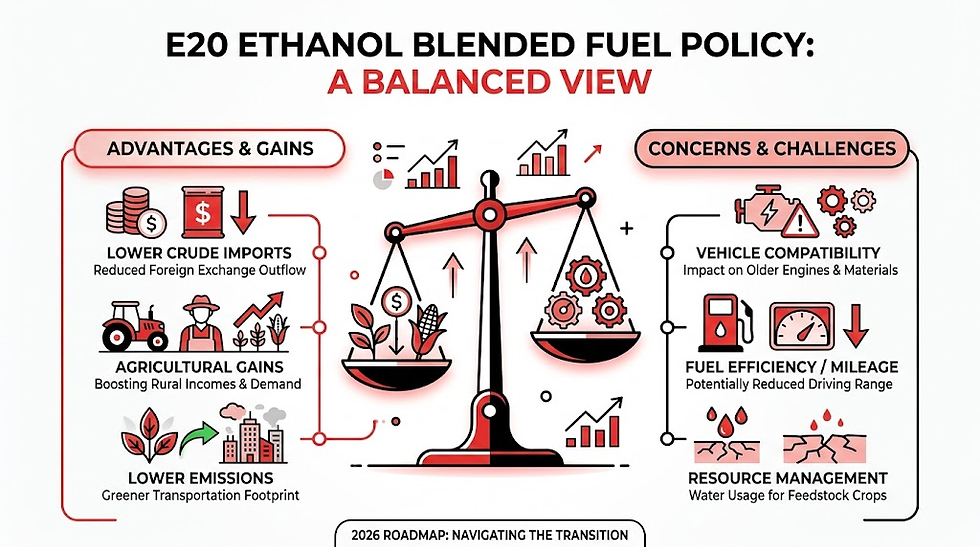
With crude prices hitting triple digits, the government’s push for 20% Ethanol Blending (E20) has become a survival strategy rather than just an environmental goal. Companies like EID Parry and other sugar manufacturers have transitioned into "biofuel powerhouses." By April 2026, India has successfully achieved an average blending rate of 16% across the country, significantly reducing the foreign exchange outflow.
B. Strategic Diversification: The Russian and American Factors
India has successfully diversified its sourcing to mitigate Middle Eastern volatility.
Russia: Despite ongoing sanctions, Russia remains India’s largest supplier, providing nearly one-third of our total crude imports at discounted rates (though the "discount" has narrowed in 2026).
USA: Imports from the United States have reached a record high, as Indian refiners look for "safe harbor" oil that doesn't have to pass through the Strait of Hormuz.
C. Harnessing Domestic Reserves
The 2026 Energy Statistics report highlights a renewed focus on Northeast India. States like Assam and Tripura, which hold over 17% of India’s onshore natural gas reserves, are finally receiving the infrastructure investment needed to reduce dependence on imported LNG.
6. The "Common Man" Perspective: A Household Budget Under Siege
When we talk about the impact of global conflict on India, we must look at the kitchen table.
Transport Costs: As diesel prices remain high, the cost of transporting vegetables from rural hubs to urban centers has risen by 12%.
Disposable Income: With more money spent on fuel and electricity, private consumption—which accounts for 61% of India’s GDP—is showing signs of a slowdown.
Savings: The depreciation of the Rupee and the volatility in the stock market (NSE/BSE) have made retail investors cautious, with many shifting from equity to "safe-haven" assets like gold, which has hit new highs in April 2026.
Summary: A Test of Resilience
The impact of global conflict on India in 2026 is a multifaceted challenge. It is a test of our diplomatic ties, our energy policy, and our economic resilience. While the "India Growth Story" remains intact, the path to $5 trillion has become significantly steeper.
The coming months will be crucial. Whether the Strait of Hormuz reopens or the conflict escalates further will determine if India ends 2026 as a "bright spot" or a "stalled engine."
FAQ: Impact of Global Conflict on India
Q1. How does the current impact of global conflict on India affect my daily fuel expenses?
The global conflict, particularly in the Middle East, has pushed Brent crude prices above $111/barrel. This increases the cost for Indian oil companies. While the government has used excise duty cuts to prevent a massive spike, you are likely seeing higher prices for premium petrol and commercial LPG. If the conflict persists, a hike in regular petrol and diesel prices is highly probable by mid-2026.
Q2. Why is the Indian Rupee falling because of the war?
Wars create uncertainty, causing investors to move their money to "safe" currencies like the US Dollar. Additionally, because India imports most of its oil, a rise in oil prices means we need more dollars to pay for it, increasing demand for USD and weakening the INR.
Q3. Will the Red Sea crisis lead to a shortage of goods?
While a total "shortage" is unlikely, you will experience delays. Goods coming from or going to Europe (like certain electronics, machinery, and luxury items) are taking 15 days longer to arrive because ships are rerouting around Africa. This also makes these items more expensive due to higher freight costs.
Q4. Can India’s transition to Electric Vehicles (EVs) help reduce this impact?
Yes. The 2026 energy crisis has significantly accelerated EV adoption in India. By reducing our dependence on petrol and diesel, EVs help insulate the economy from global oil shocks. However, this is a long-term solution and won't immediately lower food or transport costs in the next few months.
Stay Informed & Act Now
The global economy is moving faster than ever. Stay ahead of the curve by tracking real-time updates and expert analyses.
Track Real-Time Fuel Prices: Check Today's Petrol & Diesel Rates (IOCL)
Monitor Economic Indicators: Reserve Bank of India (RBI) Official Reports
Deep Dive into Policy: Ministry of Petroleum & Natural Gas Updates
Global Market Trends: Live Brent Crude Prices on Bloomberg


Comments