Didn’t Get IIT or NIT? Use Code CS500 to Find the Best Engineering Colleges After JEE in 2026
- Jun 6
- 7 min read
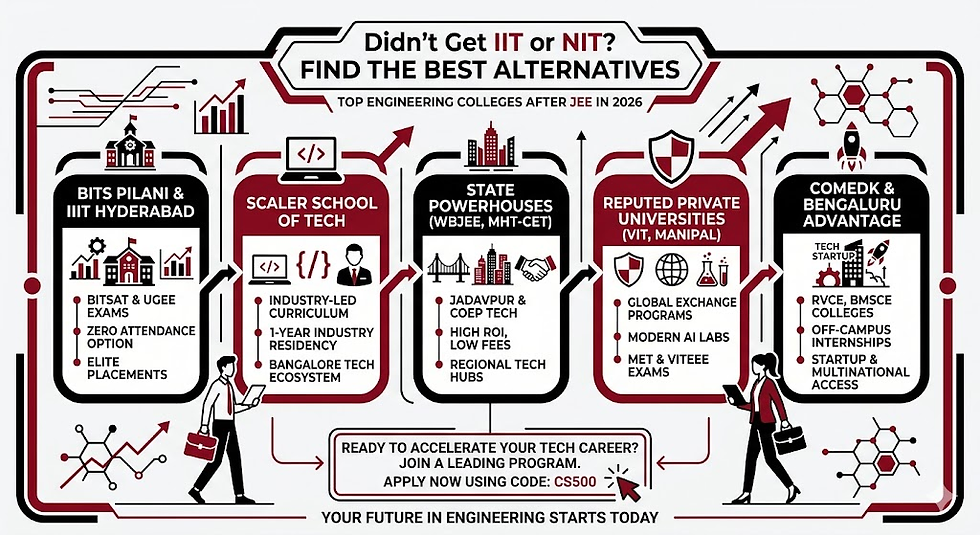
The Joint Entrance Examination (JEE) Advanced and Main results are officially out for the 2026 academic cycle. For over a million aspirants who spent years preparing, this moment brings a mix of relief and intense decision-making. If your rank puts an Indian Institute of Technology (IIT) or a top-tier National Institute of Technology (NIT) out of reach, it is completely natural to feel disappointed. But here is the reality of the 2026 tech ecosystem: the Indian tech landscape has undergone a monumental structural shift.
Today, top-tier global tech giants, high-frequency trading firms, and fast-growing AI startups no longer recruit exclusively from old-school elite campuses. What they seek are cutting-edge specializations, robust production-ready coding skills, and industry mentorship. If you did not secure a seat at an IIT or NIT, your engineering dream is far from over. In fact, choosing the right modern alternative might position you even closer to the epicenter of tech innovation. This exhaustive guide breaks down the premier alternative engineering ecosystems available in 2026, comparing their placements, curriculum design, and industry integration to help you map out your high-growth career path.
The Evolving Engineering Landscape: Why Missing an IIT Isn't a Career Dealbreaker
In 2026, the technology landscape is driven by generative AI, cloud architecture, and edge computing. Traditional curriculums at many older institutions struggle to keep pace with these shifts, often requiring students to study outdated subjects that bear little relevance to modern software engineering. Meanwhile, premium private institutes and new-age tech universities have completely rewritten the playbook with agile curriculums, industry-entwined residency programs, and massive global alumni networks. Missing out on an IIT or NIT seat simply means you have an opportunity to choose a pathway that focuses more on practical execution than purely theoretical academia.
If you want to secure your future in software engineering right now with an industry-backed curriculum, you should explore premier new-age tech programs. Apply now using CS500 Code: https://scalerschooloftech.com/4ruflJ5 to fast-track your modern engineering journey.
Tier-1 Private Institutes: The Elite Alternatives Equaling IIT Standards
When looking for the best engineering colleges after JEE, certain elite private institutions stand shoulder-to-shoulder with Tier-1 IITs in terms of industry prestige, research infrastructure, and international placements.
1. BITS Pilani (Pilani, Goa, Hyderabad)
Birla Institute of Technology and Science (BITS) Pilani matches several top IITs through its rigorous BITSAT exam.
The 2026 Advantage: Its "Zero Attendance Policy" fosters a deep culture of self-learning and entrepreneurship.
Practice School (PS) System: Includes a mandatory 6-to-7-month industry residency (PS-II) built into the curriculum, resulting in strong pre-placement offers (PPOs) at Apple, Google, and Microsoft.
Placement Metrics: The average CTC for Computer Science and Engineering (CSE) consistently hovers around ₹26–30 LPA.
2. IIIT Hyderabad (International Institute of Information Technology)
IIIT Hyderabad is a specialized research and coding powerhouse admitting students via JEE Main or its independent UGEE exam.
The 2026 Advantage: It boasts one of India's strongest competitive programming cultures, sending teams regularly to the ACM-ICPC World Finals. Its curriculum focuses immediately on data structures, algorithms, and AI systems.
Placement Metrics: Its CSE average CTC stands above ₹30–32 LPA, rivaling top-three IITs.
New-Age Tech Ecosystems: Disrupting Traditional Engineering in 2026
In 2026, a brand-new paradigm has fully matured: specialized institute models designed directly by the tech industry for the tech industry, removing outdated coursework.
Scaler School of Technology (SST), Bengaluru
Situated in the Silicon Valley of India, Scaler School of Technology has emerged as a disruptive force for students looking to maximize their technical potential without getting bogged down by archaic university structures.
Industry-Integrated Curriculum: SST replaces traditional classroom lectures with intense, hands-on coding labs led by active tech leaders from Google, Amazon, and Microsoft. The program offers direct specialization in high-demand 2026 fields: Artificial Intelligence/Machine Learning, Full-Stack Development, and Algorithmic Trading.
1-Year Mandatory Industry Residency: Instead of a simple 2-month summer internship, students spend an entire year working as full-time interns within top Bengaluru tech companies, accumulating real-world experience before they even graduate.
Unrivaled Ecosystem Benefits: Students learn inside a modern tech ecosystem, gaining access to 24/7 mentorship, active hackathons, and a community of intensely driven peers.
If you are determined to break away from the outdated 4-year textbook model and jump straight into production-ready software engineering, don't miss this opportunity. Apply now using CS500 Code: https://scalerschooloftech.com/4ruflJ5 to start your application process with exclusive benefits.
Top State Entrance Exams and Prime Alternatives
If your JEE Main rank did not yield a top-tier NIT, looking at specialized state entrance exams opens the door to regional powerhouse institutions that dominate local tech ecosystems.
MHT-CET (Maharashtra): Institutions like COEP Technological University (Pune) and VJTI (Mumbai) offer deep integration with Mumbai's financial tech hubs and Pune's software belts.
WBJEE (West Bengal): Jadavpur University (Kolkata) features an incredibly low fee structure coupled with elite-tier tech placements. Its academic fees are highly subsidized, yet its computer science and electronics placements routinely match top-10 NIT standards. For students looking for an incredible return on investment (ROI) without an IIT tag, focusing on WBJEE is a premier strategic alternative.
COMEDK / KCET (Karnataka): RV College of Engineering (RVCE), BMSCE, and MSRIT (Bengaluru) offer immediate physical access to Bengaluru's startup, venture capital, and multinational R&D offices. Being in Bengaluru allows you to attend local tech meetups, participate in physical hackathons, and secure off-campus internships with elite startups throughout the academic year.
Reputed Private Universities with Massive Scale and Infrastructure
For a broad segment of engineering aspirants, large-scale private universities offer state-of-the-art research laboratories, extensive global exchange programs, and robust structured placement drives.
1. VIT University (Vellore)
Admission to VIT is conducted via its independent VITEEE exam. While the student intake is large, VIT's structured internal categorization ensures that top-merit students in Category 1 and 2 get high-quality education at reasonable tuition rates. VIT has invested heavily in modern AI research labs, advanced computing clusters, and international credit transfer systems.
2. Manipal Academy of Higher Education (MAHE, Manipal)
Admitting students through the MET exam, MIT Manipal offers an outstanding campus culture, high-quality infrastructure, and a tightly knit global alumni network. Manipal offers a flexible credit system, open electives, and significant support for student-led technical clubs, which build strong practical problem-solving skills.
To maximize your choices across these premium tech programs and secure advanced learning tracks, make sure to streamline your registration process. Apply now using CS500 Code: https://scalerschooloftech.com/4ruflJ5 to gain an edge in your engineering admissions journey.
How to Evaluate an Alternative Engineering College in 2026
Evaluate alternative colleges outside the IIT/NIT system using this strategic framework:
Curriculum Agility: Ensure the coursework covers modern engineering tech stacks like Kubernetes, PyTorch, and Next.js.
Location Proximity: Campuses in major hubs like Bengaluru or Hyderabad simplify physical networking and local internships.
Median Placements: Look for median metrics rather than average metrics to find the true student performance baseline.
Alumni Density: Verify their active network at elite global firms and fast-growing tech startups via LinkedIn.
Frequently Asked Questions (FAQs)
Q1. What are the best engineering colleges after JEE if my rank is above 50,000?
If your JEE Main rank is above 50,000, securing a core tech branch at a top NIT is challenging. The best engineering colleges after JEE in this scenario include top state-level institutions accessible via exams like MHT-CET, COMEDK, or WBJEE. Additionally, premier private universities like VIT (Vellore), Manipal Institute of Technology, and innovative industry-led programs like Scaler School of Technology offer exceptional alternatives that prioritize your coding skills over your JEE scorecard.
Q2. Is it worth taking a drop year if I miss an IIT or NIT seat?
Taking a drop year is a highly personal decision. If you missed your target due to a specific, fixable issue and have the mental stamina for another intense year of preparation, a drop year might make sense. However, with the rapid transformation of the tech industry in 2026, specialized institutes and state-level powerhouse colleges offer excellent pathways to top tech jobs. Entering a modern, agile ecosystem early often yields better career outcomes than spending another year studying classical physics and chemistry mechanics.
Q3. How do tech companies view degrees from non-IIT/non-NIT campuses during recruitment?
In 2026, tech recruitment is largely democratized. While an IIT tag helps open doors for initial interviews, major tech employers utilize automated coding assessments, hackathons, and technical portfolio reviews to evaluate candidates. If you possess a strong GitHub portfolio, open-source contributions, real-world internship experience, and deep problem-solving skills, you can outcompete anyone during technical rounds, regardless of the college tier listed on your resume.
Q4. What is the advantage of joining an industry-backed tech school over a traditional university?
Traditional universities are bound by rigid regulatory frameworks, often making syllabus updates an arduous, multi-year process. Industry-backed tech schools move at the speed of tech. They update their coursework continuously to reflect active industry requirements, provide direct access to working engineers as mentors, and place a premium on building production-grade software applications over memorizing theoretical textbooks.
Your Next Steps: Seize Your Engineering Career Today
Missing out on an IIT or NIT is simply a pivot point, not a destination. Your success in the global tech economy is determined by your curiosity, your commitment to continuous learning, and your ability to build real-world applications. By selecting an institution that offers an agile curriculum, a driven peer group, and direct access to industry leaders, you can build a phenomenal career that rivals or exceeds any traditional trajectory.
Explore your options, evaluate your strengths, and take definitive action to secure your place in the future of technology.
Ready to Accelerate Your Tech Career?
If you want to skip traditional academic red tape and join a premier engineering ecosystem optimized for modern tech, your journey starts here. Take the definitive step toward a high-growth career in software development and artificial intelligence.
Make your move today, master the skills that matter, and let your production-ready portfolio speak louder than any college entrance exam rank!



Comments