Honda China Joint Venture: Navigating 2026 Sales & Strategy
The global automotive sector is undergoing its most radical transformation since the invention of the assembly line. Nowhere is this disruption more acute than in China—the world’s largest and most aggressive electric vehicle (EV) market. Once dominant international titans are finding themselves locked in a fierce battle for market survival as domestic Chinese manufacturers leverage lower price points, rapid software iteration, and supply chain dominance.
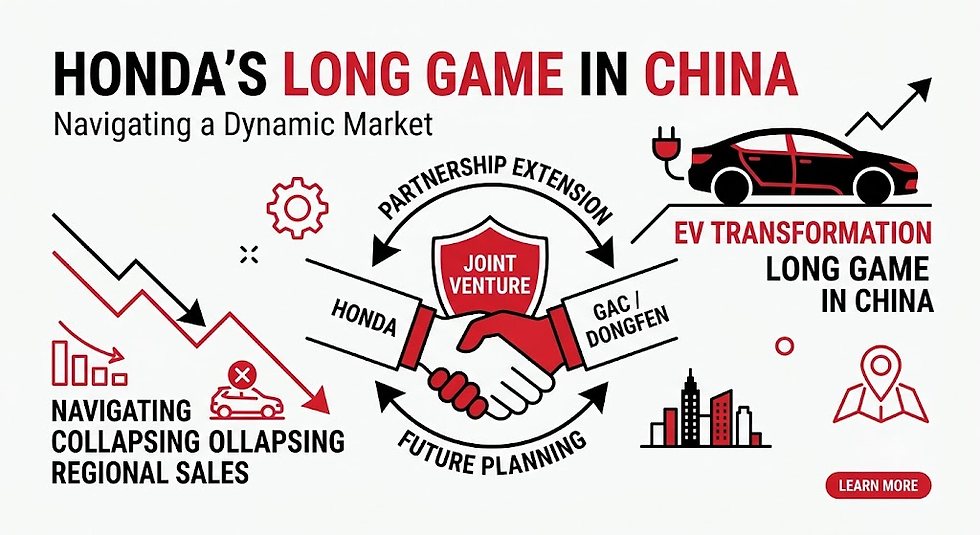
In response to these headwinds, Japanese auto giant Honda is executing a dual-pronged "long game" strategy. Rather than retreating from the market, Honda recently announced a massive commitment: doubling down on its local presence while simultaneously slashing legacy internal combustion engine (ICE) operations.
This comprehensive analysis explores how Honda is reshaping its commercial strategy through a extended Honda China joint venture, tackling steep regional sales declines, and attempting to recalibrate its electrification path to secure long-term survival in 2026.
The 2038 Commitment: Deciphering the Honda China Joint Venture Strategy
In July 2026, Honda Motor signed a historic agreement with its long-time state-owned partner, Guangzhou Automobile Group (GAC Group). The landmark deal extended the official operational term of their Honda China joint venture—GAC Honda Automobile Co., Ltd.—all the way through 2038. Originally slated to expire in 2028, this early ten-year renewal preserves the 50-50 equity arrangement that has defined Honda’s manufacturing footprint in Southern China since 1998.
This extension sends a firm, strategic signal to investors and competitors alike: Honda is not abandoning mainland China. Despite escalating geopolitical friction and softening profit margins, the company views a direct presence inside China’s tech-heavy market as non-negotiable.
Why Extend Ahead of Expiration?
Securing the partnership through 2038 accomplishes several key operational goals:
Supply Chain Continuity: Ensures long-term legal and regulatory grounding for deep localized supplier contracts, particularly regarding battery sourcing and autonomous driving software integration.
Asset Restructuring Security: Gives Honda a stable framework to consolidate asset holdings, such as integrating Dongfeng Honda Engine Co. into GAC Honda Engine Co.
Rebuilding Local Competitiveness: Unlocks joint research and development initiatives, allowing Honda to combine its traditional hardware engineering with GAC’s localized digital and new-energy architectures.
Anatomy of a Market Collapse: Understanding Regional Sales Pressures
While the 2038 JV extension proves Honda's long-term intention, the short-term reality on the ground is stark. Legacy automakers across Asia and Europe have suffered a historic contraction in Chinese market share.
For years, the joint venture model was a printer for cash and volume. Foreign brands provided combustion technology and global prestige, while local partners provided regulatory pathways and land development. However, as local Chinese New Energy Vehicle (NEV) adoption soared past 54% retail penetration, joint-venture brands saw their aggregate market share drop to roughly 25%—down from over 45% just five years prior.
The Falling Numbers
Honda's sales footprint in China has felt this macro transition severely:
Dwindling Overall Volumes: From an all-time peak of over 1.6 million vehicle sales in China in 2020, Honda’s total volume plummeted to roughly 645,000 units.
Accelerated Monthly Drops: Early 2026 data shows sales down more than 22% to 48% year-over-year in various quarters, driven by an acute contraction in legacy gas sedan demand.
Core Model Erosion: Iconic nameplates that historically generated steady volume—such as the Accord, Civic, and Fit—have faced aggressive price wars from domestic plug-in hybrids (PHEVs) and battery electric vehicles (BEVs) priced under 100,000 RMB.
Market Context: Price slashes across legacy nameplates have severely compressed margins. Discounting the GAC Honda Accord and ZR-V by thousands of dollars has kept inventory moving, but at the expense of secondary market value and brand premium.
Restructuring Strategy: Trimming Capacity & The Hybrid Pivot
Faced with structural sales declines, Honda’s 2026 playbook centers on capacity right-sizing and a strategic pivot in drivetrain technology.
1. Slashing ICE Production Capacity
For two decades, foreign OEMs built massive factories to serve expanding demand for internal combustion engines. To halt cash burn, Honda is aggressively scaling back its conventional ICE footprint:
Factory Closures and Reductions: GAC Honda’s historical Huangpu plant in Guangzhou is scheduled to end production run-rates, alongside planned capacity cutbacks at Dongfeng Honda facilities.
Trimming the Lineup: Production allocation for slow-selling ICE and early transition models—including the Honda Fit, ZR-V, and Accord e:PHEV—has been phased into order-closures or inventory clearing phases.
Target Capacity: Honda aims to reduce its legacy internal combustion annual production capacity in China from roughly 1.2 million units down to 720,000 units.
2. The Hybrid Pivot vs. Pure EV Stumbles
Honda’s initial EV push in China faced severe product-market misalignment. Early electric offerings, such as the e:NS1 and the newer "Ye" series (including the GAC Honda P7 and Dongfeng Honda S7), struggled to capture meaningful volume against heavily subsidized local alternatives boasting superior infotainment software and lower prices. Combined monthly sales for these EV lineups struggled to surpass a few hundred units each.
Recognizing this, Honda initiated a global and regional strategic adjustment in 2026. The automaker paused several capital-intensive pure BEV initiatives to focus resources on its world-renowned hybrid-electric (HEV) systems. By aiming for over 2.2 million hybrid sales globally while serving China’s massive hybrid demand, Honda is leaning into its core technical strength to maintain cash flow while next-generation EV architectures are refined.
Comparative View: Honda China Strategy vs. Industry Rivals
To understand Honda's current posture, it helps to analyze how it stacks up against other legacy automakers attempting to survive the Chinese market shift.
Feature / Metric | Honda Strategy | Toyota Strategy | Volkswagen Strategy |
JV Structure | Extended through 2038 (GAC) | Deepened tech partnerships with BYD | "In China, for China" localized platform R&D |
Capacity Action | Cutting ICE capacity to ~720k units | Reallocating legacy lines to hybrid output | Closing select ICE lines; buying Xpeng stakes |
Near-Term Drivetrain Focus | Advanced Hybrids & Select "Ye" Series EVs | Dual-boost Hybrid & BZ Series EVs | Rapid BEV launch cycle via local platforms |
Software Strategy | Local partner tech integration | Partnering with Huawei/Tencent | Cariad local division + Horizon Robotics |
The Road Ahead: How Honda Can Win the Long Game in China
Surviving in China beyond 2026 requires more than defensive capacity trims; it demands a transformation in how vehicles are designed and sold. For the Honda China joint venture entities to thrive during this extended 2038 horizon, three crucial milestones must be met:
Software-First Localization: Chinese consumers evaluate vehicles on smart cockpits, voice UI, and driver-assist capabilities. Honda must grant its local R&D divisions total autonomy to source top-tier Chinese software ecosystems.
Cost Structure Parity: Local battery supply chains and vertical integration give domestic Chinese brands a 20-30% cost advantage. Honda must leverage GAC and Dongfeng's local supply networks to lower bill-of-materials costs for localized NEVs.
Brand Re-Positioning: Honda must shift its regional marketing from "reliable Japanese ICE engineering" to "intelligent, eco-conscious mobility," utilizing new sub-brands to target younger demographics.
By extending its joint venture contract through 2038, Honda has bought the necessary time to undergo this structural transformation. While regional sales volatility remains a heavy burden on current earnings, the company's decisive willingness to downsize obsolete plant capacity and refocus on hybrids creates a viable runway for recovery.
Frequently Asked Questions (FAQs)
What is the current status of the Honda China joint venture?
In July 2026, Honda Motor Co. officially signed an agreement with Guangzhou Automobile Group (GAC Group) to extend their primary Honda China joint venture—GAC Honda Automobile Co., Ltd.—through the year 2038. The 50-50 equity arrangement remains unchanged, preserving Honda’s long-term operational footprint.
Why are Honda’s vehicle sales declining in China?
Honda’s regional sales decline stems primarily from the Chinese automotive market’s rapid shift toward New Energy Vehicles (NEVs) and electric cars. Domestic Chinese automakers have launched feature-packed, low-cost EVs and plug-in hybrids that directly compete with Honda’s traditional internal combustion engine lineup (such as the Accord, Civic, and Fit).
How is Honda adjusting its manufacturing capacity in China?
Honda is right-sizing its legacy combustion engine operations by closing older assembly plants (such as GAC Honda’s Huangpu facility) and shutting down low-margin ICE model allocations. The company is reducing its ICE production capacity in China from roughly 1.2 million units annually down to 720,000 units.
Is Honda abandoning electric vehicles in favor of hybrids?
Honda is rebalancing its global strategy by pausing certain pure electric vehicle development programs to place greater near-term emphasis on its hybrid technology platform. While EV models under the "Ye" series remain part of its Chinese strategy, hybrid vehicles provide the stable revenue stream needed while next-generation EV platforms are developed.
Further Insights & Automotive Strategy Resources
Navigating the evolving international auto industry requires up-to-date market intelligence and deep strategy analysis. Explore these resources to learn more about global automotive shifts and corporate Joint Ventures:
Global Auto Market Dynamics: Stay updated on cross-border supply chain trends and global electrification roadmaps at Honda Global Corporate Newsroom.
Automotive Industry Analysis: For deep-dive analyses on EV market penetration and competitive intelligence, explore industry reports from Nikkei Asia Automotive Sector.
Strategic Advisory Services: Looking to restructure supply chain operations or explore cross-border joint ventures? Contact our strategic consulting team at AutoIndustryInsights.com to schedule an executive briefing.
This video provides valuable commentary on how changing sales numbers and shifts in electric vehicle production strategy are impacting global legacy car manufacturers.


Comments