Didn't Get Your Preferred Branch Through MHT-CET? Explore Scaler School of Technology for the Best MHT CET Engineering Branch Alternatives – Use Code CS500
- Jun 23
- 9 min read
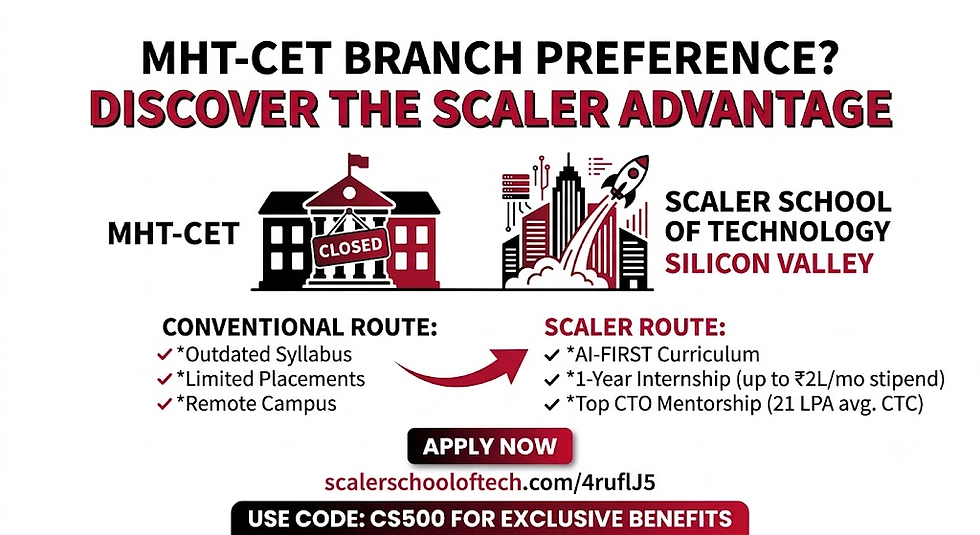
The year 2026 has witnessed an unprecedented milestone in the history of Maharashtra’s technical education. With a record-breaking 10.94 lakh students registering for the MHT-CET (Maharashtra Common Entrance Test) across the PCM and PCB streams, the battleground for securing a seat in a premier engineering institution has never been more fiercely contested. As the State Common Entrance Test Cell progresses through the multi-layered Centralized Admission Process (CAP) rounds, a harsh reality is setting in for hundreds of thousands of aspirants: the skyrocketing cutoffs mean that securing a coveted seat in Computer Science Engineering (CSE), Artificial Intelligence (AI), or Information Technology (IT) is slipping out of reach for even exceptionally bright students.
For decades, the standard narrative preached to young engineering aspirants in Maharashtra has been singular: clear the MHT-CET, get a high percentile, secure a seat at prestigious hubs like COEP Technological University (Pune), Veermata Jijabai Technological Institute (VJTI, Mumbai), Sardar Patel Institute of Technology (SPIT, Mumbai), or Pune Institute of Computer Technology (PICT), and your career is set. However, with the 2026 general category cutoffs for CS and IT branches consistently demanding a 99.5+ percentile (frequently requiring a State Merit Rank under 500 to 1,000), a massive cohort of passion-driven tech enthusiasts is left facing a frustrating compromise. They are forced to either accept a non-preferred branch like Mechanical, Civil, or Metallurgy at a top-tier college or settle for a lower-tier, semi-urban private college just to keep their computer science dreams alive.
If you find yourself stuck in this high-stakes dilemma, it is time to look outside traditional constraints. The tech landscape in 2026 doesn't value outdated university syllabi or rigid bureaucratic caps on modern branches; it values real-world execution, deep-tech engineering capability, and problem-solving agility. This is precisely where the Scaler School of Technology (SST) in Bangalore enters the picture as a premier alternative to conventional engineering tracks.
Apply now using CS500 Code: https://scalerschooloftech.com/4ruflJ5
The 2026 MHT-CET Reality Check: The Crunch for Tech Branches
To understand why a shift in perspective is necessary, one must look closely at the data defining the 2026 engineering admissions cycle in Maharashtra. The surge to over 10.9 lakh applicants has caused an extreme compression of percentiles. Under the normalization process across multiple shifts, a raw score of 140 to 150 out of 200—which historically guaranteed a top rank—now yields roughly a 98 to 99 percentile, pushing candidates down to an estimated State Merit Rank between 2,000 and 5,500.
While a 98+ percentile is undeniably excellent, an analysis of the opening and closing ranks for premier institutes reveals a daunting scenario for tech hopefuls:
COEP Technological University, Pune: Computer Engineering and AI & ML closing ranks regularly wrap up within the top 500 to 900 ranks state-wide, demanding a near-flawless 99.9+ percentile.
VJTI, Mumbai: The projected closing percentile for Computer Engineering stands at an astronomical 99.96%, with Information Technology following closely behind at 99.92%.
PICT, Pune & SPIT, Mumbai: Specialized tracks like AI & Data Science and regular CSE seats close well before the 99.5 percentile threshold for open categories.
This leaves students with a choice that often feels like a lose-lose situation. Choosing a brand-name institution like COEP but studying Metallurgy or Civil Engineering means spending four critical formative years mastering concepts that are fundamentally disconnected from the booming software ecosystem. Conversely, selecting a Tier-3 or Tier-4 college simply because they offer a "CSE" tag frequently means enduring outdated, theoretical curricula, lack of institutional funding, and minimal on-campus placement opportunities with global tech giants.
Why You Need to Look at MHT CET Engineering Branch Alternatives
The Industry-Academy Chasm in 2026
Traditional universities are governed by rigid structural frameworks. Curricula are updated once every few years, leaving little room to dynamically adapt to the rapid technological disruptions brought about by generative AI, large language models (LLMs), distributed systems, and edge computing. Students in conventional setups spend countless hours writing code on paper, maintaining physical journals, and studying legacy languages that have long been deprecated in modern production environments.
The Misconception of the "Branch Compromise"
Many students believe that they can take a core branch like Mechanical or Electrical Engineering at a top college and easily transition into software development through self-study or bootcamps. While this was viable a decade ago, the 2026 tech employment market is highly specialized. Top companies are no longer just looking for individuals who know basic syntax; they are actively searching for individuals who can architect systems, implement complex Data Structures & Algorithms (DSA), write scalable APIs, and deploy machine learning models end-to-end. Balancing a grueling, unrelated academic schedule with high-level software preparation is a recipe for burnout.
As a result, smart candidates are evaluating disruptive educational models. Exploring high-caliber MHT CET engineering branch alternatives allows students to bypass the systemic flaws of traditional counseling processes. Instead of fighting for a compromised seat under rigid state quotas, forward-thinking tech minds are redirecting their focus toward ecosystems explicitly built to mirror the demands of the modern technology industry.
Introducing Scaler School of Technology: India's Ivy League for the AI Era
Located in India's Silicon Valley, Bangalore, the Scaler School of Technology (SST) is a revolutionary 4-year residential undergraduate program designed explicitly to replace the outdated structures of traditional engineering colleges. Co-created and delivered by over 100 tech leaders, founders, and CTOs from companies like Google, Meta, Microsoft, and Amazon, SST is built on a single, powerful premise: providing a world-class, future-proof education that bridges the gap between raw potential and peak industrial competence.
SST offers a unique learning experience through its specialized 4-Year Undergraduate Programs:
4-Year Integrated Program in Computer Science & AI: Designed for those who want to go deep into technology, build complex distributed systems, master advanced system design, and graduate as Senior Software Engineers or AI/ML Engineers.
4-Year Integrated Program in AI & Business: A premium, interdisciplinary track tailored for future tech founders, AI Product Managers, and Growth Engineers, combining core computer science fundamentals with product strategy, venture creation, and business acumen.
If your MHT-CET rank limits your access to premier tech branches in Maharashtra, Scaler provides an unparalleled launchpad to enter the elite tier of global software engineering.
Apply now using CS500 Code: https://scalerschooloftech.com/4ruflJ5
Core Pillars of the Scaler School of Technology Experience
What makes Scaler School of Technology stand out from conventional engineering colleges in Maharashtra? The difference lies in its core architecture, which replaces passive lecture-hall listening with continuous, hands-on building.
1. A Future-Proof, AI-Integrated Curriculum
Unlike traditional programs where artificial intelligence is treated as a minor elective in the final year, SST embeds AI into its curriculum from day one. Every module operates on a sophisticated "Prompt rightarrow Review rightarrow Own" workflow. Students learn to use advanced AI tools as pair-programmers to accelerate their development cycles, debug complex applications, and explore edge cases, while building a flawless conceptual clarity of the underlying logic. The curriculum is dynamically reviewed and updated every six months by a board of active tech leaders to ensure no obsolete concept survives.
2. Learning from Industry Builders, Not Just Academicians
At SST, you are not taught by career professors who have never shipped production-grade software. The faculty and mentors consist of proven industry veterans—people who have built Facebook Messenger, scaled systems at OpenAI, optimized architectures at Amazon, and led major domestic unicorn projects. This elite faculty provides students with a masterclass in modern software development methodologies, high-level system design, and practical execution.
3. Unmatched Industry Immersion and Stipends
A standout feature of the Scaler undergraduate journey is its mandatory, long-term industry immersion phase. In their second and third years, students transition into real-world corporate roles. The outcomes speak for themselves:
96.3% of eligible students have already secured high-impact internship roles.
The highest internship stipend reached ₹2 Lakhs per month right in the second year of study.
Over 150+ new-age companies, including fast-growing AI startups and established MAANG corporations, are actively hiring from the talent pool.
International internship opportunities extend to tech hubs across Singapore, Bali, Germany, and New York.
4. A Culture of Innovation and Startup Incubation
SST features a dedicated Innovation Lab backed by a ₹2 Crore+ venture fund. This facility provides seed capital, technical infrastructure, and institutional access to prominent venture capitalists for student-led startups. Already, over 10+ student startups have been successfully built, with multiple deep-tech products incubated right on campus.
Head-to-Head: Traditional MHT-CET Colleges vs. Scaler School of Technology
To help you make an informed decision during this crucial admission cycle, let us contrast the structural differences between traditional engineering options available through MHT-CET counseling and the holistic model pioneered by Scaler:
Feature | Traditional MHT-CET Colleges (Tier-2/3) | Scaler School of Technology (SST) |
Location & Network | Scattered across Maharashtra; limited local tech hub access. | Located in Bangalore, the heart of India's Silicon Valley. |
Curriculum Relevance | Outdated university syllabi; rarely updated; theory-heavy. | Co-developed by 100+ tech leaders; updated every 6 months. |
Faculty Profile | Purely academic professors with limited commercial software experience. | Active and former Tech Leads, CTOs, and Founders from Big Tech. |
AI & Modern Tech Integration | Superficial or introductory electives taught late in the degree. | Core focus from Day 1; AI embedded into all modules and coding tracks. |
Internship Structure | Short 1-2 month nominal training, usually after the 3rd year. | Up to 1-year deep industry immersion with high-paying stipends. |
Average Outcomes | Varies widely; heavy reliance on mass-recruitment packages. | Stellar early traction; current campus average CTC trending at 21 LPA. |
Apply now using CS500 Code: https://scalerschooloftech.com/4ruflJ5
The SST Admission Process for 2026: Step-by-Step
Guide
Securing a seat at Scaler School of Technology does not depend on a single day's performance in a massive, high-stress state entrance exam. SST focuses on evaluating your fundamental cognitive capabilities, logical aptitude, passion for technology, and long-term vision.
Step 1: Online Application Form
Candidates must fill out a comprehensive application detailing their academic history and personal achievements. During this stage, you will select your program preference (Computer Science & AI vs. AI & Business) and submit a short video essay highlighting your motivation to join the program.
Step 2: Clear the National Scaler Entrance Test (NSET)
The NSET is a structured online test designed to evaluate your analytical, logical, and mathematical problem-solving skills. Unlike traditional physics/chemistry heavy exams, the NSET focuses heavily on foundational aptitude and core mathematical reasoning (requiring a minimum of 60% in Grade 12 Mathematics).
Step 3: Personal Interview Rounds
Shortlisted candidates advance to deep, interactive interviews with senior technical experts and counselors. These interviews assess your first-principles thinking, collaborative mindset, and teachability.
Note: The eligibility criteria dictate that candidates must be $\le 20$ years of age as of July 1, 2026, and must have cleared or be appearing for their Grade 12 examinations (2024 onwards) from any stream, provided they maintain a strong mathematical background.
Frequently Asked Questions (FAQs)
Q1. What are the best MHT CET engineering branch alternatives if I fail to get Computer Science at COEP or VJTI?
If your MHT-CET rank prevents you from entering premier computer science branches at top institutes like COEP, VJTI, or SPIT, the best MHT CET engineering branch alternatives involve looking at new-age, industry-integrated institutions rather than settling for an unrelated core branch or a Tier-3 college. Scaler School of Technology in Bangalore serves as an exceptional alternative, offering a future-proof, AI-first curriculum, direct mentorship from tech leaders, and unparalleled access to the Silicon Valley ecosystem.
Q2. Is the program offered by Scaler School of Technology recognized?
Yes, Scaler School of Technology offers a fully integrated undergraduate experience where students complete a rigorous, 4-year curriculum alongside a recognized degree pathway (such as B.Sc or B.Sc Hons. in Computer Science/Data Science) through prestigious partner institutions. The core focus, however, remains heavily centered on industry readiness, ensuring every graduate possesses a deep project portfolio that far exceeds standard academic requirements.
Q3. What is the average package and internship stipend at SST?
SST has recorded phenomenal early industry validation. The average CTC being offered on campus trends at an impressive 21 LPA. Furthermore, during their mandatory industry immersion phase, 96% of eligible students secure high-paying internships, with top stipends reaching up to ₹2 Lakhs per month.
Q4. Who is eligible to apply for the Scaler School of Technology 2026 intake?
Any student who has passed or is appearing for their Grade 12 board exams (from 2024 onwards), is aged 20 or younger as of July 1, 2026, and has scored at least 60% in Grade 12 Mathematics is fully eligible to apply for the National Scaler Entrance Test (NSET).
Final Verdict: Don't Let an Exam Score Define Your Tech Career
Your performance in a single examination like the MHT-CET should never act as a permanent barrier to your dreams of building world-changing software, launching deep-tech startups, or leading global engineering teams. If the 2026 cutoff surge has complicated your engineering plans in Maharashtra, remember that the tech industry values what you can build, not the state code of the counseling center you sat in.
By choosing Scaler School of Technology, you are choosing to position yourself directly in Bangalore’s thriving ecosystem, learning from the very professionals who build modern internet infrastructure, and gaining a full year of corporate experience before you even graduate. Take control of your career path today.
Ready to Build the Future? Apply Now!
Don't wait for the final CAP rounds to leave you with an unwanted branch. Click the link below to start your application process for the June-2 intake deadline.
💡 Exclusive Offer: Use the special referral code CS500 during your registration to unlock premium application benefits and application fee waivers.
Apply now using CS500 Code: https://scalerschooloftech.com/4ruflJ5


Comments