Digital Payment Adoption Trends: Small Business Growth in 2026
- Jul 12
- 6 min read
The traditional cash register, once the noisy heartbeat of main street commerce, has gone quiet. In its place sits a sleek, silent piece of glass or a smartphone tethered to the cloud. We are living in 2026, and the commerce ecosystem has crossed a major threshold. The global digital payment market has officially surged to an estimated $171.85 billion this year, driven by a compound annual growth rate (CAGR) exceeding 22%.
For small and medium-sized enterprises (SMEs), accepting electronic payments is no longer a tool for convenience. It is the core operational engine driving survival, scaling, and customer retention. From micro-merchants using smartphones as checkout terminals to local boutiques running omnichannel storefronts, a massive operational shift is underway.
Understanding the latest digital payment adoption trends reveals how modern payment ecosystems are completely rewriting the playbook for small business growth.
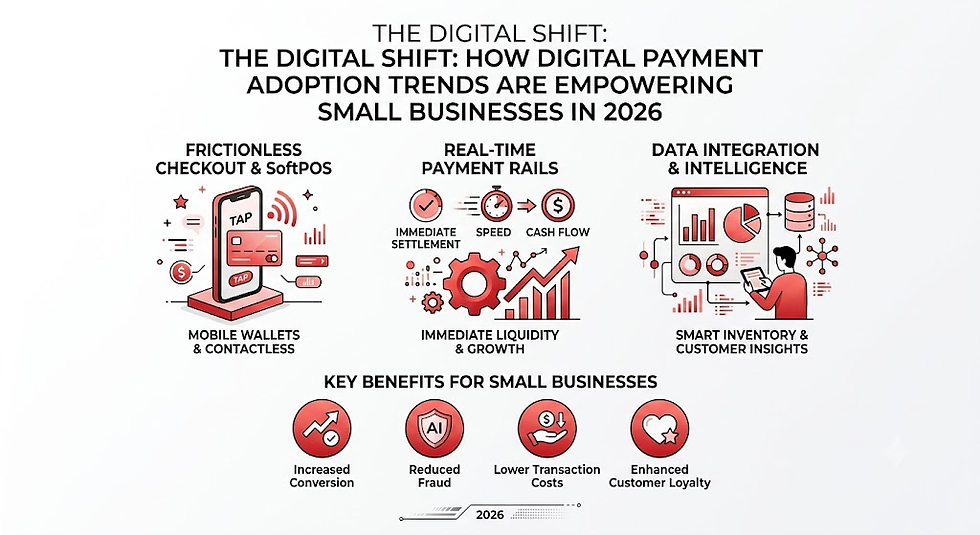
1. The Frictionless Checkout: The Rise of Contactless and SoftPOS
The most visible transformation in small businesses is happening at the point of sale (POS). The physical act of inserting a card and waiting for a chip reader—a process taking anywhere from 8 to 12 seconds—feels remarkably dated. In 2026, over 65% of all in-person card transactions in the United States utilize contactless technology, reducing transaction times to a mere 2 to 3 seconds.
This rapid shift is heavily driven by two parallel technological advancements:
Mobile Wallets: Platforms like Apple Pay, Google Pay, and regional super-apps have moved from secondary payment options to the primary choice for Gen Z and Millennial consumers. More than 45% of global consumers now routinely utilize mobile wallets for daily transactions.
SoftPOS (Tap-to-Pay on Phone): Historically, small businesses had to purchase or lease expensive hardware terminals to accept card payments. SoftPOS technology has democratized this infrastructure. Through secure, tokenized Near Field Communication (NFC) frameworks, merchants can transform any standard consumer smartphone into a PCI-compliant payment terminal without additional hardware.
Global SoftPOS deployments are on track to exceed 34 million by next year. For mobile businesses, independent contractors, and pop-up retailers, this eliminates upfront capital expenses while instantly professionalizing their customer experience.
2. Cash Flow Revolutionized via Real-Time Payment Rails
For a small business, cash flow is oxygen. Traditionally, small businesses accepting credit or debit cards had to endure settlement delays of two to three business days. When a weekend or bank holiday intervened, the gap between making a sale and having usable cash in a bank account widened dangerously.
In 2026, the global expansion of instant account-to-account (A2A) network infrastructure has radically changed this dynamic. Real-time payment systems are shifting the baseline expectation toward immediate liquidity:
Global Standard Networks: Systems like India's Unified Payments Interface (UPI) and Brazil’s Pix have reached near-universal penetration, accounting for 48% and 15% of global real-time transactions respectively.
Domestic Instant Rails: In western markets, infrastructures like the Federal Reserve’s FedNow service and the Clearing House’s Real-Time Payments (RTP) network are enabling small businesses to receive settlements within seconds of a customer tapping their phone, 24 hours a day, 365 days a year.
Immediate settlement eliminates the need for expensive short-term working capital loans or merchant cash advances just to cover inventory or payroll. It gives small business owners an exact, real-time reflection of their financial health at any given second.
3. Data Integration: Turning Transactions into Business Intelligence
When a customer pays with cash, the business gains money, but loses data. They learn nothing about who the customer is, what brought them back, or what else they might buy. The integration of modern digital payment tools changes the payment entry point from a simple collection bucket into an analytics engine.
Modern cloud-based payment gateways automatically tie transactions to inventory management software, customer relationship management (CRM) tools, and accounting platforms. When a sale occurs, inventory tallies update instantly across both physical shelves and online stores, dramatically reducing stockouts or over-purchasing errors.
Furthermore, this rich transaction data allows small businesses to run sophisticated, automated loyalty programs. Instead of handing out physical paper punch cards that customers inevitably lose, the merchant's POS recognizes the encrypted token of the customer’s digital wallet, automatically applying discounts or tracking rewards points. This builds highly personalized customer journeys previously only accessible to corporate enterprises with multi-million dollar IT budgets.
4. Enhanced Security and AI-Driven Fraud Defense
With the rapid expansion of digital commerce comes an inevitable rise in sophisticated cyber threats. The cost of chargeback fraud and payment security leaks can easily cripple an independent retail shop or local restaurant. Fortunately, small businesses in 2026 are highly protected by enterprise-grade security structures built directly into their standard payment processing packages.
Advanced network tokenization ensures that actual card numbers are never transmitted or stored on the merchant’s local hardware. Instead, a randomized, single-use token validates the purchase.
Simultaneously, payment aggregators now deploy real-time Artificial Intelligence (AI) and Machine Learning (ML) fraud management modules directly within the transaction path. These tools scan behavioral patterns, device fingerprinting, and risk parameters instantly. By predicting and neutralizing fraudulent charges before they clear, these built-in systems save merchants thousands of dollars annually in unnecessary chargeback fees and lost inventory.
5. Analyzing Macro Digital Payment Adoption Trends
To paint a clear picture of how consumer habits have permanently pivoted, let's look at the distribution of dominant payment styles across global physical retail verticals as observed mid-way through 2026.
Payment Method | Small Retail & E-Commerce Share | Key Competitive Benefit | Typical Settlement Time |
Mobile Wallets & NFC | 54.8% | Hyper-fast checkout (2-3 seconds), maximum device security | 1 - 2 Business Days |
Real-Time Rails (A2A / QR) | 28.2% | Zero interchange fee overhead, instant liquidity | Immediate (< 10 seconds) |
Traditional Plastic Cards | 12.0% | Deeply entrenched user habits, cross-demographic trust | 2 - 3 Business Days |
Physical Cash | 5.0% | Complete anonymity, offline capability | Instant (requires physical deposit) |
Operational Insight: Merchants who build flexible, multi-rail acceptance infrastructure—allowing users to pay via tap, QR scan, or digital wallet—see an average conversion rate increase of 15-20% over competitors tied exclusively to older legacy card readers.
Dedicated Frequently Asked Questions (FAQ)
How do modern digital payment adoption trends benefit micro-merchants without storefronts?
The modern evolution of digital payment adoption trends has completely decoupled payment processing from physical infrastructure. Through SoftPOS technology, independent contractors, delivery networks, and mobile market vendors can accept secure card and mobile wallet payments directly on their personal mobile devices. This eliminates the requirement to lease proprietary card hardware, lowers operational overhead, and ensures they can capture spontaneous sales anywhere without needing cash registers.
Is physical cash completely disappearing for small businesses in 2026?
While physical cash usage has hit an all-time low of roughly 5% in standard retail environments, it is not completely extinct. Rather, it has shifted from a primary transaction tool to a legacy alternative. Most modern consumers prefer phone-based or contactless options due to convenience, leaving cash primary only in specific micro-transactions or areas experiencing periodic internet infrastructure gaps.
What are interchange fees, and how can small businesses minimize them?
Interchange fees are the processing costs charged by card networks and banks to handle digital transactions. Small businesses can mitigate these costs by integrating account-to-account (A2A) real-time payment options or QR code payments. These networks bypass traditional card clearing houses entirely, routing funds directly from the buyer's bank account to the merchant's account at a fraction of the cost.
How secure are mobile wallet payments compared to magnetic stripe cards?
Mobile wallet payments are exponentially more secure than traditional magnetic stripe cards. Magnetic stripes hold static data that can easily be copied via skimming devices. Mobile wallets utilize advanced biometric authentication (such as facial recognition or fingerprint verification) along with dynamic tokenization, meaning the real card data is never revealed to the merchant or transmitted over the airwaves.
Elevate Your Business Infrastructure
Transitioning your business to align with these macroeconomic payment transformations requires the right partners and scalable tools. If you are ready to modernize your payment infrastructure, explore standard compliance toolkits through the PCI Security Standards Council to understand the latest data safety requirements. For detailed updates on economic payment architectures, review the updates provided by the Federal Reserve Financial Services regarding real-time clearing systems. Embracing a modern transaction system ensures your small business remains fast, secure, and ready for future growth.
The traditional cash register, once the noisy heartbeat of main street commerce, has gone quiet. In its place sits a sleek, silent piece of glass or a smartphone tethered to the cloud. We are living in 2026, and the commerce ecosystem has crossed a major threshold. The global digital payment market has officially surged to an estimated $171.85 billion this year, driven by a compound annual growth rate (CAGR) exceeding 22%.


Comments