Earth's Fastest-Spinning Days Explained: Why Scientists Are Monitoring Changes in Earth's Rotation Speed
- Jul 24
- 7 min read
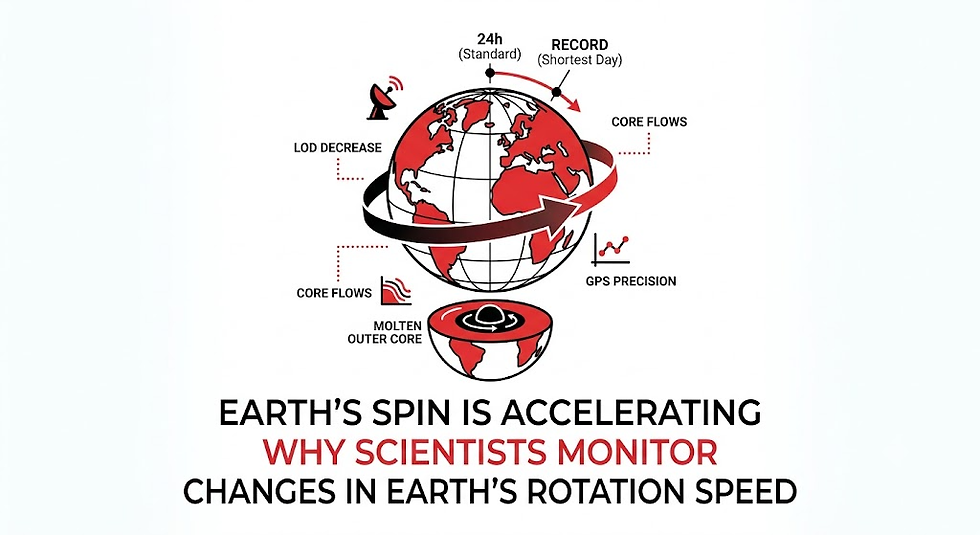
When you check your phone or watch, you take it for granted that a day lasts exactly 24 hours—or 86,400 seconds. For most of human history, that assumption was close enough to truth. However, high-precision atomic timekeeping has revealed a surprising reality: Earth does not spin on a rigid schedule. Over the past few years, our planet has registered some of the fastest rotations in recorded history, shaving crucial milliseconds off the standard 24-hour cycle.
Why is our planet speeding up, how do scientists measure these planetary accelerations, and why are global tech giants and geophysicists watching these numbers so closely? Below is a comprehensive look into the physics behind our planet's erratic spin, the recent record-breaking days, and the far-reaching technological implications for our synchronized modern world.
Measuring Planetary Motion: What Is Length of Day (LOD)?
To understand changes in planetary spin, scientists rely on a metric known as Length of Day (LOD).
In astronomical terms, one full rotation of Earth relative to the Sun averages approximately 86,400 seconds. LOD represents the precise difference—measured in milliseconds—between Earth's actual rotational period on a given date and that standardized 86,400-second baseline.
Positive LOD: Earth is spinning slower than average, making the day slightly longer than 86,400 seconds.
Negative LOD: Earth is spinning faster than average, completing its turn in fewer than 86,400 seconds.
For decades following the introduction of atomic clocks in 1955, Earth's spin was steadily slowing down. The primary culprit was lunar tidal friction—the gravitational tug of the Moon dragging against Earth's oceans, acting as a gentle planetary brake. To keep human atomic time (Coordinated Universal Time, or UTC) in alignment with astronomical time (UT1), international timekeepers periodically added "leap seconds" to our clocks.
However, around 2020, that long-standing pattern experienced a sudden and dramatic shift.
The Recent Surge in Earth's Rotation Speed
In 2020, scientists at the International Earth Rotation and Reference Systems Service (IERS) recorded 28 of the shortest days since atomic tracking began. Rather than slowing down, the planet began turning faster.
The trend reached new peaks over subsequent summers:
June 29, 2022: Earth completed its rotation 1.59 milliseconds short of 24 hours, setting a new record for the shortest single day in the atomic clock era.
July 2025 Accelerations: A series of ultra-fast turns occurred in mid-2025, with July 9–10 clocking in at approximately 1.36 to 1.37 milliseconds short.
2026 Observations: Data monitored by geodesists shows that while Earth's peak velocity cycle may be rounding a curve, day lengths remain overall shorter than historic 20th-century averages. The shortest days of 2026 are hovering around -0.65 to -0.70 milliseconds.
Key Takeaway: A fraction of a millisecond is invisible to human perception—an eye blink takes roughly 100 milliseconds. Yet in telecommunications, satellite navigation, and global computing, a single millisecond represents an immense span of time.
What Determines Earth's Rotation Speed?
Planetary rotation is not governed by a single mechanism. Instead, Earth behaves like a giant, flexible system made of a solid crust, a fluid ocean, a churning atmosphere, and a molten metallic core. Changes in Earth's rotation speed are driven by a dynamic exchange of momentum between these layers.
1. Dynamics of Earth’s Molten Core
Deep beneath the mantle lies Earth’s liquid outer core and solid inner core. Seismological studies show that fluid motions and electromagnetic couplings in the outer core fluctuate over multi-year cycles.
Because total angular momentum across the planet must remain conserved, if the inner core or liquid core slows down slightly, the solid mantle and surface crust must speed up to compensate. Geophysical research suggests core-mantle interactions are a primary engine behind multi-year accelerations.
2. Lunar Orbit and Declination
While the Moon’s gravity exerts a long-term braking effect on Earth via ocean tides, its short-term orbital geometry creates monthly fluctuations.
When the Moon moves to higher northern or southern latitudes away from Earth's equator (high declination), its gravitational torque on the equatorial bulge changes. This temporary redistribution of mass enables Earth to spin a fraction of a millisecond faster during specific orbital alignments.
3. Atmospheric Winds and Seasonal Jet Streams
The atmosphere and the solid planet continually swap angular momentum. During Northern Hemisphere summer, atmospheric circulation patterns and jet streams weaken or shift position.
When atmospheric rotation slows down, Earth's solid surface speeds up to maintain momentum equilibrium. This explains why record-breaking fast days frequently cluster during mid-year summer months.
4. Climate Change and Polar Ice Melt
Climate change introduces a fascinating counter-weight to these speedups. As global temperatures rise, massive ice sheets in Greenland and Antarctica melt. This meltwater drains from the poles into the global ocean, concentrating more mass near the equator.
Think of a spinning figure skater:
When the skater pulls their arms inward, they spin faster.
When they extend their arms outward, their spin slows down.
By transferring mass from high polar latitudes toward the equatorial midsection, melting polar ice actually acts as a planetary brake, slowing Earth's rotation speed. Geophysical modeling indicates that without accelerated polar melting over recent decades, Earth might have hit fast-spin thresholds even sooner.
Summary of Factors Influencing Earth's Spin
Factor | Primary Mechanism | Effect on Spin Speed | Time Horizon |
Lunar Tidal Friction | Gravitational drag on oceans | Slows down | Long-term (millennia) |
Core Dynamics | Momentum transfer between core and mantle | Speeds up / Slows down | Decadal / Multi-year |
Jet Streams & Atmosphere | Seasonal wind momentum exchange | Seasonal variation | Short-term (daily/monthly) |
Lunar Declination | Changing angle of lunar gravitational pull | Temporary speedup | Bi-weekly / Monthly |
Polar Ice Melting | Mass redistribution from poles to equator | Slows down | Decadal (climate scale) |
Why Scientists and Tech Leaders Are Concerned
Why does a missing millisecond matter so much? In daily personal life, a 1.5-millisecond deficit is completely unnoticeable. But modern society relies on ultra-precise timing systems that demand absolute synchronization down to the nanosecond.
+-----------------------------------------------------------------------+
|                       THE TIMING SYNCHRONIZATION                      |
|                                                                       |
|   Atomic Clocks (UTC)                Earth's Physical Spin (UT1)      |
|   Standardized, ultra-precise  <---> Variable length of solar day     |
|   (Gains/loses 1 sec per 100M yrs)   (Fluctuates by milliseconds)    |
+-----------------------------------------------------------------------+
GPS Navigation and Aerospace
Global Positioning System (GPS) satellites calculate location by measuring the exact microsecond time delay of signals sent to ground receivers. If ground clocks and orbital clocks drift out of alignment without proper mathematical correction, positioning calculations can accumulate errors measuring hundreds of meters.
Telecommunications and Financial Markets
High-frequency financial trading platforms process thousands of transactions per millisecond. Data packets traveling through global optical fiber networks require microsecond-level synchronization. When server networks encounter unexpected time adjustments, database logs can suffer corruptions or timing conflicts.
The Problem with the "Negative Leap Second"
Since 1972, timekeepers have added 27 positive leap seconds to UTC to allow atomic clocks to wait for Earth's slower rotation. However, if Earth continues to spin faster over sustained periods, timekeepers may be forced to implement a negative leap second—skipping a second entirely (going directly from 23:59:58 to 00:00:00).
Positive Leap Second (Adding a second):
23:59:58  --->  23:59:59  --->  23:59:60  --->  00:00:00

Negative Leap Second (Skipping a second):
23:59:58  ------------------------------------>  00:00:00
Major technology platforms (including Meta, Google, Amazon, and Microsoft) have strongly voiced concerns regarding leap seconds. Software systems, database timers, and operating system schedulers are almost universally designed to handle continuous sequential time. A negative leap second has never been executed in human history. Computer scientists warn that skipping a second could trigger widespread software crashes, outages, and logic errors in automated infrastructure.
Due to these technical risks, the International Bureau of Weights and Measures (BIPM) voted to abolish or increase tolerances for leap seconds by 2035, giving timekeepers and tech platforms time to adopt smoother synchronization methods.
What Lies Ahead for Earth's Rotation?
Are short days here to stay? Geophysical data indicates that while Earth experienced an extraordinary decade of high rotational speeds, natural decadal cycles are shifting once again.
Models from the International Earth Rotation and Reference Systems Service suggest that while day lengths remain shorter than historical norms, overall acceleration may be plateauing as atmospheric conditions, lunar orbits, and core dynamics rebalance.
Geophysicists will continue using satellite geodesy, Very Long Baseline Interferometry (VLBI), and atomic clock arrays to track every fractional fluctuation in our planet's rotation. As our technological world demands higher precision, understanding the heartbeat of our planet remains as essential as ever.
Frequently Asked Questions (FAQ)
What causes variations in Earth's rotation speed?
Changes in Earth's rotation speed are driven by a combination of factors, including gravitational interactions with the Moon, seasonal wind patterns, fluid movement within Earth's molten core, and the redistribution of ocean and ice mass across the surface.
What was the shortest day ever recorded on Earth?
The shortest day recorded in the atomic clock era occurred on June 29, 2022, when Earth completed its rotation 1.59 milliseconds faster than the standard 24-hour (86,400-second) baseline. Subsequent short days were also recorded in July 2025 (-1.37 milliseconds).
Does a faster rotation mean days will keep getting shorter?
Not necessarily. While Earth experienced a notable acceleration burst between 2020 and 2025, long-term trends fluctuate. Over millennial timescales, ocean tides caused by the Moon gradually slow the planet down, even though short-term internal dynamics can make it speed up for years at a time.
How does climate change affect how fast Earth spins?
Melting polar glaciers transfer water from the Arctic and Antarctic toward the equator. This shift of mass broadens Earth's midsection, creating a braking effect that slightly slows down planetary rotation—similar to a spinning skater spreading their arms.
What is a negative leap second, and will we need one?
A negative leap second occurs when timekeepers remove one second from international atomic clocks to align them with a faster-spinning Earth. If Earth's elevated rotational pace continues, a negative leap second may be considered, though global timing bodies plan to eliminate leap seconds by 2035 to protect digital infrastructure.
Stay Ahead of Global Earth Science Trends
Understanding our changing planet requires tracking the latest developments in geodesy, physics, and atmospheric science. Explore these official resources to monitor planetary data and timekeeping standards in real time:
Check live astronomical time tracking and day-length data directly at the International Earth Rotation and Reference Systems Service (IERS).
Learn about atomic timekeeping standards and leap second policy updates from the National Institute of Standards and Technology (NIST).
Discover how planetary mass distribution is monitored using space geodesy at NASA Earth Science Data Systems.
Have thoughts or questions about Earth's changing spin? Share your perspective in the comments below or join the scientific discussion on social media!



Comments