Earthbound Astronauts: How to Apply for NASA’s Next Simulated Moon and Mars Mission
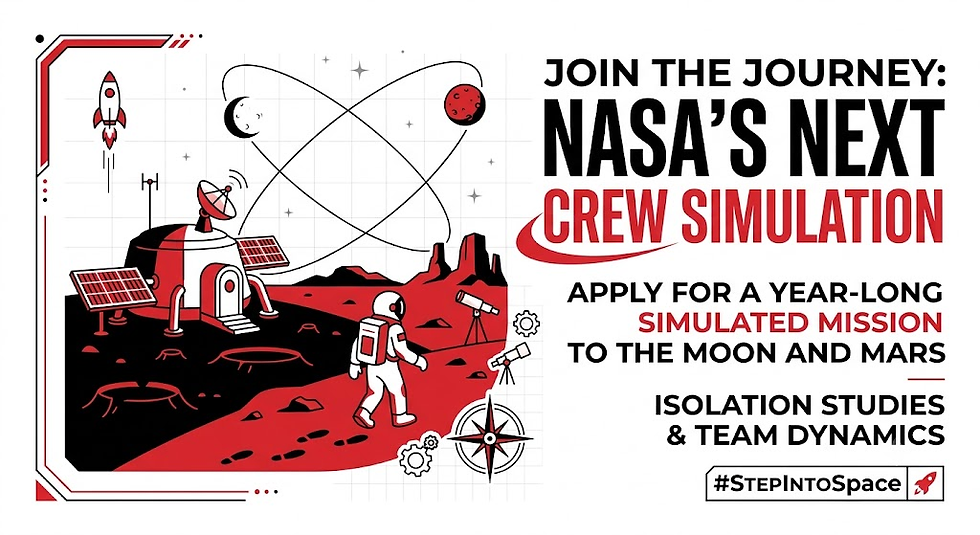
Imagine stepping into a sealed environment, leaving behind your friends, family, and the comfort of the open air for an entire year. For twelve months, your universe shrinks to the confines of specialized, high-tech habitats. Your communications with the outside world face a grueling 22-minute delay, mimicking the vast distances of deep space. Your daily routine consists of scientific research, system maintenance, crop cultivation, and tightly managed resources.
This isn't a sci-fi premise—it is NASA's newly announced Moon and Mars Exploration Analog (MMEA) campaign.
In July 2026, NASA officially opened applications for its inaugural MMEA mission, a groundbreaking ground-based experiment set to begin no earlier than August 2027 at the Johnson Space Center in Houston, Texas. For those who have dreamed of contributing to humanity's next giant leap without actually leaving Earth's gravity, this is a historic, potentially paid opportunity.
This guide breaks down everything you need to know about this revolutionary year-long campaign, what the space agency is looking for in its test subjects, and exactly how to apply.
What is the Moon and Mars Exploration Analog (MMEA)?
For years, NASA has relied on isolated, confined environments to prepare humans for deep space travel. Historically, these took the form of distinct programs. The Human Exploration Research Analog (HERA) focused heavily on isolation, team dynamics, and the psychological strain of confined transit spaces. Meanwhile, the Crew Health and Performance Exploration Analog (CHAPEA)—which enters its final stages of Mission 2 in mid-2026—focused on planetary surface operations inside a highly realistic 3D-printed Mars habitat.
The newly unveiled MMEA campaign represents an ambitious evolution in space exploration analogs. Instead of keeping transit and surface operations separate, the MMEA integrates both phases into a single, seamless, 14-month campaign (consisting of 12 months inside the habitats and two months of intensive pre- and post-mission training).
The Two-Phase Habitat Experience
Selected crew members will experience the full narrative arc of an interplanetary mission:
The Transit Phase: For the first portion of the simulation, the four-person crew will live inside a multi-story, hyper-confined structure that mimics a deep-space transit vehicle. This simulates the months-long journey across the void between Earth and its celestial targets. Space is tight, privacy is minimal, and the psychological reliance on your crewmates is absolute.
The Surface Phase: Upon "arrival," the crew will transition into a sprawling, 1,700-square-foot, 3D-printed surface habitat. This environment simulates living on a lunar base or a Martian colony. It features private crew quarters, a communal living area, medical rooms, dedicated workstations, crop cultivation zones, and a massive enclosed "sandbox" filled with red soil to replicate dangerous planetary extravehicular activities (EVAs).
By combining these two distinct environments, NASA researchers can study how a single crew adapts across the entire timeline of a deep space voyage. This includes the psychological shifting points between the monotony of deep-space cruise phases and the intense, high-tempo demands of surface exploration.
What Is NASA Looking For? The Ideal Candidate Profile
The selection process for this simulated Moon and Mars mission is remarkably strict, intentionally mirroring the rigorous criteria used to select official NASA astronauts. The agency isn't simply looking for people who can handle being lonely; they are seeking highly qualified, resilient professionals capable of executing scientific objectives under extreme stress.
Basic Eligibility Criteria
To even be considered for the selection pool, applicants must fulfill several mandatory requirements:
Citizenship: You must be a United States citizen or a permanent resident (green card holder).
Age Range: Candidates must be between 30 and 55 years old. This range aligns with the average age of active astronauts, ensuring that data gathered represents the exact demographics heading to space in the 2030s.
Physical Dimensions: Applicants can be no taller than 74 inches (6 feet 2 inches). The physical layouts of the transit and surface modules feature strict volume constraints; excess height presents ergonomic and safety issues.
Language Skills: Absolute fluency and proficiency in English are required for flawless communication and data recording.
Time Commitment: You must legally consent to a 14-month timeline, encompassing 12 months of total isolation and two combined months of rigorous baseline physical testing, psychological evaluations, and post-mission debriefs.
Academic and Professional Background
NASA places a heavy emphasis on the quality of your academic and professional preparation. Because the crew must operate autonomously, individuals with strong backgrounds in Science, Technology, Engineering, and Mathematics (STEM) are highly preferred.
Advanced Degrees: A Master’s degree in a STEM field is the baseline preference. However, higher academic accolades can directly substitute for required professional experience. For instance, a Master’s degree counts as one year of professional experience, while a completed Doctoral degree (PhD) counts as three years.
Professional Experience: Candidates should ideally possess several years of professional experience in engineering, biological sciences, physical sciences, computer science, or mathematics.
Alternative Pathways: NASA also highly values military experience. Serving as a military officer or possessing extensive test-piloting credentials can serve as an equivalent substitute for traditional civilian STEM pathways.
Cracking the Psychological Code: The Traits That Matter Most
While an impressive resume gets you through the initial automated filters, your psychological makeup determines whether you survive the multi-day selection camp at Johnson Space Center. Living with only three other individuals for 378 days requires unique behavioral traits.
Emotional Stability and Self-Regulation
In an isolated environment, small annoyances can mutate into major conflicts. NASA psychologists look for individuals with high emotional intelligence who can self-regulate their frustrations. If an equipment breakdown occurs, or if a communications delay makes solving a critical problem frustratingly slow, a test subject must maintain composure.
"Expeditionary Skills"
Borrowed from the world of extreme mountaineering and wilderness survival, expeditionary skills are the cornerstone of effective crew dynamics. These include:
Followership: The ability to accept direction gracefully, support the designated crew commander, and put the safety of the collective habitat ahead of individual ego.
Communication: Expressing needs clearly and resolving interpersonal conflicts before they fester into systemic tribalism inside the habitat.
Self-Care and Group Care: Monitoring your own mental wellness while remaining observant of your crewmates' physical and emotional shifts.
Step-by-Step: How to Apply for NASA's Newest Simulation
If you meet the physical, academic, and psychological benchmarks, the application process requires a dedicated, structured approach. Because openings are limited to just four primary crew members and a small handful of alternates, attention to detail is paramount.
Step 1: Online Screening and Application Submission
Your journey begins at the official NASA Analogs Screening portal. You will need to build an exhaustive profile detailing your academic credentials, employment history, and physical medical baseline. Be prepared to submit official university transcripts and verifiable professional references.
Step 2: In-Depth Medical and Psychological Screening
Candidates who survive the resume audit undergo a battery of physical exams and psychological tests. These mirror the FAA Class III physical standards required for commercial pilots. You will be screened for underlying cardiovascular issues, metabolic imbalances, and bone density metrics. Simultaneously, psychiatric evaluations will ensure you possess no predispositions to claustrophobia, severe depression, or anxiety under confinement.
Step 3: Multi-Day Selection Evaluation
The final tier of applicants is invited to NASA’s Johnson Space Center for a multi-day group evaluation. Here, selectors place you in micro-simulations alongside other candidates. You will tackle complex engineering problems, manage simulated emergencies, and perform tasks under sleep deprivation. Selectors watch from behind the scenes, tracking who steps up, who listens, and who fractures under operational friction.
Why Is This Simulated Moon and Mars Mission So Critical for 2026?
As of 2026, the Artemis program is rapidly moving from theoretical planning to operational reality. With the success of recent test flights and the countdown ticking down toward sustained operations at the Lunar Moon Base, NASA can no longer afford to guess how the human body and mind react to long-duration deep space voyages.
The data gathered during the upcoming MMEA campaign will directly influence:
Habitat Architecture: Validating whether 3D-printed structures provide the acoustic, spatial, and psychological comforts required to keep human beings sane over multi-year deployments.
Nutritional Strategy: Testing space-permissible diets and indoor crop cultivation setups to figure out if crews can grow enough caloric assets to offset resource constraints.
Medical Autonomy Protocols: Developing software and training protocols that allow non-doctors to perform complex medical procedures when real-time advice from Earth is delayed by over twenty minutes.
Frequently Asked Questions (FAQs)
What is the primary purpose of a simulated Moon and Mars mission?
The fundamental objective of a simulated Moon and Mars mission is to study human health, team dynamics, and behavioral performance under the realistic resource constraints, communication delays, and extreme isolation characteristic of deep space travel. The data helps NASA validate hardware and design protocols to ensure future astronauts remain safe and mission-ready.
Do participants get paid for the year-long simulation?
Yes, NASA provides financial reimbursement for all research volunteers selected for the MMEA campaign. The exact compensation details are disclosed to candidates during the final stages of the selection process and vary based on the specific duration and parameters of the baseline data collection periods.
Can non-US citizens apply for this specific simulation?
No. To qualify for the newly announced Moon and Mars Exploration Analog, applicants must be either United States citizens or hold a valid permanent residency status (Green Card). This is due to strict security clearances and protocol access requirements at the Johnson Space Center.
The Times of India
Are You Ready to Apply? Take the Leap Today
Humanity's expansion into the solar system isn't just built on rocket fuel—it is built on hard data. By stepping forward to volunteer your time, your mind, and your body to science, you can directly shape the future of deep space colonization.
If you have the STEM credentials, the psychological resilience, and the burning desire to push the boundaries of human potential, don't let this historic opportunity pass you by.
Explore the official application requirements, review the medical eligibility paperwork, and submit your profile directly to NASA’s recruitment team through the verified portals below:
Submit Your Application Portal: NASA MMEA Official Screening Site
Explore All Active Analog Programs: NASA Johnson Space Center Analogs Recruiting
Inquiries and Support: Contact the screening panel directly at jsc-analog-application@mail.nasa.gov



Comments