Empowering the Frontline: Why Indian Railways May Give More Powers to Station Masters
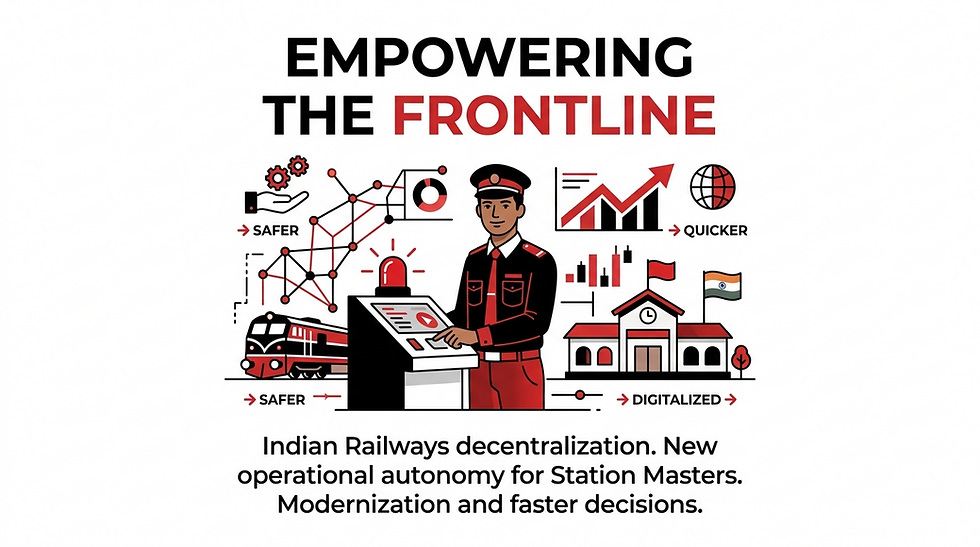
The heartbeat of India’s massive transport infrastructure is undergoing a tectonic shift. As one of the world's largest rail networks transitions into a high-speed, digitally-driven era, the Ministry of Railways is re-evaluating its foundational governance structures. In a landmark high-level review, Union Railway Minister Ashwini Vaishnaw laid out a comprehensive blueprint targeting operational bottlenecks. The standout strategy? Indian Railways plans to give more powers to Station Masters to ensure safer, highly agile, and passenger-centric operations.
For decades, the Station Master was viewed primarily as an operational cog responsible for signaling and local coordination. However, by 2026, exponential traffic growth, multi-track corridors, and the rollout of advanced high-density networks have pushed traditional centralized administration to its limits. Turning stations into self-sustaining hubs of quick decision-making is no longer an option—it is an operational necessity.
Understanding the Shift: Why Station Decentralization Matters
At its core, the proposal to give more powers to Station Masters represents a shift from a rigid bureaucracy to frontline autonomy. Station Masters are responsible for coordinating multiple technical departments (signals, tracks, commercial, and security) while simultaneously managing immediate passenger grievances and local railway colonies.
Historically, even minor structural repairs or localized logistics issues required approvals from divisional headquarters. This delayed response times and deflated consumer satisfaction.
By decentralizing administrative and financial control, Indian Railways is empowering ground-level executives to resolve issues in real-time. For business leaders, supply chain professionals, and transport analysts, this structural reform means fewer operational delays, faster bottleneck clearances, and an overall optimization of the logistical grid.
Key Trends and Developments in 2026
The decision to restructure ground-level roles comes on the heels of the recent Railway Board Circular (RBE No: 32/2026), which revised designation structures across the cadre. This designated Group 'C' Station Superintendents as Station Managers and Deputy Station Managers.
This change matches key tactical changes made during the latest ministry sessions:
1. Enhanced Financial Autonomy
Station Masters will receive expanded financial limits for local procurement and emergency maintenance. Instead of waiting for divisional funds to repair a failing passenger amenity or a minor infrastructural asset, the station management can deploy resources immediately.
2. High-Density Multi-Track Allocation
With traffic complexity scaling up across high-density corridors, the Ministry has prioritized allocating additional Station Masters to multi-track sections. This shares the heavy workload and ensures that safety-critical duties are never compromised by commercial tasks.
3. Integrated Station Management System (SMS) & Paperless Apps
To eliminate bureaucratic delay, Indian Railways is testing a mobile app-based paperless system alongside an integrated Station Management System. This digital framework links all on-site departments directly to the Station Master's dashboard, automating communication and expediting passenger dispute resolutions.
4. Advanced Training via VR and Simulators
As train operations grow complex with the deployment of Kavach safety systems and semi-high-speed rails, training methodologies are getting an upgrade. The 2026 framework mandates the integration of Virtual Reality (VR) modules and high-fidelity simulators to prepare frontline staff for high-stress emergency scenarios.
Benefits, Challenges, and Strategic Opportunities
Key Benefits
Rapid Micro-Decision Making: Eliminates administrative delays by allowing the local station authority to sign off on immediate operational and structural needs.
Enhanced Passenger Satisfaction: Direct financial and administrative leverage translates to functional water facilities, cleaner platforms, and swift grievance redressal.
Safety Optimization: Relieving Station Masters from extraneous commercial tasks allows absolute focus on track safety and signal integrity.
Major Challenges
The Burden of Dual Responsibilities: As highlighted by recent railway labor union alerts, pushing Station Masters to handle commercial ticket sales alongside complex track signaling can increase cognitive load and risk safety.
Upskilling Inertia: Transitioning an old workforce to digital, paperless apps and VR-based tools requires massive training drives.
Risk of Disparate Management: Without clear guidelines, financial decentralization could lead to inconsistent standards of station management across different zones.
Strategic Opportunities
Inclusive Workforce Design: With a growing number of women Station Masters and women Pointsmen entering active field operations, Indian Railways is redesigning stations with targeted safety equipment and user-friendly field tools.
Avenues for Executive Growth: The 2026 reform creates clearer pathways for Station Masters to move directly into senior management and leadership tiers, building a stronger corporate talent pipeline within the civil service.
Comparative Analysis: Traditional vs. Empowered Framework
Operational Parameter | Traditional Railway Framework | The 2026 Empowered Framework |
Financial Authority | Dependent on Divisional HQ approvals for minor expenses. | Delegated financial budgets for local repairs. |
Workflow System | Heavy, manual logbooks and physical paper coordination. | Mobile app-based paperless systems and Integrated SMS. |
Staffing & Workload | Single Station Master handling multi-track density and ticketing. | Multi-person allocation in high-density corridors. |
Safety Training | Classroom-based lectures and static instruction books. | Simulator-driven and Virtual Reality (VR) environments. |
Practical Recommendations for Rail Management and Industry Leaders
To successfully implement this policy shift, stakeholders across the logistics and public sectors should adopt the following best practices:
Enforce Strict Functional Separation: Ensure that operational safety tasks (signaling, track changes) and commercial duties (passenger ticketing) are handled by separate personnel. Do not combine these roles under a single Station Master.
Deploy Phased Digital Onboarding: Introduce the paperless application suite in stages. Run parallel runs alongside legacy systems to keep operations smooth while the workforce adapts.
Establish Clear Auditing Guardrails: While increasing local financial powers, deploy automated, algorithmic auditing tools within the integrated Station Management System to track expenditures without adding bureaucratic delays.
Prioritize Ergonomic and Inclusive Field Tools: Ensure that safety equipment, portable communications tools, and station layouts account for an increasingly diverse workforce, including women operational staff.
Frequently Asked Questions (FAQ)
Q1: Why does Indian Railways want to give more powers to Station Masters?
A1: Indian Railways aims to give more powers to Station Masters to decentralize decision-making, remove bureaucratic delays, and improve passenger service delivery. Empowering frontline staff lets stations resolve local operational, maintenance, and administrative issues instantly without waiting for divisional approvals.
Q2: What financial changes are being proposed for Station Masters in 2026?
A2: The 2026 proposals focus on enhancing the local financial allocation of Station Masters. This allows them to independently fund immediate maintenance work, fix passenger infrastructure issues, and manage emergency station requirements.
Q3: How is technology being integrated into the Station Master's role?
A3: The modernization roadmap includes introducing mobile app-based paperless working systems and an integrated Station Management System. Furthermore, training programs are introducing Virtual Reality (VR) and advanced simulators to prepare staff for complex operational scenarios.
Q4: What safety concerns have railway labor unions raised regarding this transition?
A4: Unions have voiced concerns that in some smaller stations, Station Masters are being asked to handle commercial Passenger Reservation System (PRS) ticket bookings alongside safety-critical signaling duties. They argue that this dual pressure can compromise safety on high-density lines.
Q5: How will this reform impact career progression within Indian Railways?
A5: The proposed framework intentionally addresses career stagnation by creating structured avenues for Station Masters to rise into higher-level management and leadership roles within the national transporter's corporate hierarchy.
Q6: How does the plan accommodate the rising number of women in operational roles?
A6: The review explicitly mandates the deployment of user-friendly operational tools and enhanced safety equipment at stations to support the growing number of women Station Masters and women Pointsmen.
Conclusion
The initiative to give more powers to Station Masters marks a crucial evolution in how Indian Railways manages its massive network. By trusting its frontline leaders with administrative autonomy, financial flexibility, and modern digital tools, the national transporter is laying the groundwork for a agile, responsive, and future-proof transit ecosystem. Balancing these new responsibilities with strict safety guidelines will be key to unlocking a safer, more efficient era for Indian rail.
Further Insights on Railway Reforms
To learn more about structural reforms, infrastructure modernizations, and official press announcements, explore the following resources:
Review the official policy updates and minister briefings via the Press Information Bureau (PIB).
Track ongoing administrative directives, structural modifications, and cadre circulars on the official Ministry of Railways Portal.
Examine long-term macro trends and connectivity project developments published by DD News India.

Comments