Escalation of the Israel-Iran War: What’s Happening, Why It Matters, and Global Implications.
- Mar 4
- 5 min read
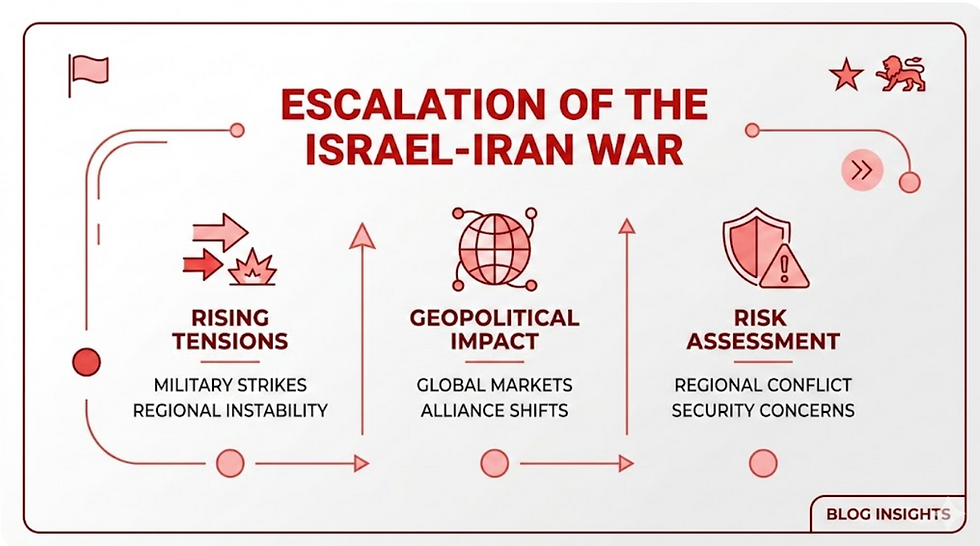
The conflict between Israel and Iran has rapidly escalated into one of the most serious geopolitical crises in recent years. What began with targeted military action has spread into a broader regional confrontation involving proxy forces, multiple theatres of conflict, economic disruptions, and international diplomatic turmoil.
This guide explains:
The recent escalation and triggers
How the conflict broadened beyond Israel and Iran
Key military developments
Regional and global impacts
Possible pathways forward
The situation continues to evolve rapidly, with new developments almost daily. Here’s a detailed breakdown.
Escalation of the Israel–Iran War (2026)
Aspect | Key Development | Why It Matters |
Initial Trigger | US–Israel strikes inside Iran | Marked a major expansion of direct conflict |
Targeted Killing | Assassination of Iran’s Supreme Leader Ali Khamenei | Sharp escalation and retaliation drivers |
Regional Spread | Militias and proxies like Hezbollah engaged | Broadens conflict scope |
Strategic Routes | Strait of Hormuz effectively closed | Disrupts global energy supply |
Global Reaction | Condemnations, diplomatic pressure | Influences international response |
Broader War Risk | US military actively involved | Raises fears of wider war |
What Triggered the Escalation?
The most recent phase of the Israel–Iran war escalated sharply in late February 2026 due to coordinated military action by Israel – with U.S. support – against strategic targets inside Iran. This campaign, widely referred to as Operation Lion’s
Roar or Operation Epic Fury in media reporting, involved airstrikes against:
Iranian military command centers
Nuclear program facilities
Leadership targets including Iran’s Supreme Leader, Ali Khamenei
The assassination of Khamenei marked a dramatic turning point, eliminating Iran’s highest-ranking political and religious figure and provoking immediate and severe retaliation from Tehran and its allied militias.
Iran responded with missile and drone strikes targeting:
Israeli territory
Military and diplomatic assets across the Gulf region
U.S. bases in countries like Kuwait, Qatar, and the UAE
This exchange has turned what might have been a contained conflict into a rapidly expanding regional war.
Regional Broadening: From Border Skirmishes to
Multi-Front Engagement
The Israel–Iran conflict is no longer limited to direct hostilities between those two states. It has spread into multiple theatres:
1. Lebanon and Hezbollah Involvement
Iran’s key ally Hezbollah has launched rocket and drone attacks on northern Israel, prompting major Israeli airstrikes across southern Lebanon. Civilians have been killed, infrastructure destroyed, and hundreds of thousands displaced.
This marks the most significant escalation between Israel and Hezbollah in years, and threatens to pull Lebanon more deeply into the conflict.
2. Missile Exchanges and Proxy Engagements
Iran has demonstrated long-range capabilities, launching missiles and drones into Israeli territory and across the Arabian Peninsula. Several Gulf states have reported intercepted missiles and drone attacks, and the conflict has threatened U.S. diplomatic compounds and military bases.
3. Strategic Routes and Shipping Disruptions
The Strait of Hormuz has been effectively closed by Iran’s Islamic Revolutionary Guard Corps (IRGC), disrupting one of the most vital global energy transit points.
This move has immediate implications for:
Crude oil and LNG shipments
Global supply chains
Energy price volatility
The closure underscores how military escalation now directly threatens international commerce.
Why This Escalation Is Different
This conflict differs from previous flare-ups in several key ways:
1. Leadership Assassination
Targeted killing of a sitting supreme leader is rare and intensifies retaliatory incentives. The death of Khamenei was widely reported and confirmed as part of the joint U.S.–Israel operation.
2. Wider U.S. Involvement
Unlike previous regional conflicts, the United States is openly participating in military operations, signaling a strategic shift and complicating diplomatic pressures.
3. Multi-Dimensional Conflict
The war includes:
Kinetic military strikes
Cyber operations
Proxy engagements
Strategic economic measures
This multi-domain escalation raises the stakes beyond a conventional border conflict.
International Reactions and Global Diplomatic Pressure
World leaders have reacted with a mix of condemnation, caution, and calls for de-escalation:
Many countries in the Global South have condemned the U.S.–Israeli actions as violations of international law, accusing Western powers of imperialism and unilateral military behaviour.
Some Western allies have urged restraint to avoid broader war, while others are pushing for negotiated pauses.
The United Nations has held emergency sessions to address the conflict’s implications for peace and security.
The diplomatic landscape is fragmented, with some nations calling for immediate ceasefires and others backing the security arguments for military action.
Human & Economic Costs
Human Toll
Hundreds killed in Iran due to strikes and bombardments.
Civilians in Lebanon and northern Israel have died or been injured amid bombardments and missile exchanges.
U.S. military personnel have also suffered casualties.
Economic Impact
The closure of the Strait of Hormuz and disrupted shipping flows have triggered:
Surge in oil prices globally
Interruption to energy markets
Elevated freight and insurance costs
Pressure on inflation in importing economies such as India and others in Asia and Europe
These economic shocks add another layer of complexity and urgency to diplomatic efforts.
Possible Scenarios Moving Forward
1. Continued Escalation
Without diplomatic intervention, the conflict could tilt toward:
Wider regional war
More active engagements by militias and state actors
Increased proxy battles in Iraq, Syria, and elsewhere
2. Partial De-escalation
Negotiated pauses or mediated interventions could limit the spread but may not end core hostilities.
3. Prolonged Frozen Conflict
The confrontation could settle into patterns of sporadic violence and standoffs similar to earlier Middle East tensions.
4. Broader Global Impact
Extended disruption of energy supply lines and economic sanctions could have lasting global market effects, influencing inflation, trade, and geopolitical alignments.
Frequently Asked Questions ( FAQs )
What triggered the recent escalation?
The recent escalation began with coordinated U.S.–Israeli strikes on strategic targets in Iran, including the reported assassination of Iran’s Supreme Leader Ali Khamenei, which prompted immediate Iranian retaliation.
Is this conflict expanding beyond Israel and Iran?
Yes. Allied militias, especially Hezbollah in Lebanon, are actively engaging in hostilities, broadening the conflict.
Why has the Strait of Hormuz become critical?
Iran’s closure of the Strait has disrupted one of the world’s most important energy transit routes, affecting global oil and gas supply chains.
Are international powers involved?
The United States is directly involved in military operations, while other global powers are diplomatically engaged, some condemning the attacks and others urging restraint.
What are the risks if the war continues?
Continued conflict could lead to wider regional warfare, higher global energy prices, significant economic disruption, and increased humanitarian suffering.
Final Takeaway
The 2026 escalation of the Israel–Iran war marks a dangerous phase in Middle East geopolitics, with direct military engagement, regional proxy involvement, and global economic repercussions.
The assassination of Iran’s supreme leader, the widening fronts of hostility, and strategic disruptions such as the closure of the Strait of Hormuz make this far more than a bilateral conflict it is a crisis with far-reaching implications for global stability, energy markets, and regional peace.
As the situation evolves, diplomatic efforts alongside geopolitical developments will shape whether this remains a short-lived confrontation or becomes a prolonged strategic confrontation with enduring global impact.


Comments