F1 Wheel Shield Failure Explained: Anatomy of Antonelli’s GP Loss
- Jul 6
- 6 min read
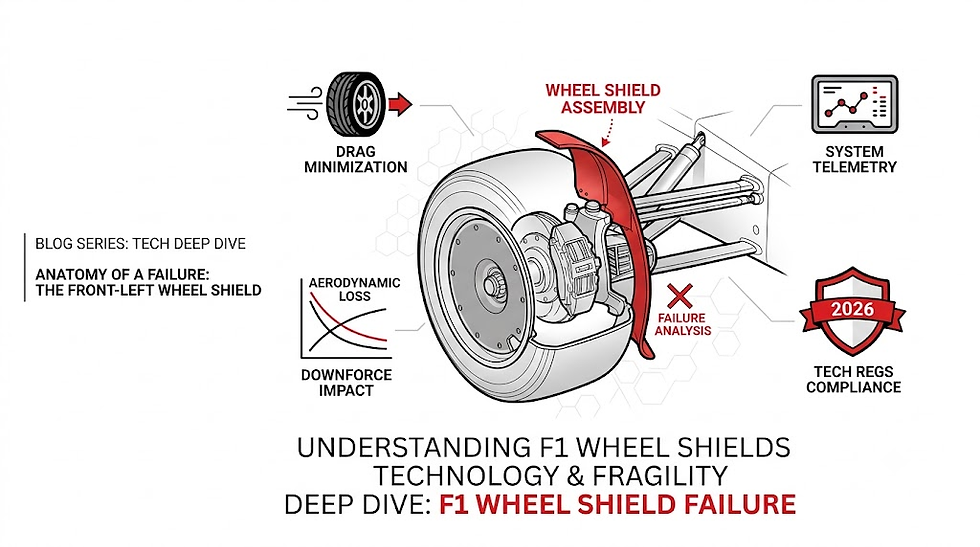
The margins between glory and heartbreak have never been thinner than they are under the current technical framework. At the 2026 British Grand Prix, fans witnessed this reality firsthand. Kimi Antonelli, driving a masterclass of a race for Mercedes, saw his commanding lead unravel in a matter of seconds on lap 41.
The culprit? Not an engine blowout, a gearbox glitch, or a driver error—but a rare, structural F1 wheel shield failure triggered by a momentary clipping of the exit curb at the legendary, high-speed Copse corner.
For many viewers, the incident left behind a glaring question: What exactly is a front-left wheel shield, and how can a piece of carbon fiber bodywork completely dismantle a Grand Prix victory?
To understand the breakdown of Antonelli’s Mercedes W17, we must look into the intricate, high-stakes aerodynamics of the outer assemblies under the latest regulations.
What is a Front-Left Wheel Shield?
Officially classified in the FIA technical regulations as part of the Front Wheel Bodywork Assembly (and often referred to structurally as the outboard disc or wheel cover), the front-left wheel shield is a specialized aerodynamic shroud mounted directly onto the outer wheel hub.
Unlike conventional road car hubcaps, which are purely cosmetic, these components are highly advanced aerodynamic devices. They seal the outer face of the 18-inch magnesium alloy wheel rims. Under the framework, while the underlying wheel rims are now opened up to bespoke team designs to assist with structural conductive heat transfer, they must be tightly enclosed by these precise carbon-fiber lips and outer annular discs.
The primary job of the front-left wheel shield is twofold:
Minimizing Aerodynamic Drag: Spinning open wheels are catastrophic for a race car's aerodynamic profile. As the tire rotates, it creates a massive pocket of chaotic, high-drag air. The wheel shield smooths out this boundary layer, forcing the air to glide cleanly over the rotating face of the tire rather than getting trapped in the negative space of the wheel spokes.
Eliminating "Outwash" Wake: The fundamental mission of the current aerodynamic generation is to foster closer on-track racing by cleaning up the "dirty air" thrown behind a car. The wheel shield prevents teams from using the wheel rotation and internal brake ducts to blow turbulent air outward (outwash). By sealing this lateral passage, the airflow is channeled inward toward the bargeboards and floor edge, dramatically reducing the wake left for a following car.
The Aero Rules: A Battleground of Margins
When the FIA introduced the updated regulations, they overhauled how teams manipulate front-end airflow. The front wings were narrowed by 100mm, and the massive upper wheel deflectors (the winglets that sat directly over the tires in the previous rule cycle) were entirely deleted.
Without those upper deflectors to pre-condition the air rushing over the front axle, the wheel shields themselves have taken on an exponentially greater load. Take a look at how front-axle dynamics balance these changes:
Aerodynamic Component | Regulatory Mandate | Engineering Function |
Outboard Disc (Wheel Shield) | Team-designed carbon fiber lip; must prevent air passage between inboard and outboard cavities. | Lowers vehicle drag coefficient; prevents turbulent lateral outwash. |
Front Wing Endplate | Narrower span, shifted further inboard with a simplified footplate design. | Forces the initial air structure to pass inside the front tire footprint. |
Internal Brake Ducts | Strictly governed exit ports; no cross-wheel ventilation allowed. | Relies on conductive heat transfer through the magnesium rim to cool tires. |
Because teams now have more autonomy over the subtle geometry of these outboard discs, engineers shape them right to the absolute limit. Every micrometer of the carbon fiber skin is optimized to interact seamlessly with the front wing's wake and the revised floor boards downstream.
If you compromise that single component, you don't just lose a hubcap; you structurally alter the entire aerodynamic map of the car.
Why are Wheel Shields So Fragile?
When Kimi Antonelli clipped the curb at Copse on lap 41, he subjected his front-left suspension assembly to a violent, high-frequency oscillation. Copse is taken at speeds exceeding 160 mph, meaning the physical energy transferring through the tire carcass is immense.
There are three distinct reasons why a modern wheel shield is highly vulnerable to an F1 wheel shield failure under these conditions:
1. Minimalist Structural Mass and Carbon Optimization
Under the weight regulations, cars saw their minimum weight slashed to 768kg. To hit these strict weight targets while managing the heavy electrical components of the hybrid power units, teams had to strip mass from every non-safety-critical component. The wheel shields are manufactured from ultra-thin, lightweight carbon fiber composites. They are designed to withstand predictable, perpendicular aerodynamic air pressures—not unpredictable, high-load kinetic impacts from a jagged concrete curb.
2. High-Frequency Centrifugal and Rotational Stress
Unlike early stationary prototypes in the mid-2000s, modern wheel shields rotate dynamically with the wheel assembly. Spinning at over 2,000 RPM down the Wellington and Hangar straights, the shield is already under intense centrifugal tension. When a car strikes a curb, the tire sidewall deflects violently. This deflection causes the rigid carbon fiber lip of the shield to momentarily make contact with the flexing tire wall, or transfers a harsh harmonic shock straight through the mounting stays.
3. Thermal Degradation from Brake Radiation
F1 braking systems routinely reach temperatures up to 1000°C. With the current rules banning open wheel venting, this massive thermal energy has nowhere to go but to radiate directly outward through the magnesium wheel rim. This means the wheel shield operates in a highly volatile thermal environment. Over a 41-lap stint, this constant baking can subtly weaken the resin bonding the carbon fiber layers together, rendering the component brittle and susceptible to shattering upon sudden impact.
The Domino Effect: How Antonelli’s Race Unraveled
The moment the front-left shield fractured on Antonelli's car, a destructive chain reaction was set off.
First, the physical destruction of the carbon disk introduced immediate aerodynamic asymmetry. With the left shield shattered, the front-left tire suddenly acted as a massive aerodynamic wall, spiking drag on one side of the chassis. This immediately threw off the car's balance under braking, pulling the Mercedes W17 unpredictably to the left.
Second, the loose carbon fiber debris from the breaking shield began to tear backward under the rushing airflow. These jagged fragments traveled directly into the path of the floor foot and floor boards located right behind the front wheel. The floor is the absolute heart of a modern F1 car's downforce generation; as the debris scarred the sensitive underside channels and disrupted the clean vortex feeding the rear diffuser, Antonelli lost an estimated 15-20 points of downforce instantly.
From there, his lap times plummeted, his front-left tire began to overheat due to the erratic airflow, and what should have been a triumphant victory turned into a desperate damage-limitation drive.
FAQ: Understanding F1 Wheel Component Failures
What causes an F1 wheel shield failure during a race?
An F1 wheel shield failure is typically caused by a combination of high-frequency kinetic shocks (such as aggressively riding a track curb), structural fatigue from centrifugal force, and thermal degradation caused by heat radiating from the 1000°C brake assemblies.
Can teams race without these wheel shields?
No. The FIA technical regulations mandate that the outboard face of the wheel rim must be fully enclosed by these assemblies to prevent teams from generating illegal outwash air structures. Running without them or with a severely damaged shield violates compliance and heavily penalizes aerodynamic performance.
How do the current rules affect wheel shield designs compared to older seasons?
Unlike the standardized, uniform hubcaps used between 2022 and 2025, the current technical rules grant teams the freedom to develop custom geometric lips and annular discs. This allows for tailored management of airflow and brake cooling, but it also means teams push the structural thickness down to the bare minimum to save weight.
The Cost of Innovation
Antonelli’s setback at Silverstone stands as a stark reminder that modern Formula 1 is a sport where engineering optimization borders on self-destruction. In the pursuit of shedding every possible gram and controlling every single molecule of airflow around the front tires, teams willingly operate on a knife's edge.
When those designs succeed, they deliver pole positions and podium finishes. But when a curb at Copse bites back, it exposes just how fragile the pinnacle of motorsport engineering can truly be.
To track live telemetry data, race analysis, and upcoming technical updates for the remainder of the World Championship season, visit the official Formula 1 Racing Hub. For detailed breakdowns of individual team garage updates and engineering specifications, follow the technical insights directly on the FIA Official Portal.


Comments