The Botany Breakthrough: Meet Begonia Quadricornualata, the Extraordinary Four Horned Begonia in India Discovered in 2026
- Jul 14
- 6 min read
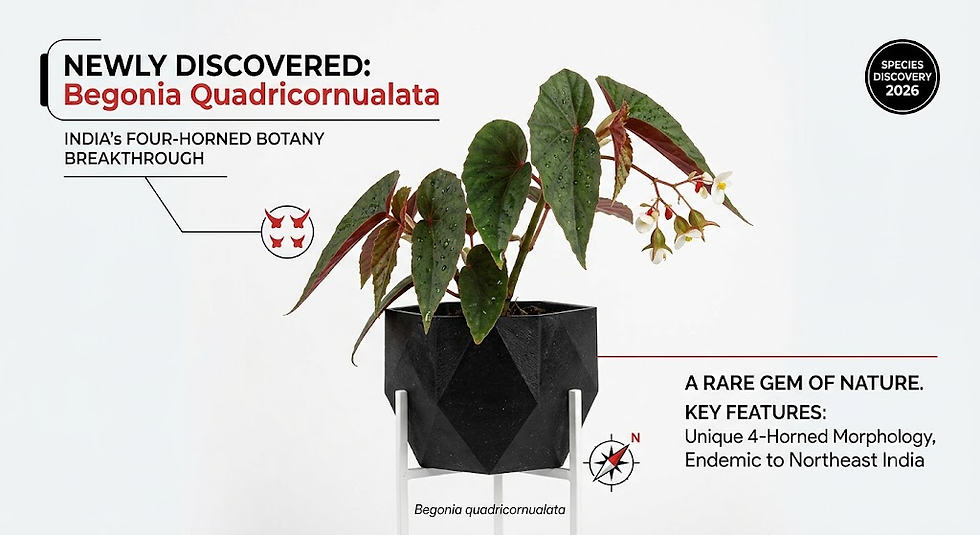
The year 2026 has already proven to be an extraordinary epoch for biological exploration, but few discoveries have excited the international botanical community quite like the unveiling of Begonia quadricornualata. Found nestled deep within the hyper-biodiverse, mist-shrouded valleys of Northeast India, this newly described plant species is rewriting our understanding of the genus Begonia.
With its striking asymmetric foliage and a highly unusual reproductive morphology, this stunning discovery stands out even among the world's most diverse plant families. Dubbed the "four-horned Begonia" due to the unique structural protrusions on its seed capsules, this remarkable specimen showcases the endless evolutionary creativity hidden within India’s remaining pristine wilderness.
In this deep-dive blog post, we will explore the fascinating science behind Begonia quadricornualata, trace the footsteps of the scientists who braved rugged terrains to find it, examine its delicate microhabitat, and discuss what its discovery means for the future of conservation in the Eastern Himalayas.
The Thrill of Botanical Discovery in the Eastern Himalayas
Northeast India—particularly the states of Arunachal Pradesh, Mizoram, and Tripura—acts as a massive evolutionary bridge between the Himalayan range and the Indo-Myanmar biodiversity hotspot. It is a region characterized by steep elevation gradients, torrential seasonal monsoons, and microclimates that isolate plant populations. This isolation acts as a powerful driver of speciation (the evolutionary process by which new, distinct species arise).
The genus Begonia is one of the largest and fastest-growing groups of flowering plants on Earth, boasting well over 2,000 accepted species globally. These plants are famous for their sensitive ecological requirements; they thrive in high-humidity, low-light environments, often growing as lithophytes (plants that grow on rocks) or terrestrial herbs on the damp walls of deep river gorges.
The discovery of Begonia quadricornualata adds a breathtaking new chapter to this lineage. Found growing in small, highly localized populations, it represents a specialized survival strategy tailored to the humid, shaded microclimates of India's montane wet-temperate forests.
Discovering the Four Horned Begonia in India: Habitat and Expedition Details
The expedition that led to the identification of this plant was no easy feat. A collaborative team of taxonomists from the Botanical Survey of India (BSI) and regional university botany departments ventured into remote, unmapped sectors of the Eastern Himalayan foothills.
Extreme Terrain and High Humidity
To find the four horned Begonia in India, researchers had to trek through vertical river gorges and slippery limestone cliffs. The species was discovered thriving in deep shade, directly clinging to wet, moss-covered shale. These microhabitats are constantly bathed in fine spray from nearby waterfalls, maintaining a relative humidity level of nearly 90% year-round.
The soil in these locations is extremely thin, consisting primarily of organic leaf litter, decayed moss, and mineral runoff from the decomposing rock faces. This specialized environment makes the plant highly endemic (native and restricted to a certain place). It cannot easily spread to adjacent areas that lack this precise mix of shade, constant moisture, and rocky substrate.
Morphological Breakdown: What Makes Begonia quadricornualata Unique?
To understand why botanists are calling this a breakthrough, we must examine the specific anatomical features that differentiate Begonia quadricornualata from its closest evolutionary relatives. Begonias are generally known for asymmetric leaves and winged fruits, but this species pushes these traits to a beautiful
extreme.
1. The Foliage and Stem
The plant is a perennial, rhizomatous herb, growing to a height of about 30 to 45 centimeters.
The Leaves: The leaves are highly asymmetric and cordate (heart-shaped) at the base. The upper surface (adaxial side) exhibits a striking, dark velvety green color, often variegated with subtle silver-grey spots between the major veins. The leaf margins are finely serrated and fringed with tiny, reddish-purple hairs (trichomes) that trap a boundary layer of air to prevent moisture loss in saturated environments.
The Petioles and Stems: The petioles (leaf stalks) and succulent stems are a deep crimson red, covered in a dense layer of translucent, white woolly hairs. This red coloration is a common adaptation in understory plants, helping them maximize the absorption of green and blue light filtered through the dense forest canopy.
2. The Inflorescence and Flowers
Begonia quadricornualata is monoecious, meaning it bears separate male (staminate) and female (pistillate) flowers on the exact same plant.
Male Flowers: The male flowers feature four unequal, pale pinkish-white tepals (petals and sepals that look alike). The outer pair is broad and rounded, while the inner pair is narrow and lance-shaped. At the center sits a brilliant golden-yellow, symmetric cluster of stamens.
Female Flowers: The female flowers are slightly larger, sporting five tepals. They are supported by a red, densely hairy pedicel (flower stalk) that droops gracefully under the weight of the developing ovary.
3. The "Four Horns": The Ultimate Distinguishing Feature
The most defining characteristic of Begonia quadricornualata is its fruit. While typical Begonia capsules have three unequal, flat wings designed to catch the wind for seed dispersal, this species has evolved a modified capsule.
The capsule features four distinct, thickened, horn-like projections (hence the specific epithet quadricornualata). These horns are tough, fibrous, and slightly curved upward. Rather than relying purely on wind, these heavy, horned capsules are designed for water-mediated dispersal (hydrochory). When heavy monsoon raindrops strike the horned capsule, the impact mechanically ejects the tiny, dust-like seeds, splashing them onto nearby wet rock crevices where they can successfully germinate.
Comparing Indian Begonia Discoveries
To place Begonia quadricornualata in context, we can look at how its features compare to other prominent Begonia species discovered in Northeast India over recent years, such as Begonia mishmiorum (2026), Begonia nyishiorum (2025), and Begonia egamii (2023).
Species | Year Described | Key Morphological Feature | Dispersal Mechanism | Primary Habitat |
Begonia quadricornualata | 2026 | Four thickened, horn-like capsule wings | Hydrochory (Raindrop-splash) | Shaded wet limestone and shale cliffs |
Begonia mishmiorum | 2026 | Pinkish-white bracteoles enclosing the ovary | Wind-dispersed (Anemochory) | Fragmented slopes, Anjaw district |
Begonia nyishiorum | 2025 | Striking dense petiole hairs (indumentum) | Wind-dispersed | East Kameng forest understory |
Begonia egamii | 2023 | Rugulose leaves, asymmetric androecium | Wind-dispersed | Open canopy, Leparada reserve |
The Ecological and Conservation Urgency of 2026
While the discovery of Begonia quadricornualata is a cause for celebration, it also shines a bright light on the fragile state of India's wilderness in 2026. Micro-endemic species that live on single cliff faces or in isolated valleys are exceptionally vulnerable to environmental changes.
Habitat Fragmentation and Infrastructure Buildout
The primary threat to the four horned Begonia in India is habitat loss driven by infrastructure development. Northeast India is undergoing rapid road construction, hydroelectric projects, and agricultural expansion. When a new mountain road is carved through a gorge, it alters the local hydrology, cuts off seasonal waterfalls, and exposes shaded cliff faces to direct sunlight. For a sensitive plant like Begonia quadricornualata, even a minor drop in local humidity or a few hours of intense sun can wipe out an entire localized population.
Climate Change and Shifting Monsoons
Additionally, changing weather patterns are disrupting the delicate monsoonal cycle of the Eastern Himalayas. Unpredictable dry spells followed by extreme, erosive downpours lead to landslides that strip away the fragile mossy rock faces where these plants cling.
Because of these acute threats, taxonomic researchers are preparing a provisional assessment to submit to the International Union for Conservation of Nature (IUCN), proposing that Begonia quadricornualata be classified as Critically Endangered (CR).
Frequently Asked Questions About Begonia quadricornualata
What makes the "four horned Begonia in India" different from other Begonias?
The most unique feature of this plant is its seed capsule. Unlike standard Begonias that have three flat wings for wind dispersal, this species has evolved four thick, horn-like projections on its fruit. This structural change optimizes seed dispersal via raindrop impact (hydrochory) rather than wind, allowing it to propagate efficiently along vertical, wet rock walls.
Where exactly was Begonia quadricornualata discovered?
It was discovered in the wet, montane valleys of Northeast India. The plant thrives exclusively in highly humid, heavily shaded microenvironments, clinging to mossy limestone and shale cliffs near active waterfalls and river gorges.
Can I grow Begonia quadricornualata at home?
Currently, Begonia quadricornualata is not available in the commercial horticultural trade. It is a highly protected, sensitive wild species. Because of its extremely specific humidity and substrate requirements, it is incredibly difficult to keep alive outside its native microhabitat. Conservationists emphasize that wild populations must be left undisturbed.
Why is the discovery of this species so important in 2026?
The discovery highlights the incredible, undocumented biodiversity still hiding within India's remote forests. It underscores the urgent need to protect fragile ecosystems from habitat fragmentation caused by rapid road construction, agricultural encroachment, and shifting climatic patterns.
The Road Ahead: Safeguarding India's Botanical Heritage
The formal classification of Begonia quadricornualata is a reminder that we are still in the golden age of discovery. Countless plant species—many of which could hold keys to medical breakthroughs or teach us invaluable lessons about evolutionary resilience—remain hidden in the deep folds of the Indian subcontinent.
Protecting this botanical wealth requires a shift from passive conservation to active habitat preservation. By designating micro-reserves around critical river gorges and integrating biodiversity surveys into the planning phases of infrastructure projects, India can ensure that future generations will still have wild, mysterious places to explore.
Act Now: How You Can Support Botanical Conservation
Protecting newly discovered species like Begonia quadricornualata requires collective effort. You can make a real-world impact today by supporting organizations dedicated to mapping, studying, and safeguarding India's unique flora.
Support the Botanical Survey of India (BSI): Keep up to date with official taxonomic publications and exploration initiatives by visiting the Botanical Survey of India.
Empower Local Communities: Support the Wildlife Trust of India, which works tirelessly to protect endangered species and natural habitats across India.
Join Global Plant Science: Learn how you can contribute to global botanical databases and conservation initiatives through the Royal Botanic Garden Edinburgh, a leading institution in Begonia research.



Comments