GCSE Board Review 2026: The "Gold Standard" You (Probably) Can't Take in India
- Jan 7
- 4 min read
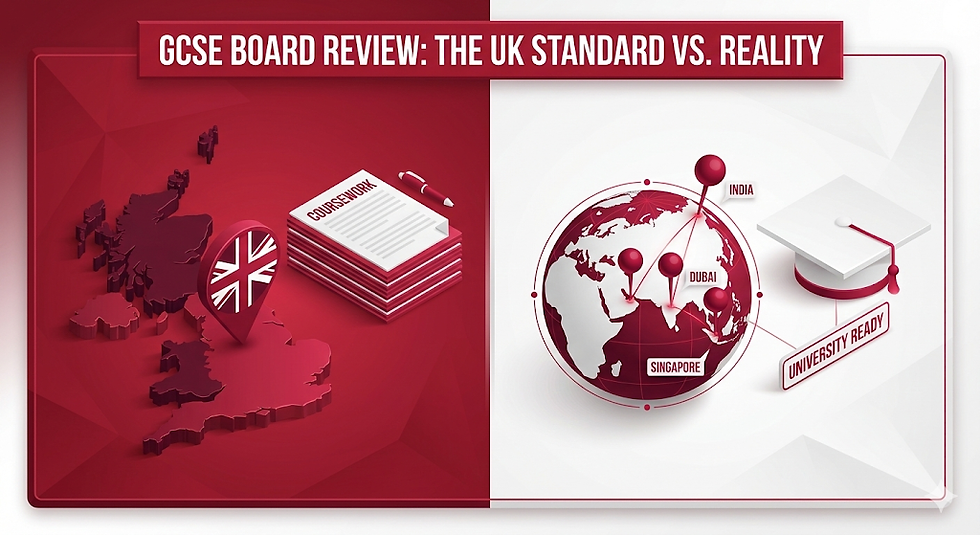
If you are researching British education for the 2026 Intake, you have likely hit a wall of acronyms. You hear "GCSE" in movies and news, but "IGCSE" in your local international school brochure.
Are they the same? Is one better? And if you are sitting in Pune or Delhi, can you even take the GCSE?
As a Study Abroad Consultant, I see this confusion daily. Parents often think "GCSE" is just the short form for the Cambridge board. It is not. The General Certificate of Secondary Education (GCSE) is the national curriculum of the UK.
This review decodes the GCSE board specifically for Indian families—explaining its strict 9-1 grading, its UK-centric syllabus, and the logistical reality of why you generally cannot take this exam unless you are moving to London.
Highlights: GCSE Board Snapshot (2026)
Here is the quick data matrix for the 2026 academic cycle.
Feature | Details |
Full Name | General Certificate of Secondary Education |
Primary Location | United Kingdom (England, Wales, N. Ireland) |
Availability in India | Extremely Rare (Mostly limited to select subjects/private centers) |
Administering Bodies | AQA, Edexcel, OCR, WJEC (UK Government Regulated) |
Grading System | Strictly 9-1 Scale (Letters are gone) |
Assessment Style | Linear Exams (End of Year 11) + Mandatory Coursework |
Global Status | The "Parent" qualification of the IGCSE |
1. The Curriculum: Unapologetically British
The biggest difference between the GCSE and the international version (IGCSE) is the content. The GCSE is designed for teenagers living in Britain.
English Literature: You must study Shakespeare and British poetry. The context is heavily rooted in UK culture and history.
Humanities: History and Geography papers focus on UK rivers, the Tudors, or the British industrial revolution. There is very little "Global" history compared to the IGCSE.
The "Practical" Element: In the UK, GCSEs often require mandatory practical assessments (e.g., Science experiments conducted in a lab) that count toward the final grade. This is difficult to administer overseas, which is why the IGCSE exists.
2. The Grading System: Mastering the "9-1" Ladder
By 2026, the shift from A*-G to the 9-1 Numerical System will be ancient history in the UK, but it still confuses Indian parents.
9 is the new "Super A":* It is awarded to the top 2-3% of students. It signals exceptional performance.
8 is an A:* A solid, top-tier score.
7 is an A: The minimum requirement for most competitive courses at UK universities.
4 is a Standard Pass (C): If you get a 3, you technically failed and might have to resit Math/English.
Consultant's Note: If you are moving to the UK for Grade 11 (Sixth Form), schools will ask for a "Grade 6 average." This means a high B average.
3. The "India" Reality Check: Can You Take It?
This is the most critical part of this review.
The Short Answer: No.
In 99% of cases, international schools in India (like Dhirubhai Ambani, Oberoi, or Pathways) offer the IGCSE, not the GCSE.
Why? The GCSE syllabus is regulated by the UK government for state funding purposes. It is logistically rigid.
The Exception: Some private candidates or very specific schools might offer a single GCSE subject (like a language), but a full GCSE diploma is virtually nonexistent in India.
The Strategic Implication:
If you are an Indian student applying to Oxford or Cambridge, do not worry. They view the IGCSE (which you take in India) and the GCSE (which British kids take) as academic equivalents. You are not at a disadvantage.
4. University Acceptance: The Platinum Standard
For the 2026 intake, the GCSE (and its twin, the IGCSE) remains the gold standard for university entry requirements in the UK.
The "Gatekeeper" Role: Top UK universities (Russell Group) look at your GCSE/IGCSE Math and English scores to decide if you can handle their course.
Example: To study Medicine at UCL or Imperial, you often need a Grade 6 or 7 in Math and English at the GCSE level, regardless of how well you do in Grade 12.
US Acceptance: US colleges view GCSEs as equivalent to the first two years of High School (Grade 9-10). A string of 8s and 9s looks incredibly impressive on a Common App profile.
FAQs regarding GCSE Board Review
Q1: Is GCSE harder than CBSE?
Yes, generally. The GCSE asks for critical analysis and "application of knowledge" rather than just memory. However, the math level in CBSE Grade 10 is often considered slightly more advanced than GCSE Foundation Math.
Q2: If I move to the UK in Grade 10, will I take GCSEs?
Yes. If you join a UK school in Year 10 or 11, you will be put into the GCSE stream. You might find the "coursework" components (essays done during the year) new and challenging compared to Indian exam-only formats.
Q3: Does a Grade 9 in GCSE guarantee Oxford admission?
No, but it helps. Oxford and Cambridge explicitly state that they look at GCSE grades to see if a student has a "consistent" academic history. A student with straight 9s in GCSE is statistically more likely to get an interview.
Q4: What is the difference between GCSE and O-Levels?
"O-Level" is an obsolete term in the UK (replaced by GCSE in 1988). However, Singapore and Sri Lanka still use a version called "GCE O-Level," which is closer to the IGCSE in structure.
Q5: Can I mix GCSE and IGCSE subjects?
Yes. In the UK, many private schools mix them. They might do IGCSE Math (because they think it's better) but GCSE History (because they want to study British history). Universities accept the mix without issue.
Conclusion
The GCSE Board is a robust, world-class curriculum—but it is built for Britain.
If you live in India: You don't need to "choose" GCSE. Your school will automatically give you IGCSE. This is good! IGCSE is more flexible and culturally neutral.
If you are moving to the UK: Be prepared for the Coursework culture. You won't just be graded on the final exam; your performance throughout the year matters.
Your Action Plan for Today:
Check Your Transcript: If you are in an "International" school in India, look at your textbooks. Do they say "Cambridge" or "Edexcel International"? If so, you are doing IGCSE, not GCSE.
Aim for the "7": Whether you are doing GCSE or IGCSE, the magic number for 2026 university admissions is Grade 7. Focus your prep on crossing that threshold.
Ignore the "Easy" Myth: Neither board is "easier." Both require you to think critically.


Comments