Grading System in Karnataka SSLC 2026 Explained
- 4 days ago
- 4 min read
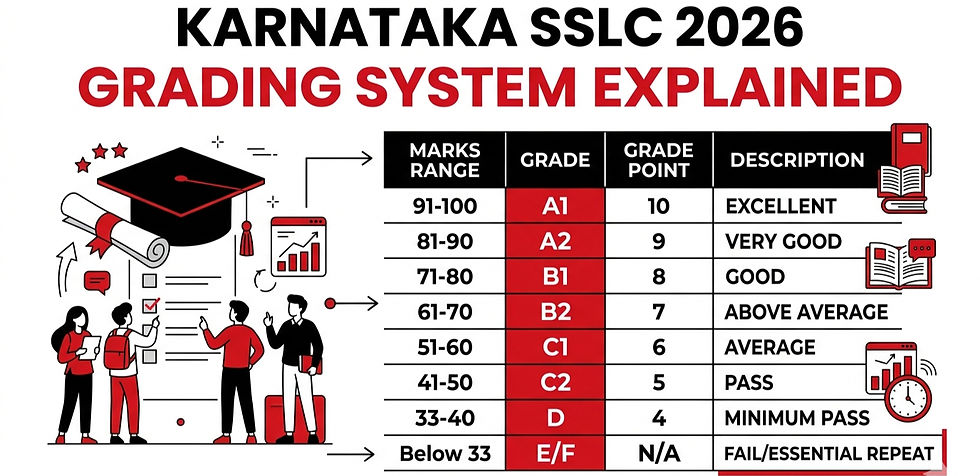
The Karnataka SSLC Grading System 2026 is one of the most important aspects students must understand before checking their results or planning further studies. Introduced and regulated by the Karnataka School Examination and Assessment Board (KSEAB), this grading system evaluates students based on their performance using a structured six-grade scale rather than just raw marks.
In this detailed guide, you will understand how the grading system works, marks-to-grade conversion, passing criteria, recent 2026 updates, and how to calculate your percentage accurately.
What is the Karnataka SSLC Grading System 2026?
The Karnataka SSLC Grading System 2026 is a six-point grading structure used to assess Class 10 students. Instead of only focusing on marks, it categorizes performance into grades ranging from A+ to C.
This system is designed to:
Reduce exam stress
Provide a clearer understanding of performance
Promote fair evaluation across students
Under this system:
A+ is the highest grade
C is the minimum passing grade
Karnataka SSLC Grading System 2026 (Overall Marks)
Below is the official grading scale based on total marks:
Marks Range | Percentage | Grade |
563 – 625 | 90% – 100% | A+ |
500 – 562 | 80% – 90% | A |
438 – 499 | 70% – 80% | B+ |
375 – 437 | 60% – 70% | B |
313 – 374 | 50% – 60% | C+ |
219 – 312 | 35% – 50% | C |
Students scoring above 90% (563+ marks) receive the top grade A+.
Karnataka SSLC Grading System 2026 for Each Subject
Out of 100 Marks
Marks | Grade |
90 – 100 | A+ |
80 – 89 | A |
70 – 79 | B+ |
60 – 69 | B |
50 – 59 | C+ |
35 – 49 | C |
Out of 125 Marks (First Language)
Marks | Grade |
113 – 125 | A+ |
100 – 112 | A |
88 – 99 | B+ |
75 – 87 | B |
63 – 74 | C+ |
44 – 62 | C |
These subject-wise ranges help students understand their performance more precisely.
Latest Updates in Karnataka SSLC Grading System 2026
The 2026 academic year introduced some important policy changes:
1. Third Language Now Graded, Not Marked
The third language subject is now evaluated using grades only (A–D)
Marks are not added to total score
2. Total Marks May Be Reduced
Earlier total: 625 marks
Now (excluding third language): 525 marks (in some cases)
3. Passing Percentage Reduced
Minimum passing criteria changed from 35% to 33% overall
These updates aim to reduce academic pressure and make evaluation more student-friendly.
Karnataka SSLC Passing Marks 2026
To pass the SSLC exam, students must meet both subject-wise and overall criteria:
Subject-wise Passing Marks
Minimum 30 marks per subject
At least 33% overall score
Total Passing Marks
Minimum 206 out of 625 marks (or equivalent adjusted total)
Failing to meet these criteria means students must appear for supplementary exams.
How to Calculate Percentage Using Karnataka SSLC Grading System 2026
Understanding percentage calculation is crucial.
Step-by-Step Method:
Add marks from all subjects
Divide by total subjects
Multiply by 100
Example:If you scored 450 out of 600 →Percentage = (450 ÷ 600) × 100 = 75%
This corresponds to Grade B+.
Importance of Karnataka SSLC Grading System 2026
The Karnataka SSLC Grading System 2026 plays a key role in:
1. College Admissions
Grades determine eligibility for:
PU colleges
Diploma courses
Competitive exams
2. Academic Benchmarking
Provides a standardized way to:
Compare student performance
Evaluate school-level results
3. Stress Reduction
Grading reduces pressure compared to strict marks-based ranking.
Difference Between Marks System and Grading System
Feature | Marks System | Grading System |
Evaluation | Exact marks | Grade categories |
Pressure | High | Moderate |
Comparison | Direct | Relative |
Understanding | Detailed | Simplified |
The grading system offers a more holistic evaluation approach.
Karnataka SSLC Marksheet 2026 Details
Your marksheet will include:
Student name
Registration number
Subject-wise marks
Grades
Total marks
Result status
The online result is provisional, while original marksheets are issued by schools.
Karnataka SSLC Exams 2 & 3 (Supplementary System)
Students who fail can appear for:
Exam 2 (Supplementary)
Exam 3 (Improvement)
This ensures students get multiple chances in the same academic year.
Karnataka SSLC Grading System 2026 for Private Students
Private candidates follow a slightly different structure:
No internal assessment
Total marks: 625
Same grading scale applies
Common Mistakes Students Make
Ignoring internal marks contribution
Miscalculating percentage
Confusing grade ranges
Not checking updated passing criteria
Understanding the Karnataka SSLC Grading System 2026 properly helps avoid these errors.
Tips to Score Higher Grades in SSLC 2026
Focus on concept clarity
Practice previous year papers
Maintain strong internal assessment scores
Revise regularly
Manage time effectively
FAQs on Karnataka SSLC Grading System 2026
Q1. What is Karnataka SSLC Grading System 2026?
The Karnataka SSLC Grading System 2026 is a six-grade evaluation system (A+ to C) used to assess student performance based on marks and percentages.
Q2. What is the minimum passing grade in Karnataka SSLC Grading System 2026?
The minimum passing grade is C, which corresponds to 35–50% marks.
Q3. How is percentage calculated in Karnataka SSLC Grading System 2026?
Percentage is calculated by dividing total marks obtained by total marks and multiplying by 100.
Q4. What grade is given for 90% in Karnataka SSLC Grading System 2026?
Students scoring 90% or above receive an A+ grade.
Q5. Is third language included in Karnataka SSLC Grading System 2026?
No, in 2026, the third language is graded separately and not included in total marks.
Conclusion
The Karnataka SSLC Grading System 2026 is designed to simplify evaluation while maintaining academic standards. With grades ranging from A+ to C, students can better understand their performance without excessive pressure.
The recent updates—such as grading the third language and reducing passing criteria—reflect a shift toward a more student-friendly system. However, understanding the grading structure, marks distribution, and calculation methods is essential for accurate result interpretation.
Official Links
Check your SSLC 2026 result on the official board website:
Visit the Karnataka School Examination and Assessment Board (KSEAB):
Download your digital marksheet via DigiLocker:



Comments