H-1B Visa Rules 2026: USCIS Guide on New Regulations & Tech Hiring Impact
- Apr 7
- 4 min read
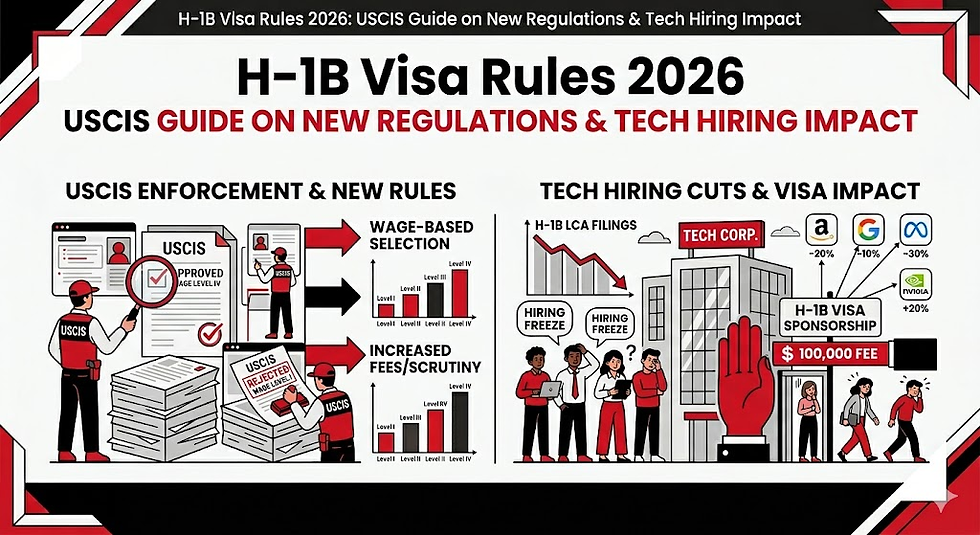
The landscape for international talent in the United States is undergoing a seismic shift. As we navigate through 2026, the Department of Homeland Security (DHS) and U.S. Citizenship and Immigration Services (USCIS) have implemented some of the most stringent updates to the H-1B program in decades. These changes coincide with a cooling tech sector, where major players like Amazon, Google, and Meta have significantly reduced their visa sponsorships amidst broader hiring cuts.
For professionals and students aiming for the H-1B cap season, understanding the H-1B Visa Rules 2026 is no longer optional—it is a survival requirement.
The Shift to a Weighted Selection Process
The most significant change to the H-1B landscape is the departure from a purely random lottery. Starting with the Fiscal Year (FY) 2027 cap season (which began registration in March 2026), USCIS has moved to a Wage-Based Weighted Selection Model.
This system is designed to prioritize "the best and the brightest" by giving higher odds to those offered higher salaries. Under this new framework, registrations are entered into the selection pool multiple times based on their Occupational Employment and Wage Statistics (OEWS) level:
Wage Level IV: Entered into the pool 4 times.
Wage Level III: Entered into the pool 3 times.
Wage Level II: Entered into the pool 2 times.
Wage Level I: Entered into the pool 1 time.
This change effectively means that entry-level positions (Level I) face a much steeper uphill battle compared to senior or highly specialized roles.
New H-1B Visa Rules 2026: Fee Hikes and Stricter Scrutiny
Beyond the selection process, the financial burden of sponsorship has increased dramatically. A Presidential Proclamation issued in late 2025 now mandates an additional $100,000 payment for certain H-1B petitions filed for beneficiaries located outside the United States.
While certain "National Interest" exceptions exist—particularly in sectors like public health, defense, and critical infrastructure—most corporate entities hiring from abroad must now account for this massive cost.
Key Integrity Measures in 2026
Form I-129 Updates: USCIS now only accepts the 2026 version of Form I-129. Older versions are rejected immediately.
Detailed Job Descriptions: The revised forms require granular data on job roles, specific qualifications, and the direct relationship between the field of study and the position.
Enhanced Site Visits: There is an increased frequency of workplace inspections to ensure that the "proffered wage" matches the actual pay and that the job duties align with the initial petition.
Impact of Tech Hiring Cuts on Visa Sponsorship
The "Big Tech" era of mass H-1B filings has hit a significant roadblock. Recent data from the Department of Labor shows a sharp decline in H-1B Labor Condition Application (LCA) filings from traditional giants.
Company | H-1B Filings (Q1 2025) | H-1B Filings (Q1 2026) | % Change |
Amazon | 4,647 | 3,057 | -34% |
Meta | 1,200 (approx) | 610 (approx) | -49% |
1,150 (approx) | 580 (approx) | -50% | |
Nvidia | 369 | 434 | +17% |
The data highlights a clear trend: while most of the tech industry is leaner and more focused on AI-driven efficiency, companies at the forefront of the AI boom, like Nvidia, are actually increasing their intake of specialized foreign talent. For applicants, this means the competition has shifted from "volume" to "niche expertise."
What This Means for International Students and Professionals
If you are an F-1 student on OPT or a professional looking to transition to an H-1B, your strategy must evolve. The H-1B Visa Rules 2026 favor those who can command higher wages.
Negotiate for Level II or Higher: If your role qualifies for a Level II wage, ensure your employer registers you as such to double your selection odds.
Focus on Specialized Roles: Generic software engineering roles are seeing the most cuts. Roles in AI research, cybersecurity, and specialized medical technology remain in high demand.
The "National Interest" Route: If you are outside the U.S., look for employers in sectors that might qualify for the $100,000 fee waiver under the National Interest Exception.
Conclusion
The 2026 H-1B environment is defined by "Quality over Quantity." While the number of available visas remains capped, the barriers to entry have risen through higher wage requirements and increased petition costs. For those with high-level expertise, the path is clearer, but for entry-level candidates, the competition has never been more intense.
Frequently Asked Questions (FAQ)
1. What are the major changes in the H-1B Visa Rules 2026?
The major changes include the implementation of a weighted selection process based on wage levels (Level I to IV), a new $100,000 fee for certain offshore petitions, and stricter scrutiny regarding job-to-degree alignment.
2. How does the wage-based selection affect my chances?
Under the new H-1B Visa Rules 2026, your chances are significantly higher if you are in a higher wage bracket. A Level IV applicant has four times the entries in the lottery compared to a Level I applicant.
3. Are there any exceptions to the new $100,000 H-1B fee?
Yes, the Secretary of Homeland Security can grant exceptions for roles deemed in the "National Interest." This typically includes positions in public health, medical research, national security, and essential technological innovation.
4. Why are tech companies filing fewer H-1B petitions in 2026?
A combination of tech layoffs, a shift toward leaner AI-integrated teams, and the increased costs/scrutiny of the new USCIS regulations has led companies like Amazon and Google to cut their filings by nearly 50% year-over-year.
CTA
Check Case Status: Official USCIS Case Tracking
Registration Guidelines: NBEMS H-1B Cap Season Portal
Prevailing Wage Data: Foreign Labor Certification Data Center


Comments