Heavy Rain Alert in India: IMD Issues Critical Warnings for Multiple States
- Jul 7
- 6 min read
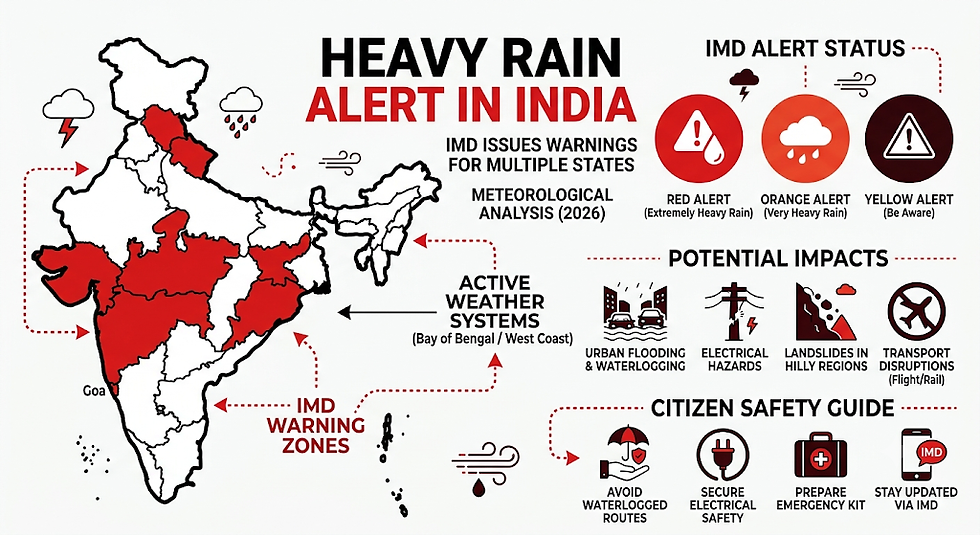
The Southwest Monsoon has entered its fiercest phase of the season, unleashing heavy downpours across the Indian subcontinent. The India Meteorological Department (IMD) has issued emergency advisories for several regions as a powerful weather system moves across the country. From the submerged streets of Mumbai to the landslide-prone terrains of Himachal Pradesh and Arunachal Pradesh, severe weather conditions are testing urban infrastructure and disaster management teams.
With multiple weather systems acting in tandem—including a well-marked low-pressure area over the Bay of Bengal and active offshore troughs along the western coast—meteorologists are warning citizens to prepare for prolonged spells of intense precipitation.
Below is an in-depth analysis of the active weather systems, state-wise regional alerts, infrastructural impacts, and necessary safety guidelines during this critical phase of the monsoon season.
The Meteorological Cause: Why Is the 2026 Monsoon So Fierce?
The primary driver behind the current intense monsoon activity is a well-marked low-pressure area that formed over the northwest Bay of Bengal. This atmospheric system has pulled in immense volumes of moisture from the sea, cooling and condensing into towering rain clouds as it travels inland across north Odisha and Chhattisgarh.
This low-pressure zone is not operating in isolation. It is heavily reinforced by two major meteorological phenomena:
The Active Monsoon Trough: An elongated belt of low pressure stretching horizontally across the country is currently lying south of its normal position. This specific alignment favors heavy to extremely heavy rainfall distribution over central, western, and eastern India.
The West Coast Offshore Trough: A secondary low-pressure channel is hugging the western coast, stretching from southern Gujarat down to coastal Karnataka. This channel acts as a conveyor belt, drawing continuous, heavy moisture streams from the Arabian Sea directly into the coastal plains and Western Ghats.
As these two moisture streams feed into the same unified rain belt, multiple states are experiencing exceptional, record-breaking downpours within 24-hour cycles.
Regional Breakdown: States on High Alert
The IMD has categorized its warnings using a color-coded alert system (Red, Orange, and Yellow) to signify the severity of incoming rainfall.
1. Western India: Maharashtra, Goa, and Gujarat
Coastal Maharashtra and the financial capital, Mumbai, have borne the brunt of this active monsoon spell. The IMD placed Mumbai, Thane, Palghar, and Raigad under strict Red and Orange alerts as the city recorded over 200 mm to 300 mm of rain within 24 hours. The intense downpours have severely impacted daily routines, forcing the suspension of runway operations at Chhatrapati Shivaji Maharaj International Airport and causing significant rail delays.
In Gujarat, the situation remains equally critical. Coastal districts, particularly within the Saurashtra and Kutch regions, have experienced severe deluges. In Junagadh district, exceptional localized downpours recorded up to 57 cm of rain in a single day, leading to widespread flash floods in low-lying residential areas.
2. Eastern and Central India: Odisha, Jharkhand, and Madhya Pradesh
The intensification of the Bay of Bengal low-pressure system into a depression has prompted Odisha authorities to place all districts on high alert. The IMD issued a Red warning for western and central districts including Kandhamal, Boudh, Angul, Sambalpur, and Sonepur, anticipating rainfall exceeding 204.4 mm.
Concurrently, neighboring states like Jharkhand, Chhattisgarh, and Madhya Pradesh are under an active Orange alert. Strong wind speeds reaching 50–60 kmph, gusting up to 70 kmph, are expected alongside heavy thunderstorms, making lightning a severe hazard in rural areas.
3. Northern and Northeastern India: J&K, Himachal Pradesh, and the Seven Sisters
In the north, the monsoon has advanced further into Rajasthan, Punjab, and Haryana. While Delhi is experiencing light to moderate showers with gusting winds, the hill states of Himachal Pradesh, Uttarakhand, and Jammu & Kashmir face a high risk of flash floods and cloudbursts.
In Northeast India, heavy rainfall has triggered massive landslides in Arunachal Pradesh, cutting off several remote villages in the Lower Siang district. Local administrations have deployed commercial helicopters to airlift emergency food and medical relief to isolated communities.
Summary of IMD Rainfall Warnings Across India
To help you track the intensity of the monsoon across various zones, the table below outlines the specific state-wise alerts, predicted rainfall intensities, and potential hazards issued by the weather department.
Region / Zone | States & Union Territories Covered | IMD Alert Status | Primary Hazards & Risks |
West Coast & Konkan | Maharashtra (Mumbai, Thane), Konkan & Goa | Red / Orange Alert | Severe urban flooding, waterlogging, flight & rail disruptions, high tides. |
Western Plains | Gujarat (Saurashtra & Kutch), East Rajasthan | Red / Orange Alert | Flash floods, overflowing dams, localized traffic gridlocks. |
Eastern Coast & Plains | Odisha, Gangetic West Bengal, Bihar, Jharkhand | Red / Orange Alert | Inundation of agricultural lands, lightning strikes, strong coastal winds. |
Central Highlands | Madhya Pradesh, Chhattisgarh, Vidarbha | Orange Alert | Swollen river bodies, heavy water runoff, lightning hazards. |
Hilly Terrains | Himachal Pradesh, Uttarakhand, Jammu & Kashmir | Orange Alert | Landslides, mudslides, sudden cloudbursts, blocking of national highways. |
Northeast India | Arunachal Pradesh, Assam, Meghalaya, Nagaland | Orange Alert | Complete isolation of remote villages, riverbank erosion, flash floods. |
Safety Guidelines and Impact of the Heavy Rain Alert in India
When a comprehensive heavy rain alert in India is active, civic infrastructure is pushed to its limits. Waterlogging quickly compromises drainage systems, leading to severe traffic disruptions, open manhole hazards, and risk of electrocution from damaged power lines. In mountainous terrains, soil saturation drastically increases the probability of sudden landslides, posing an immediate danger to motorists and commuters along national highways.
⚠️ PUBLIC SAFETY NOTICE:
Residents in Red and Orange alert zones are strictly advised to restrict non-essential travel.
Keep emergency kits ready and monitor local administration channels for real-time updates.
Essential Protocols for Citizens in High-Alert Areas:
Avoid Waterlogged Routes: Do not drive or wade through flooded streets. Underlying potholes, open drains, or strong undercurrents can be deceptive and life-threatening.
Secure Electrical Safety: Turn off main switches if water enters your home. Stay away from electric poles, transformers, and dangling wires on the street.
Stay Clear of Swollen Rivers: Avoid visiting rivers, waterfalls, or coastal areas for recreational purposes. Sudden upstream discharges can cause water levels to rise rapidly within minutes.
Prepare an Emergency Kit: Keep flashlights, fully charged power banks, essential medications, dry food rations, and clean drinking water readily accessible.
FAQ: Frequently Asked Questions
Q1.What should citizens do when a heavy rain alert in India is active?
When a heavy rain alert in India is active, citizens should minimize outdoor movement, especially in low-lying or landslide-prone areas. It is important to stay updated via official IMD bulletins or local disaster management updates, avoid parking vehicles under weak structures or trees, and keep emergency contact numbers saved. Corporate employees should follow work-from-home advisories issued by state authorities.
Q2.What is the difference between a Red, Orange, and Yellow alert issued by the IMD?
The IMD uses color-coded alerts to indicate weather severity and recommend action:
Red Alert (Take Action): Represents extremely heavy rainfall (above 204.4 mm) with high potential for damage, life risk, and major infrastructure breakdown.
Orange Alert (Be Prepared): Indicates very heavy rainfall (115.6 mm to 204.4 mm) with expected disruptions to transport, power, and potential flooding.
Yellow Alert (Be Aware): Signifies moderate to heavy rain, warning citizens to remain updated on worsening weather patterns.
Q3.Why are urban cities like Mumbai highly susceptible to flash floods?
Major urban centers face severe waterlogging due to a combination of old, overburdened drainage networks, rapid concrete expansion that prevents natural water absorption, and heavy plastic pollution blocking outflows. When high-intensity rainfall coincides with high tides in coastal cities like Mumbai, the drainage systems cannot discharge water into the sea, resulting in immediate flash floods.
Q4How can travelers check for active landslide warnings in hilly regions?
Before traveling to states like Himachal Pradesh, Uttarakhand, or Jammu & Kashmir during the monsoon, travelers should consult the daily regional bulletins on the official IMD portal and review road safety updates provided by the respective State Disaster Response Force (SDRF) on social media platforms.
Conclusion: Staying Vigilant During the Monsoon Peak
The current active phase of the Southwest Monsoon highlights the growing volatility of seasonal weather patterns. As the IMD continues to monitor low-pressure movements and update its warnings, public safety relies heavily on collective compliance with civic advisories. By staying informed, avoiding high-risk zones, and taking basic precautions, citizens can navigate this severe weather spell safely.
Access Real-Time Weather Updates & Emergency Services
Stay informed with verified information from official government agencies and disaster management portals across India:
Official Meteorological Forecasts: Track live satellite data and regional color-coded warnings on the India Meteorological Department (IMD) Portal.
National Safety Protocols: Read comprehensive flood safety and emergency guidelines from the National Disaster Management Authority (NDMA).
Mumbai Local Civic Updates: Monitor live waterlogging reports, traffic diversions, and helpline contacts via the Brihanmumbai Municipal Corporation (BMC) Portal.



Comments