How to Graduate with Experience, Not Just a Degree
- Mar 25
- 5 min read
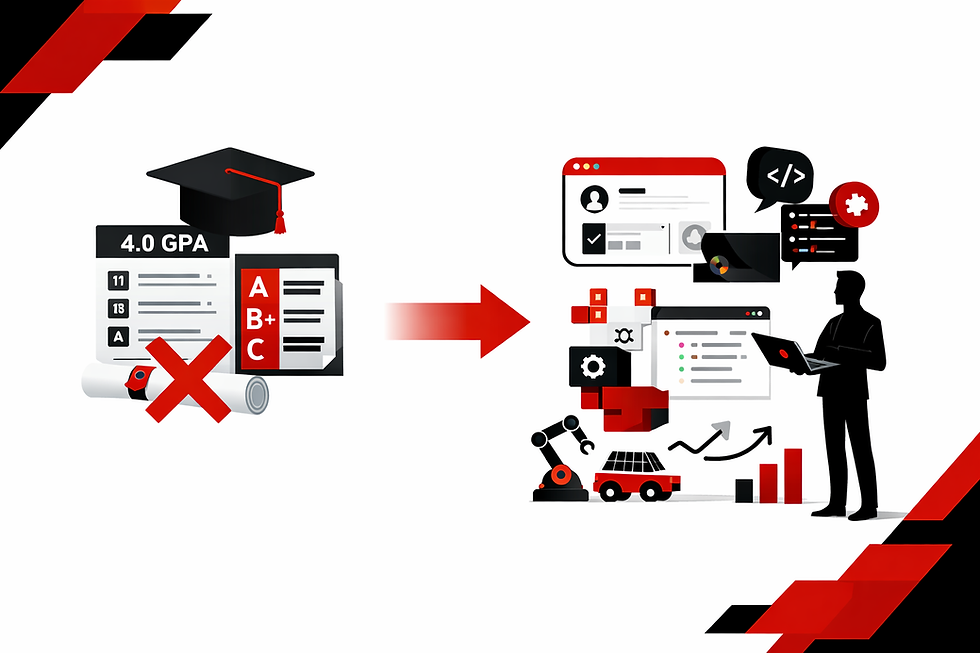
It is 2026, and the "Great Paper Inflation" has officially peaked. For decades, a university degree was the golden ticket—a guaranteed entry into a comfortable middle-class life. But if you walk into any engineering firm or tech startup today, you’ll see that the entry-level market has fundamentally changed. Recruiters are no longer impressed by a 4.0 GPA from a prestigious school if that’s all you have.
The reality of the current job market is that AI has automated the "junior" level tasks. The coding, the basic documentation, and the manual data entry that used to be the bread and butter of new graduates are now handled by autonomous agents. To thrive, you need to be an orchestrator, not just a student. You need to know How to Graduate with Experience, Not Just a Degree.
This isn't just about getting a part-time job or an internship. It’s about building a "Digital Identity" and a "Proof of Work" portfolio that screams competence before you even open your mouth in an interview. In 2026, experience is a choice, not something you wait for an employer to give you.
The 2026 Experience Matrix: Degree vs. Proof of Work
In the engineering domain, the gap between what universities teach and what the industry demands is wider than ever. Here is how the two paths stack up in the eyes of a modern hiring manager.
The Value Gap: Why Experience Wins in 2026
Feature | The Traditional Degree Path | The Experience-First Path | Market Value (2026) |
Primary Proof | Graduation Certificate / Transcript | Public GitHub Repos & Live Demos | Critical |
Technical Skill | Theoretical understanding of math/code | Ability to orchestrate AI agents for builds | High |
Trust Factor | Institutional reputation | Verified community contributions (Open Source) | Critical |
Problem Solving | Solving "Textbook" problems | Solving real-world user pain points | High |
Job Signal | High GPA (Academic Discipline) | System Design & Architectural Logic | High |
Career Trajectory | Entry-level "Trainee" | "Mid-level" Orchestrator from Day 1 | Infinite |
How to Graduate with Experience, Not Just a Degree: A Strategic Roadmap
1. Build Your "Proof of Work" Ecosystem
In 2026, "knowing" is cheap; "doing" is everything. The first step in How to Graduate with Experience, Not Just a Degree is to move away from tutorial hell. Anyone can follow a YouTube video and build a calculator. To prove experience, you must build something that has a user base—even if that base is just ten people.
Think like a founder. Instead of just doing your Final Year Project for a grade, treat it as a Minimum Viable Product (MVP). Deploy it on a live server, manage the database, and handle the "messy" parts of engineering—like security vulnerabilities and latency issues—that textbooks never cover.
2. Master the Art of AI Orchestration
The biggest mistake students make today is using AI to "cheat" or finish homework faster. In contrast, the smartest students use AI as their "Junior Staff." By learning how to direct multiple AI agents to handle frontend, backend, and QA, you are essentially functioning as a Team Lead while still in college.
Recruiters in 2026 aren't looking for the person who can write the best syntax; they are looking for the person who can design the best System Architecture. When you can show that you managed a complex project by orchestrating AI, you aren't just a graduate—you're an experienced system designer.
3. Open Source: The Global Resume
In the engineering world, GitHub is the new transcript. Contributing to open-source projects is the most verifiable way to show you can work on a professional team. When you merge a pull request into a major library like LangChain or a robotics framework, you are being "vetted" by the best engineers in the world.
That merged code is worth more than a thousand "A" grades. It shows you understand version control, peer review, and large-scale codebase maintenance.
Why "Wait for an Internship" is a Dead Strategy
Many students think that the only way to get experience is to wait for a company to "pick" them for an internship. In 2026, this is a dangerous gamble. Thousands of students are applying for the same few spots at Big Tech.
The students who win are those who build their own "Parallel Internships." They spend their weekends contributing to open source, building "One-Person Startups," and documenting their journey in technical blogs. By the time they apply for an internship, they already have more "Live" experience than the senior engineers interviewing them.
The "Silent Skill": System Design
If you want to know How to Graduate with Experience, Not Just a Degree, you must master System Design. AI can write functions, but it still struggles with the high-level logic of how systems talk to each other.
How do you scale a database for 100,000 users?
How do you ensure zero-downtime deployment?
How do you manage state in a distributed system?
These are the "Architectural" skills that separate the survivors from the automated. Spend less time memorizing syntax and more time drawing diagrams.
FAQ: How to Graduate with Experience, Not Just a Degree
1. How can I get experience if I don't have time between classes?
The secret is "Double Dipping." Never do an assignment just for the grade. Every project you do for school should be cleaned up, documented, and pushed to your public portfolio. In the context of How to Graduate with Experience, Not Just a Degree, your coursework is your experience, provided you treat it with professional standards.
2. Is it still worth getting a high GPA in 2026?
It doesn't hurt, but it's no longer a primary signal. A 3.2 GPA with a live, functioning startup project will beat a 4.0 GPA with no portfolio every single time. Employers want to see "Problem-Solving Grit," not just the ability to memorize facts.
3. What is the most important "Digital Identity" platform for engineers?
GitHub is number one, followed closely by a personal technical blog. In 2026, being able to explain why you made a technical decision is just as important as the decision itself. A blog shows your "Communication Stack," which is a high-value skill.
4. Can I really build a startup in my final year?
Absolutely. With current AI tools, the technical barrier to entry is almost zero. The challenge is the "Logic" and "Market Fit." Even if the startup fails financially, the engineering experience you gain from trying to scale a real product is the best "degree" you'll ever earn.
5. Do recruiters actually look at my GitHub?
In 2026, they don't just look at it—their AI hiring agents "scan" it. These agents look for code quality, commit consistency, and how you interact with others in pull requests. Your digital footprint is your true resume.
Conclusion: Own Your 2026 Career
The era of the "Passive Student" is over. You can no longer afford to spend four years just absorbing information and waiting for a degree to transform your life. You have to be the architect of your own experience.
By building in public, contributing to open source, and mastering system design, you ensure that when you walk across that stage, you aren't just holding a piece of paper—you're holding a career. How to Graduate with Experience, Not Just a Degree is about shifting your mindset from "Student" to "Builder."


Comments