Why Every Indian College Student Suddenly Wants to Be a Content Creator — And the Reality Check They Need
- Jun 20
- 9 min read
A few years ago, the dream jobs on campus were software engineer, doctor, MBA graduate, or government officer. Today, there's a new answer quietly appearing in classrooms across India: content creator.
Walk into any college canteen from Mumbai to Bengaluru, and the conversations have shifted. You’ll hear students debating YouTube click-through rates over samosas, planning Instagram Reels between lectures, drafting thought-leadership posts for LinkedIn during boring presentations, or scouting quiet corners on campus to record a podcast. The traditional campus placements are no longer the exclusive holy grail. Instead, "building a personal brand" has taken center stage.
This leaves us with a fascinating, polarizing question: Is content creation a genuine career opportunity for the youth of India—or are students falling for the internet's newest, highly engineered fantasy?
1. The Creator Dream Is Everywhere
It is almost impossible to scroll through social media without encountering a massive Indian creator success story. We watch 20-something vloggers buying luxury cars, tech reviewers getting invited to global launch events, and finance creators breaking down complex stock market trends to millions of listeners.
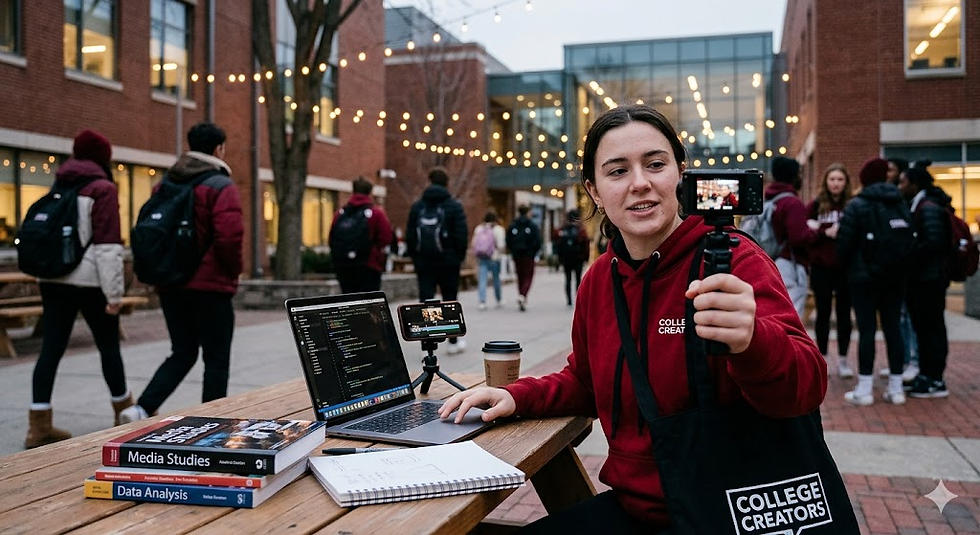
This relentless exposure creates a powerful psychological shift. When a student sees an influencer their own age securing premium brand sponsorships or building an independent startup from their bedroom, the traditional corporate ladder suddenly looks incredibly slow. The creator dream isn't just about entertainment anymore; it feels accessible, lucrative, and entirely within reach for anyone with a smartphone and an internet connection.
2. Why Traditional Career Paths Feel Less Certain
To understand why a college student content creator explosion is happening, we have to look at the state of traditional paths. The anxiety on Indian campuses today is palpable.
Placement Anxiety & Competition: Landing a high-paying campus placement has become an absolute bloodbath, with thousands of applicants fighting for a handful of coveted roles.
Graduate Unemployment: The market is saturated with engineering and management graduates, many of whom face long periods of underemployment.
The Threat of AI Disruption: With artificial intelligence automating entry-level coding, writing, and analytical tasks, students are genuinely worried that the jobs they are studying for might not even exist by the time they graduate.
In this climate of uncertainty, the creator economy India offers an alternative. It represents a space where your employment isn't dependent on a human resources manager or a placement cell coordinator. You don't need a CV to post a video—you just need to hit upload.
3. The Appeal Is About More Than Money
While the financial rewards can be staggering, the emotional pull of this industry goes much deeper. For Gen Z creators, the ultimate luxury isn't just a high salary; it's autonomy.
Absolute Freedom: The ability to work from anywhere, anytime, without a boss monitoring your screen.
Creative Expression: A canvas to talk about niche passions—whether it's anime, poetry, history, or indie game development.
Instant Recognition: Building a community of people who genuinely look forward to your perspective provides a profound sense of validation and belonging that a corporate desk job rarely offers.
Ultimately, students are drawn to content creation because it promises the chance to build something entirely personal. It turns an individual into an institution.
4. The Social Media Illusion
However, this is exactly where the reality check becomes necessary. Social media is a machine built on survivorship bias.
Algorithms naturally boost and highlight viral success stories. When an Indian student breaks through and hits one million subscribers, their milestone is celebrated across platforms. What the algorithm hides are the hundreds of thousands of creators who have posted twice a week for two years to an audience of fifty people.
Everyone sees the creator signing six-figure brand deals. Nobody sees the burnout, the creative dry spells, or the vast, silent majority who eventually delete their channels out of sheer exhaustion. It is a hyper-visible lottery where we only see the winners.
5. What Content Creation Actually Looks Like
The biggest disconnect among student influencers is the gap between consumption and production. Watching a sleek, 60-second video is effortless. Producing it is a grueling, multi-disciplinary operation.
True content creation isn't just talking to a camera; it is running a solo media house. It requires you to be a researcher, scriptwriter, director, lighting technician, audio engineer, video editor, community manager, and data analyst all at once.
What People Think Creators Do | What Creators Actually Do |
Record fun videos | Operate a small, high-pressure media business |
Post content effortlessly | Spend hours on research, editing, marketing, and SEO |
Get famous overnight | Build systems, scripts, and rigorous consistency |
Earn massive sponsorships | Spend months or years creating without a single rupee of income |
6. The College Student Content Creator Explosion
Indian colleges have inadvertently become the perfect incubators for the social media careers movement. Campuses are dense hubs of shared experiences, trends, and built-in audiences.
We see campus vloggers documenting "a day in my life at IIT/DU," study influencers live-streaming their 10-hour prep sessions, coding creators sharing roadmap tutorials, and lifestyle influencers showcasing campus fashion. Because students live together, study together, and share the same anxieties, a student creator has an immediate feedback loop. They know exactly what hurts, what's funny, and what will resonate with their peers.
7. The Skill Nobody Talks About
Many students jump into this field believing that learning how to edit on Premiere Pro or using a high-end camera is the secret sauce. It isn't. The real skill isn't content creation; it's audience building.
Creating a video is a technical task. Building an audience requires a deep, psychological understanding of human nature. It means earning a stranger's trust, maintaining absolute consistency even when you don't feel like it, communicating complex ideas simply, and nurturing a community over years. These are incredibly difficult emotional and social skills to develop, and they cannot be bypassed by an algorithm hack or a viral audio trend.
8. The Good News: Content Creation Teaches Real Skills
Despite the steep learning curve, entering the creator space is far from a waste of time. Even if a student never hits a massive follower milestone or turns it into a full-time career, the journey itself is a masterclass in professional development.
By consistently creating content, you naturally develop high-income skills:
Public Speaking & Communication: You learn to articulate ideas clearly and confidently.
Copywriting & Storytelling: You master the art of holding an audience’s attention.
Digital Marketing & Analytics: You learn how to read data, interpret user behavior, and iterate based on metrics.
Project Management: Balancing college schedules, exams, assignments, and a content calendar teaches unprecedented self-discipline.
If a recruiter sees a candidate who built a highly engaged community of 5,000 people around a specific topic, that candidate instantly stands out from a pile of identical résumés.
9. The Dangerous Side
We cannot discuss influencer culture India without addressing its dark side. When your career, self-worth, and daily mood are tied to an algorithmic feed, things can get toxic very quickly.
Many young creators fall into the trap of validation addiction. A dip in views is misinterpreted as a personal failure. Comparison culture thrives here; watching a peer's channel blow up while yours plateaus can trigger intense anxiety and feelings of inadequacy. When your identity becomes completely enmeshed with your public metrics, creative burnout is not an "if"—it is a "when."
10. The Students Who Usually Succeed
When you look closely at the college students who successfully transition from hobbyists to sustainable creators, a distinct pattern emerges.
They don't share a secret algorithm trick; they share a mindset. These students play the long game. They possess a deep, genuine interest in their niche that exists independent of views. They are curious, highly analytical about their own mistakes, patient enough to handle months of zero growth, and deeply committed to providing actual value to the person watching on the other side of the screen. They aren't chasing quick fame; they are chasing mastery.
11. The Students Who Usually Burn Out
On the flip side, the students who quit within three to six months usually share a predictable trajectory. They enter the space purely attracted by the glamour and quick monetization. They copy whatever is currently viral, jump from trend to trend without any personal voice, and set unrealistic expectations of hitting tens of thousands of followers in weeks. When the initial excitement fades and they are faced with the reality of editing a video at 2 AM after an exhausting college exam, they quickly abandon the project.
12. Content Creation vs Skill Building: The False Choice
A common, destructive narrative on Indian campuses is that you have to choose a side: you are either a serious student building professional skills, or you are a content creator. This is a false dichotomy.
In fact, the strongest content almost always comes from the intersection of expertise and media.
Coding + Content: A computer science student who builds real software and documents their bugs.
Finance + Content: A commerce student analyzing real corporate earnings reports for fun.
Design + Content: An architecture student tearing down and rebuilding bad city layouts.
Your core domain expertise is what makes your content valuable. The students who win in the creator economy are usually the ones who spent years becoming interesting before they tried becoming famous.
13. The AI Factor
As we look at the creator economy 2026 landscape, AI has completely changed the rules of the game. Today, anyone can generate a script, create an AI voiceover, or stitch together stock footage in seconds. The barrier to entry to create "content" has dropped to absolute zero.
This realities forces a massive shift in value. If anyone can produce generic content with a prompt, what actually becomes valuable?
The answer is simple: Authenticity, lived experience, and raw human perspective. Audiences are turning away from over-polished, generic information. They want to see real faces, hear real failures, and connect with genuine personalities. Your unique human perspective is your only moat against automation.
14. Would I Recommend Content Creation to College Students?
If a junior walks up to me in the college courtyard today and asks, "Should I start a channel or an account?" my answer is an emphatic, nuanced yes—but with conditions.
Start creating if your goals are to:
Build a robust personal brand and a professional network.
Conquer your fear of public speaking and refine your communication skills.
Document your genuine learning journey and share value with others.
Do not start creating if:
You view it as a magical escape hatch from studying or working hard.
Your mental peace is entirely dependent on external validation, likes, and comments.
It severely compromises your academic foundation and core skill development.
15. The Better Way to Think About It
The ultimate paradigm shift is to decouple content creation from the desire for fame. Don't start creating content because you desperately want to become an influencer. Start because you have stumbled upon something fascinating, learned a hard lesson, or mastered a skill that you believe is genuinely worth sharing.
When you shift your goal from "How do I get one million views?" to "How do I genuinely help or entertain the 100 people watching this?", the pressure evaporates. The process becomes sustainable, the content becomes authentic, and ironically, your chances of actual growth skyrocket.
Conclusion
Content creation isn't the shortcut many Indian students think it is. It is a demanding, unpredictable, and highly competitive landscape that requires a distinct set of entrepreneurial skills.
But if approached with the right mindset, it might just be one of the most valuable side quests you can pursue during your college years. Don't chase the virality; focus on the skills, build your domain expertise, and play the long game. The audience will follow when you have something truly valuable to say.
FAQs
1. Is content creation a good career in India?
Yes, it can be a highly lucrative and fulfilling career, but it functions much like an entrepreneurial venture. It features high income potential for top creators through brand deals, merchandising, and ad revenue, but lacks the immediate financial stability, health benefits, and structure of a traditional corporate job.
2. Can college students become successful creators?
Absolutely. Many of India’s most prominent creators started their journeys directly from their hostel rooms. College students are uniquely positioned because they understand youth trends, have access to a tight-knit campus peer network, and generally have more flexible schedules to experiment than working professionals.
3. Should students focus on content creation or skills?
They should focus on both simultaneously. Content creation without a foundational skill or domain expertise often results in superficial, generic content. The most sustainable approach is to develop a hard skill (like coding, design,
finance, or writing) and use content creation as a medium to share your progress.
4. How long does it take to earn money from content?
For most creators, it takes anywhere from 6 to 18 months of consistent uploading before seeing any meaningful financial returns. Monetization relies heavily on building a loyal, highly engaged audience rather than just hitting a random viral milestone.
5. Is influencer culture growing in India?
Yes, it is expanding rapidly. With affordable high-speed internet reaching tier-2 and tier-3 cities, localized and regional language content is seeing exponential growth. Brands are continuously shifting a significant portion of their traditional advertising budgets toward influencer marketing.
6. What skills does content creation teach?
It teaches a broad, highly versatile stack of modern digital skills, including video production, scriptwriting, storytelling, public speaking, search engine optimization (SEO), digital marketing, data analytics, and project management.
7. Can content creation help with placements?
Yes. Having a well-curated personal brand on platforms like LinkedIn or a portfolio on YouTube can serve as a living resume. It demonstrates proactiveness, real-world communication skills, and digital literacy to forward-thinking recruiters.
8. Why do many creators quit?
Most creators quit due to creative burnout, unrealistic expectations of overnight fame, or an inability to handle the emotional highs and lows of fluctuating algorithmic metrics. When views drop, the lack of immediate validation can make the heavy workload feel unsustainable.
9. Does AI make content creation easier or harder?
AI makes the technical process of creating content (editing, script generation, research) much easier, but it makes standing out significantly harder. Because the internet is becoming flooded with generic AI-generated media, unique human perspective and authentic authority are more critical than ever.
10. Should students start creating content in college?
Yes, college is the absolute best time to experiment. The financial stakes are generally lower than they will be post-graduation, and the skills you pick up along the way will heavily benefit you regardless of whether you choose a corporate desk or a full-time creator path.


Comments