Indian E-Commerce Export Playbook 2026: Complete Guide for First-Time Exporters
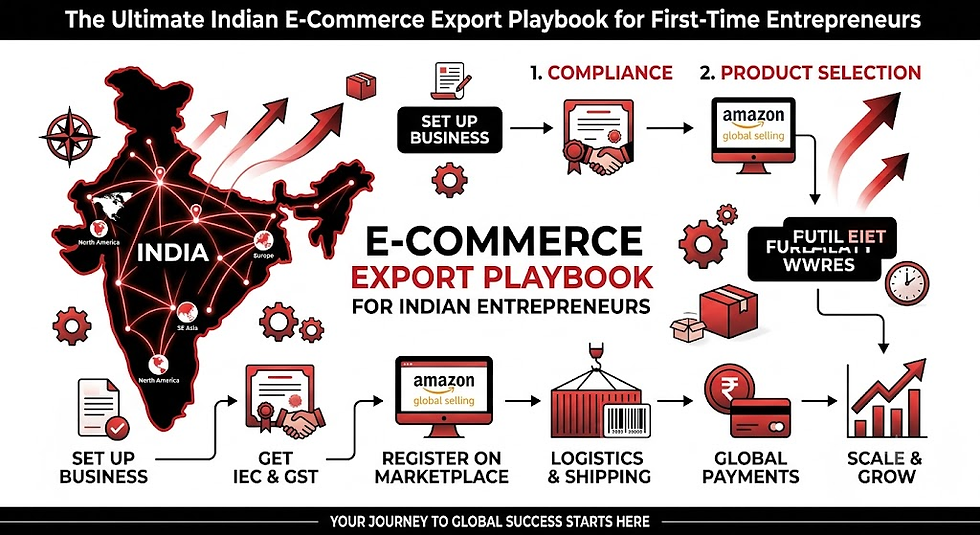
Cross-border e-commerce has transformed from an experimental growth channel into an indispensable revenue pillar for Indian brand founders, manufacturers, and micro, small, and medium enterprises (MSMEs). Driven by unprecedented global demand for authentic Indian products—ranging from handcrafted textiles and traditional footwear to organic wellness formulas, specialty teas, and artisanal jewelry—Indian brands are reaching consumers in North America, Europe, the Middle East, and Southeast Asia faster than ever before.
In fiscal year 2025–26, India recorded historic trade milestones, reaching an all-time high of over $863 billion in total combined exports. Under the Government of India’s Foreign Trade Policy (FTP), the country has set an ambitious target of reaching $200 billion to $300 billion in annual cross-border e-commerce exports by 2030. To achieve this, government ministries, the Directorate General of Foreign Trade (DGFT), the Reserve Bank of India (RBI), and Central Board of Indirect Taxes and Customs (CBIC) have systematically dismantled long-standing regulatory hurdles, digitizing compliance and establishing dedicated e-commerce infrastructure.
However, navigating international compliance, customs procedures, global payment reconciliations, and cross-border logistics can feel overwhelming for first-time exporters. This guide provides a definitive, step-by-step breakdown designed to turn international trade into a repeatable, profitable system.
The Strategic Foundations of the Indian E-Commerce Export Playbook
Before dispatching your first international parcel, you must build a bulletproof legal and regulatory foundation. Skipping foundational compliance can lead to seized shipments, frozen bank accounts, or heavy regulatory penalties under the Foreign Exchange Management Act (FEMA).
1. Business Entity & IEC Registration
Every commercial exporter operating from India requires an Importer Exporter Code (IEC). Issued by the DGFT, the IEC is a 10-digit identification number linked directly to your Permanent Account Number (PAN).
Process: You can apply online via the DGFT portal using your Aadhaar or digital signature certificate (DSC). Approval is typically granted within 24 to 48 hours.
Business Structure: While sole proprietorships can hold an IEC, forming a Limited Liability Partnership (LLP) or Private Limited Company offers superior legal protection and credibility when negotiating with foreign partners or seeking growth capital.
2. Authorized Dealer (AD) Code Registration
An AD Code is a 14-digit numerical code issued by your business bank branch (an Authorized Dealer bank registered with the RBI). It certifies that your bank account is authorized to handle foreign currency remittances.
ICEGATE Integration: Once obtained, your AD Code must be registered on the Indian Customs Electronic Gateway (ICEGATE) for every port, airport, or Foreign Post Office (FPO) from which your goods will depart. Without registered AD Codes, customs systems cannot generate digital shipping bills or track foreign inflow.
3. GST Registration & Letter of Undertaking (LUT)
Exporting physical goods is treated as a "zero-rated supply" under India’s Goods and Services Tax (GST) framework. This means you do not need to collect GST from international buyers.
Filing an LUT: To export without paying Integrated GST (IGST) upfront, first-time exporters must file a Letter of Undertaking (LUT) annually through the GST portal. This preserves your operational cash flow. Alternatively, you can pay IGST at export and later claim an IGST refund on ICEGATE, though the LUT path remains the preferred route for D2C e-commerce.
Product Selection, Niche Positioning, and Global Duty Landscapes
Success in cross-border e-commerce requires selling items that offer high perceived value relative to their volumetric weight. Lightweight, non-perishable, and high-margin products perform best in cross-border logistics.
High-Growth Export Categories for Indian Exporters
Apparel & Ethnic Wear: Handcrafted sarees, embroidered lehengas, organic cotton loungewear, and leather footwear.
Ayurveda, Beauty & Wellness: Natural skincare, herbal supplements, essential oils, and organic hair treatments (subject to destination-country health approvals).
Home Decor & Handicrafts: Brass artifacts, wooden carvings, hand-knotted rugs, and sustainable bamboo homeware.
Gourmet Food & Beverages: Single-origin spices, specialty Darjeeling/Assam teas, and organic superfoods.
Navigating the 2026 Global Import Tariff & De Minimis Rules
International trade policy has evolved rapidly. Exporters must design their pricing models around destination-specific customs duties and taxes:
United States: Following recent legislative updates, the $800 duty-free de minimis threshold has seen increased scrutiny and adjustments for specific product categories. Exporters must ensure complete 10-digit Harmonized System (HS) codes and accurate manufacturer details are provided on every commercial invoice to avoid border holds.
European Union (EU): The EU requires Import One-Stop Shop (IOSS) registration for sales under €150. IOSS allows e-commerce merchants to collect VAT at checkout, facilitating faster customs clearance without unexpected charges for the customer at delivery.
United Kingdom: Sales to UK buyers under £135 require the merchant or marketplace to collect UK VAT (20%) at the point of sale and remit it directly to HM Revenue & Customs (HMRC).
Logistics and Customs Clearance: CSB-IV vs. CSB-V
Fulfilling international orders requires choosing between postal channels and express commercial couriers. Understanding Indian customs clearance documents is vital for long-term compliance.
Choosing CSB-V for Commercial E-Commerce
For commercial sales, first-time entrepreneurs should insist that their logistics partner files a Courier Shipping Bill V (CSB-V). CSB-V supports commercial shipments up to ₹10,00,000 (10 Lakhs) per consignment. Filing CSB-V ensures that your shipment is formally recorded as a commercial export, making you eligible for government export incentive schemes like RoDTEP (Remission of Duties and Taxes on Exported Products) and ensuring smooth banking reconciliation.
E-Commerce Export Hubs (ECEHs) & Postal Exports
To further streamline small-value shipping, DGFT and India Post have established nationwide infrastructure:
Dak Ghar Niryat Kendras (DNK): India Post operates hundreds of DNK centers across urban and rural districts. Through the online DNK portal, small sellers can book international parcels, complete paperless customs documentation, and drop off packages at their local post office for worldwide dispatch via Foreign Post Offices (FPOs).
DGFT E-Commerce Export Hubs (ECEHs): These plug-and-play logistics facilities combine warehousing, customs inspection, return-processing centers, and expedited air-cargo connectivity under one roof, reducing international fulfillment timelines for D2C brands.
Banking, Foreign Exchange, and RBI Compliance: Navigating EDPMS
A common operational hurdle for new Indian exporters involves foreign exchange tracking. Under FEMA, every dollar, euro, or pound earned through exports must be repatriated back to India and reconciled through official banking channels.
How EDPMS & e-BRC Work
Shipping Bill Generation: When your parcel passes customs under CSB-V, Customs automatically transmits the shipping bill data to the RBI’s Export Data Processing and Monitoring System (EDPMS).
Foreign Remittance Arrival: When your buyer pays via a payment gateway or international wire, your bank receives the foreign currency and issues a Foreign Inward Remittance Advice (FIRA) or Foreign Inward Remittance Certificate (FIRC).
Reconciliation & e-BRC: Your bank links the inward remittance to the corresponding shipping bill in EDPMS to close the entry. Once "knocked off" in EDPMS, an Electronic Bank Realisation Certificate (e-BRC) is generated digitally.
Note: Unreconciled shipping bills older than nine months can land an exporter on the RBI Caution List, blocking future international shipments. Under updated RBI frameworks, streamlined self-declaration rules simplify the digital closure of small-value e-commerce shipping bills (under ₹10 lakh), drastically reducing administrative burdens for growing businesses.
Sales Channels: Global Marketplaces vs. Standalone D2C Stores
First-time Indian exporters typically choose between global online marketplaces or building an independent Direct-to-Consumer (D2C) online storefront.
1. Global Marketplaces (Speed to Market)
Platforms: Amazon Global Selling, Etsy, eBay, and Walmart Marketplace.
Pros: Built-in international buyer traffic, trusted checkout systems, and integrated fulfillment options like Fulfillment by Amazon (FBA), where you store inventory in destination-market warehouses.
Cons: Higher referral fees, strict seller performance metrics, and limited ownership of customer data.
2. Standalone D2C Webstores (Brand Ownership)
Platforms: Shopify, WooCommerce, or Magento integrated with international shipping aggregators (e.g., Shiprocket X, Lexship, DHL Express).
Pros: Complete control over brand identity, higher profit margins, direct access to customer email lists, and long-term customer equity.
Cons: Requires active marketing investment in performance ads (Meta, Google, TikTok), search engine optimization (SEO), and localized multi-currency checkout tools.
Recommended Hybrid Strategy: Start on a marketplace like Amazon Global Selling or Etsy to establish early cash flow and validate product demand. Concurrently, build your standalone D2C webstore to cultivate brand loyalty and drive repeat sales.
Frequently Asked Questions (FAQs)
Q1: Why do first-time sellers need an Indian e-commerce export playbook?
An Indian e-commerce export playbook provides a structured roadmap through regulatory compliance, CSB-V customs filings, RBI EDPMS tracking, and international logistics. Following a systematic playbook helps first-time Indian entrepreneurs avoid shipment rejections, legal penalties under FEMA, and unexpected border duties.
Q2: Can I export goods from India without a GST number?
No. Commercial export of physical goods requires a valid GST registration. While exports are zero-rated under GST laws, having a GSTIN is mandatory to file a Letter of Undertaking (LUT), claim Input Tax Credit (ITC) on raw materials, and clear commercial customs via CSB-V.
Q3: What is the maximum order value allowed under CSB-V for e-commerce exports?
Under current Indian customs regulations, commercial e-commerce shipments valued up to ₹10,00,000 (10 Lakhs) per consignment can be exported using the Courier Shipping Bill V (CSB-V) format through registered courier terminals and express hubs.
Q4: How long do I have to bring foreign payment back to India?
According to RBI guidelines under FEMA, realization and repatriation of full export proceeds must be completed within nine months from the date of shipment. Failure to reconcile inward remittances against open shipping bills in EDPMS within this timeframe may lead to bank caution-listing.
Launch Your Global Journey: Strategic Resources & Next Steps
Going global is no longer reserved for large multinational corporations. With the right compliance foundation, logistics integrations, and payment workflows, an Indian entrepreneur operating from a home office or small workshop can build a global brand.
To begin setting up your cross-border enterprise, explore these official portals:
Obtain Your IEC & Explore Trade Policy: Visit the official Directorate General of Foreign Trade (DGFT) Portal to apply for your Importer Exporter Code and access trade facilitation services.
Register for Customs Digital Services: Set up your business profile and link your AD Code on the ICEGATE - Indian Customs Portal.
Access Local Postal Export Centers: Learn how to ship international parcels through your nearest post office using the India Post Dak Ghar Niryat Kendra (DNK) Portal.
Explore Global Marketplace Expansion: Launch your products across international storefronts via Amazon Global Selling India.


Comments