Is Scaler School of Technology the Future of Engineering Education? Use Code CS500 for Exclusive Benefits
- May 26
- 8 min read
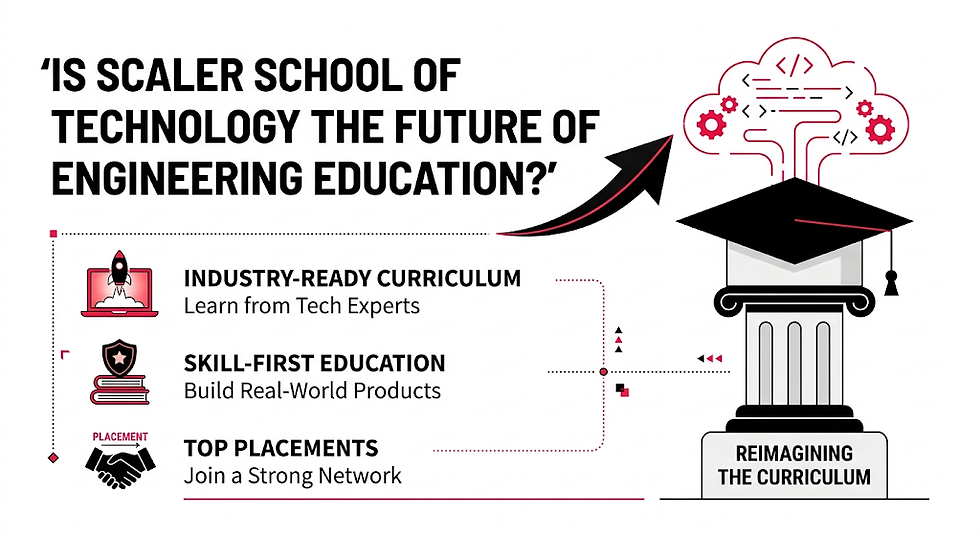
The global tech landscape in 2026 is moving at a breakneck pace. With generative AI, autonomous software agents, and cloud-native microservices rewriting the rules of the market, traditional engineering colleges are facing an unprecedented crisis. The classic four-year computer science degree, burdened with outdated theoretical syllabi and rigid rote-learning methods, is struggling to keep up with industry requirements. Tech leaders openly criticize the widening gap between what legacy universities teach and what modern software product companies actually require from fresh engineering graduates.
Amid this educational disruption, a new paradigm has emerged to challenge the status quo. Scaler School of Technology (SST), situated right in the heart of India’s Silicon Valley—Bengaluru—has positioned itself not simply as an alternative, but as a complete architectural reimagining of higher education. But a critical question remains for tech aspirants and parents alike: Is Scaler School of Technology truly the future of engineering education?
In this deep-dive analysis, we will explore Scaler School of Technology’s unique 4-year residential program in Computer Science, its hands-on industry curriculum, 2026 placement trends, and how it directly compares to legacy institutions like the IITs, NITs, and top-tier private universities.
If you are ready to fast-track your tech career with a curriculum built for the real world, you can take your first step today. Apply now using CS500 Code: https://scalerschooloftech.com/4ruflJ5 to unlock premium application mentorship and exclusive scholarship benefits.
The Crisis in Legacy Engineering Education (2026 Perspective)
To understand why Scaler School of Technology is gaining massive structural traction, we must honestly evaluate the current state of traditional engineering programs. For decades, pursuing a B.Tech in Computer Science meant cracking hyper-competitive entrance exams, only to spend the next four years studying obsolete hardware concepts, drawing mechanical graphics on drawing sheets, or memorizing code to write it down on physical paper during final semester exams.
The real-world consequences of this traditional educational model are stark:
The Employability Gap: Over 80% of Indian engineering graduates remain structurally unemployable in core product engineering roles without massive external upskilling or expensive corporate training pipelines.
Static Curricula: While the software industry is actively deploying multi-agent LLM systems and advanced Kubernetes architectures, legacy university syllabi take years to pass through bureaucratic academic councils, rendering them completely obsolete by the time they hit classrooms.
Lack of Real Mentorship: Professors in traditional setups are often career academicians who have never built, scaled, or deployed a high-traffic software product in a real-world corporate tech environment.
This is exactly where Scaler flipped the script. Instead of structuring an educational institution around rigid academic compliance, they built it from the ground up around deep industry integration.
What is Scaler School of Technology?
Scaler School of Technology offers an intensive, fully residential 4-year program in Computer Science designed explicitly to cultivate elite software engineers. Unlike traditional colleges that award conventional university-stamped degrees focused heavily on theory, Scaler provides a hyper-practical learning ecosystem.
They partner with recognized universities to offer UGC-approved parallel degrees (such as a B.Sc. in Computer Science and an MCA pathway). This dual-structure approach ensures that students hold the official academic credentials necessary for higher international studies, competitive exams, or public sector roles, while the actual day-to-day core program delivery is managed by Scaler's elite industry faculty.
The program is structured into clear, milestone-driven phases that systematically transition a student from a complete beginner to an industry-ready tech professional:
Years 1 & 2 (Foundations & System Architecture): Mastery of Data Structures, Algorithms, Advanced Low-Level & High-Level System Design, Full-Stack Development, and AI/ML foundations.
Year 3 (One-Year Paid Industry Internship): A mandatory, full-length internship working inside top-tier tech product companies, earning a real stipend while gaining verifiable corporate experience.
Year 4 (Advanced Specialization & Engineering Leadership): Specializing in domains like Next-Gen Generative AI, Algorithmic Trading, or Cloud Systems, alongside building complex, production-grade capstone projects.
Why Scaler School of Technology Represents the Future of Engineering Education
When we rigorously evaluate whether Scaler constitutes the future of engineering education, we must examine the core differences in their daily learning delivery model.
1. A Curriculum Co-Created with Tech Leaders
At Scaler, the curriculum is updated dynamically based on real-time hiring metrics. In 2026, as companies rapidly shift focus toward AI-assisted software development and distributed cloud systems, Scaler students are already building production-grade applications using these frameworks. You won't find students writing code on paper here; assessments are entirely project-based, managed via GitHub workflows and automated testing suites.
2. Faculty from the Trenches of Top Tech
Instead of traditional professors, classes at Scaler School of Technology are taught by tech veterans who have spent years building infrastructure at Google, Microsoft, Amazon, Meta, and Netflix. When a student learns about microservices or system scalability, they are learning it directly from an engineer who managed infrastructure for millions of active users.
3. Integrated 1-Year Paid Internships
In a traditional engineering college, internships are an afterthought—lasting only two months during summer breaks. Scaler integrates a rigorous, full-year paid internship into its third-year structure. By the time an SST student graduates, they already have a full year of corporate experience on their resume, making them vastly more attractive to recruiters than a fresh graduate with only textbook knowledge.
Don't wait for a traditional placement cell to hand you outdated roles. Take control of your tech journey right now. Apply now using CS500 Code: https://scalerschooloftech.com/4ruflJ5 to get started with your application today.
Deep Dive: The SST Curriculum and 2026 Specializations
The academic engine of Scaler is tuned for high performance. The first two years compress the foundational elements of computer science with intense operational rigor. Students don't just learn programming languages; they learn the underlying paradigms of modern software craft.
Phase / Year | Core Focus Areas | Key Outcomes |
Year 1 | Advanced Problem Solving, DSA, Frontend & Backend Basics, Math for CS | Building scalable web apps from scratch |
Year 2 | Low-Level & High-Level System Design, Cloud Computing, DevOps, AI Integrations | Developing production-ready distributed systems |
Year 3 | 12-Month Immersive Industry Internship | Real-world corporate exposure and financial independence via stipends |
Year 4 | Advanced Specializations (Generative AI, Cyber Security, Cloud Native Systems) | Engineering leadership and capstone deployment |
In 2026, Scaler has introduced dedicated modules on Generative AI engineering, prompt optimization architectures, and LLM fine-tuning, ensuring that their students are at the absolute cutting edge of the artificial intelligence wave. This agile curriculum model proves why many experts see this disruptive methodology as the definitive blueprint for modern tech learning.
Traditional B.Tech vs. Scaler School of Technology: A Direct Comparison
Choosing where to spend your next four years is a critical decision. Let’s look at a head-to-head comparison between a standard tier-1/tier-2 B.Tech college and Scaler School of Technology.
The Learning Environment
Traditional colleges rely heavily on passive lecture structures. Students attend lectures to maintain mandatory 75% attendance criteria, often self-studying from online tutorials right before exams. At Scaler, the environment mimics a high-growth tech startup. Students work in collaborative open spaces, participate in regular weekend hackathons, and resolve real-time bugs under the direct guidance of dedicated instructional associates.
Placement Mechanisms
Traditional placement cells rely on legacy corporate relationships to bring companies for mass recruitment or standard entry-level service roles. Scaler leverages its massive network of 900+ partner tech companies (built through its highly successful professional upskilling track, Scaler Academy). Because these companies already trust Scaler to upskill their existing internal workforces, they aggressively hire fresh talent out of Scaler's ecosystem.
If you want to bypass the broken campus placement system and enter an ecosystem built for elite tech roles, make your move now. Apply now using CS500 Code: https://scalerschooloftech.com/4ruflJ5 and secure your future.
Analyzing the 2026 Placement Stats and Industry Acceptance
A common concern among traditional parents is: Will top tech companies accept a non-traditional program? The data from 2025 and early 2026 completely dismantles this doubt. Scaler's parent company has a proven track record of placing thousands of alumni in top product companies with stellar packages. For the School of Technology undergraduate cohort, early internship performance and pre-placement offers (PPOs) have set new benchmarks:
Average Stipends: Third-year students during their 1-year internship are securing stipends ranging from ₹40,000 to over ₹1,00,000 per month.
Top Recruiters: Companies like Uber, Microsoft, Razorpay, Flipkart, and Atlassian are actively onboarding Scaler students because they require zero onboarding training—they can ship production code on day one.
Global Exposure: With a curriculum built on international standards, graduates are well-positioned for global remote roles and international tech engineering jobs.
The market has spoken: tech companies don't care about the name of an ancient college building; they care about clean code, problem-solving capabilities, and systemic architectural understanding.
Is Scaler School of Technology Right for You?
While Scaler is pioneering a phenomenal model, it is not a magic pill for everyone. The program requires intense commitment, passion for technology, and a strong work ethic.
Who is it for?
Students who are deeply passionate about computers, software building, and problem-solving.
Individuals who want to skip generic subjects like chemistry or mechanical workshops and focus 100% on computer science.
Driven aspirants who want financial independence early through high-paying corporate internships.
Who is it NOT for?
Students looking for a relaxed, easy-going college life focused entirely on traditional campus festivals and minimal study.
Individuals whose primary goal is a standard government job that strictly requires a traditional, multi-discipline 4-year B.Tech degree configuration.
Frequently Asked Questions (FAQs)
Q1: Is Scaler School of Technology safe for the future of engineering education?
Ans: Yes, absolutely. Scaler School of Technology represents the absolute future of engineering education because it completely solves the industry-academia mismatch. By embedding a 1-year corporate internship, hiring active tech leaders as faculty, and keeping a real-time updated syllabus, SST ensures its students remain highly employable and ahead of structural industry shifts, unlike traditional engineering formats.
Q2: Does Scaler offer a recognized degree?
Ans: Scaler School of Technology provides a practical, industry-led program alongside a fully recognized, UGC-approved degree pathway (like a B.Sc. in Computer Science and an MCA) through its affiliated university partners. This ensures students get the best of both worlds: elite, practical tech skill sets from Scaler and formal degree recognition for higher education or visa purposes.
Q3: How competitive is the admission process for SST?
Ans: The admission process is highly selective. Candidates must pass the Scaler NSET (National Scholarship and Entrance Test), followed by multiple rounds of interviews evaluating mathematical aptitude, logical reasoning, and passion for technology.
Q4: What is the benefit of using the application code CS500?
Ans: Using the specific application code CS500 grants you exclusive benefits, including fast-tracked profile verification, access to premium scholarship opportunities, and dedicated mentorship sessions with Scaler experts during your intake process.
Final Verdict: Step Into the Future of Tech
Traditional engineering education models are fracturing under the weight of accelerated technological growth. As we move deeper into 2026, the demand for highly specialized, agile, and practical software creators will only grow. Scaler School of Technology has laid out a compelling roadmap that prioritizes mastery over memorization, mentors over professors, and real-world impact over traditional paper degrees. If you want to become an elite software engineer and future-proof your career against automation, Scaler is arguably the most powerful platform available today.
Secure Your Seat Today
Ready to take the leap and join the next generation of tech leaders? Use the verified official links below to submit your application and unlock exclusive benefits.
🚀 Official Admission Portal: Apply now using CS500 Code: https://scalerschooloftech.com/4ruflJ5
💡 Exclusive Coupon Code: Make sure CS500 is applied at check-out for optimized registration and premium scholarship access.
📞 Next Steps: Fill out your foundational details, clear the NSET examination, and prepare to accelerate your tech journey like never before!


Comments