Mastering MHT CET 2026: The Ultimate 90-Day, 60-Day, and 30-Day Preparation Strategy for Top Percentiles
- Jun 15
- 8 min read
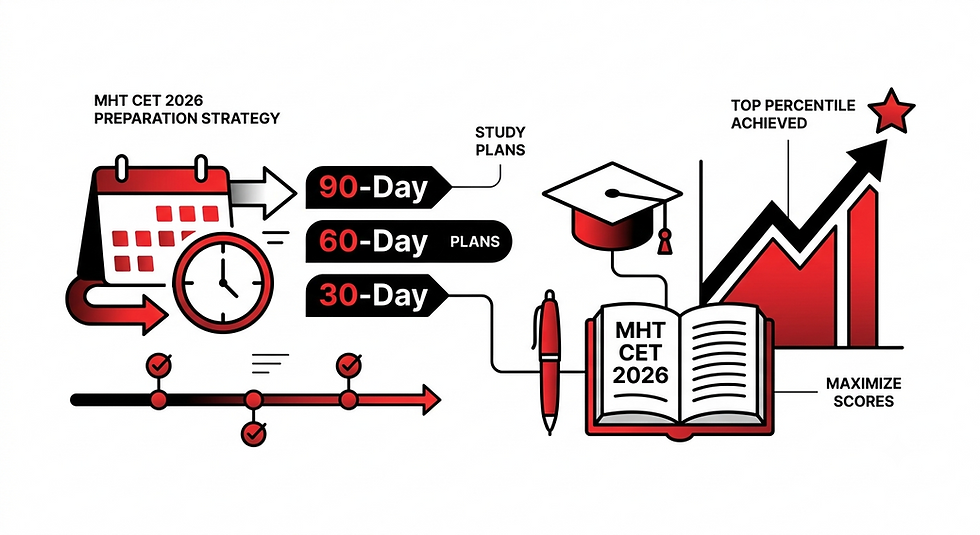
With over 700,000 students competing annually for elite seats in Maharashtra’s premier engineering and pharmacy institutes like COEP, VJTI, and ICT, the stakes for the State Common Entrance Test Cell's examination have never been higher. As the competitive landscape evolves, relying on haphazard study routines is no longer an option. Securing a 99+ percentile demands a structured, high-yield, and meticulously timed MHT CET 2026 preparation strategy.
Whether you have three months left or are entering the final month-long crunch, your approach to the State Board textbook curriculum, mock tests, and time management will dictate your success. This definitive guide breaks down actionable 90-day, 60-day, and 30-day timelines designed to maximize your score and secure your dream college seat.
Understanding the MHT CET Landscape in 2026
The Maharashtra Common Entrance Test (MHT CET) remains a computer-based test split primarily into two groups: PCM (Physics, Chemistry, Mathematics) and PCB (Physics, Chemistry, Biology).
                       ┌─────────────────────────┐
                       │   MHT CET Exam Split    │
                       └────────────┬────────────┘
                                    │
            ┌───────────────────────┴───────────────────────┐
            ▼                                               ▼
┌───────────────────────┐                       ┌───────────────────────┐
│       PCM Group       │                       │       PCB Group       │
│ (Engineering / Tech)  │                       │      (Pharmacy)       │
└───────────────────────┘                       └───────────────────────┘
The exam heavily penalizes conceptual ambiguity. Understanding the structural parameters of the paper is the first step toward building an effective preparation framework:
Syllabus Distribution: The examination draws 20% of its questions from the Class 11 Maharashtra State Board syllabus and 80% from the Class 12 syllabus.
No Negative Marking: While there is no negative marking, the difficulty level of the Mathematics section is frequently benchmarked close to JEE Main standards, making accuracy under tight time constraints critical.
Marking Scheme: In the PCM group, Mathematics carries 2 marks per question (50 questions, 100 marks), while Physics and Chemistry carry 1 mark per question (50 questions each, 100 marks total). The entire exam is out of 200 marks.
For ambitious aspirants, aiming for a top percentile means minimizing silly errors and mastering the art of solving 150 questions in 180 minutes.
Key Trends and Developments in 2026
The State CET Cell has steadily refined its normalization process to ensure absolute fairness across multi-session shifts. A key shift in recent cycles is the increasing emphasis on application-based, multi-concept questions rather than pure rote memorization.
Furthermore, with competitive cut-offs climbing every year, relying solely on old question patterns is risky. The 2026 cohort must adapt to:
Computer-Based Test (CBT) Interface Familiarity: Simulating the exact digital test environment is crucial, as navigating between questions efficiently can save up to 5–7 minutes during the actual exam.
Intertwined Concepts: Physics and Chemistry papers are increasingly featuring questions that merge two distinct chapters (e.g., Electrostatics combined with Gravitation concepts).
Strategic Analysis: Benefits, Challenges, and Opportunities
Achieving a high score is less about studying 16 hours a day and more about optimizing your execution framework.
Key Benefits of a Structured Plan
Eliminates Decision Fatigue: Wake up knowing exactly which topic to study, eliminate choice paralysis, and maintain daily momentum.
Balanced Subject Coverage: Prevents the common pitfall of over-studying a favorite subject while neglecting lower-yield, high-scoring topics.
Optimized Revision Windows: Ensures that concepts learned in week one are systematically reviewed before exam day.
Major Challenges to Overcome
Managing Board Exams vs. CET: Balancing the descriptive writing requirements of the Maharashtra HSC Board exams with the objective speed required for MHT CET.
The Speed-Accuracy Trade-off: Rushing through the calculation-heavy Mathematics paper often results in avoidable errors.
Syllabus Vastness: Retaining the massive volume of formulas, reactions, and theorems across three dense subjects.
Strategic Opportunities
The Textbook Advantage: Unlike other national entrance exams, MHT CET is strictly bound to the Maharashtra State Board textbooks. Mastering every line, solved example, and exercise question gives you an immediate competitive edge.
High-Yield Topic Prioritization: By focusing heavily on chapters that carry the highest weight, you can secure 70% of the marks with 50% of the syllabus.
The Master 90-Day MHT CET 2026 Preparation Strategy
The 90-day window is the golden zone for comprehensive preparation. It allows ample time for deep conceptual dives, targeted problem-solving, and thorough revision.
High-Weightage Chapters Matrix
Before diving into the timeline, ensure your daily schedule prioritizes these crucial chapters:
Subject | High-Weightage Chapters (Class 12) | Approx. Weightage |
Mathematics | Integration, Differentiation, Matrices, Vectors & 3D Geometry, Probability Distribution | 45% of Math section |
Physics | Rotational Dynamics, Electrostatics, Magnetic Fields due to Electric Current, Wave Optics, Modern Physics | 40% of Physics section |
Chemistry | Chemical Thermodynamics, Coordination Compounds, p-Block / d-Block Elements, Aldehydes, Ketones & Carboxylic Acids, Electrochemistry | 42% of Chem section |
Phase 1: The 90-Day Roadmap (Comprehensive Mastery)
┌─────────────────────────────────────────────────────────────────┐
│                     THE 90-DAY ROADMAP                          │
├───────────────────┬───────────────────────┬─────────────────────┤
│   Days 1 - 45     │     Days 46 - 75      │    Days 76 - 90     │
│  Concept Mastery  │ Target Weaknesses/PYPs│ Full Mock Tests/Calm│
└───────────────────┴───────────────────────┴─────────────────────┘
Days 1–45: Core Conceptual Consolidation & State Board Mapping
Action: Dedicate 6 hours daily to core theory and textbook exercises. Read every chapter of the Maharashtra State Board textbooks line by line.
Execution: Solve all the solved and unsolved problems at the back of each chapter. Complete your high-weightage chapters during this phase.
Goal: Ensure 100% conceptual clarity in Class 12 topics, which constitute 80% of your exam.
Days 46–75: Targeted Weakness Eradication & Past Year Papers (PYPs)
Action: Transition into intensive problem-solving. Dedicate 70% of your study time to practicing multiple-choice questions (MCQs).
Execution: Solve MHT CET past year papers from the last five years. Use a timer to track how long you take per question. Focus heavily on Class 11 chapters during this phase.
Goal: Identify lingering conceptual gaps and build calculation speed.
Days 76–90: Full-Length Simulation & Fine-Tuning
Action: Take a full-length, online mock test every alternate day during the exact slot timings of the real exam (9:00 AM–12:00 PM or 2:00 PM–5:00 PM).
Execution: Spend 3 hours analyzing each mock test. Maintain an error log detailing whether your mistakes were due to conceptual gaps, calculation errors, or poor time management.
Goal: Build mental stamina and fix pacing strategies.
Phase 2: The 60-Day Roadmap (The Accelerator Plan)
If you are starting with just 60 days remaining, you must skip exhaustive theory reading and embrace an exercise-to-theory approach.
Days 1–30: High-Yield Sprint & Formula Sheets: Focus strictly on the high-weightage chapters listed in the table above. Create concise formula sheets for Physics and Mathematics, and summary charts for organic Chemistry mechanisms. Spend 4 hours daily on MCQs and 2 hours reviewing formulas.
Days 31–50: Chapter-wise Mock Tests & PYP Drills: Solve topical mock tests to ensure you can quickly apply formulas under pressure. Do not spend time on obscure, low-weightage chapters if you haven't mastered the core essentials.
Days 51–60: Strict Testing and Analysis: Take at least 8–10 full-length mock exams. Use your formula sheets daily for quick revision bursts.
Phase 3: The 30-Day Roadmap (The High-Percentile Rescue Plan)
With 30 days left on the clock, your objective switches from learning new material to consolidating what you already know and optimizing exam strategy.
Week 1 & 2 (Days 1–14): The PYP Grind: Solve two past year question papers daily. Treat every paper like the actual exam. Focus on chemistry as your primary scoring engine—it takes the least time and offers high returns.
Week 3 (Days 15–21): Systematic Revision: Review your error logs and formula sheets. Do not open new reference books or attempt to learn complex, unfamiliar chapters.
Week 4 (Days 22–30): Final Polish and Mental Conditioning: Take 3 final full-length mock tests to preserve your test-taking rhythm. Focus on sleep cycles and reducing exam-day anxiety.
Common Mistakes to Avoid
Neglecting the State Board Textbooks: Many students mistakenly prioritize heavy national-level reference books over Maharashtra State Board textbooks. MHT CET questions are frequently lifted directly from the text, lines, or solved examples of state textbooks.
Inadequate Mock Test Analysis: Simply checking your final score on a mock test is useless. If you do not spend hours digging into why you got specific questions wrong, your score will plateau.
Ignoring Chemistry: Students often obsess over difficult Mathematics problems and neglect Chemistry. Chemistry is the ultimate percentile booster because it can be completed quickly, leaving extra time for calculation-heavy sections.
Frequently Asked Questions (FAQs)
How can I score a 99+ percentile using an MHT CET 2026 preparation strategy?
Scoring a 99+ percentile requires absolute mastery of the Maharashtra State Board textbooks, rigorous practice of the past five years' question papers, and an exam strategy designed to balance speed and accuracy. Prioritizing high-weightage chapters like Integration, Rotational Dynamics, and Chemical Thermodynamics is essential.
Is the syllabus for MHT CET 2026 different from JEE Main?
Yes. While the core concepts of Physics, Chemistry, and Mathematics overlap, MHT CET is based strictly on the Maharashtra State Board curriculum (80% from Class 12 and 20% from Class 11). Additionally, MHT CET does not have negative marking, whereas JEE Main penalizes wrong answers.
Can I clear MHT CET 2026 if I only study for 30 days?
If you have a strong foundational understanding of your Class 12 board syllabus, a targeted 30-day crash strategy focused on solving past year papers, memorizing formulas, and taking full-length mock tests can help you secure a highly competitive score.
Which textbook is best for the MHT CET 2026 preparation strategy?
The absolute best and most critical textbooks are the official Maharashtra State Board textbooks for Physics, Chemistry, and Mathematics. Reference books like Marvel or Target Publications should only be used to practice additional MCQs once the state textbooks are completely mastered.
How are marks normalized in MHT CET?
Since the exam is conducted across multiple days and shifts, the State CET Cell uses a percentile-based normalization method. This accounts for variations in the difficulty levels of different question papers, ensuring that your final percentile reflects your performance relative to other candidates in your specific shift.
Should I prepare for Class 11 topics for MHT CET?
Yes, Class 11 topics constitute 20% of the total marks (20 marks out of 100 in Math, and 20 marks out of 100 in Physics/Chemistry combined). Focus on the specific chapters listed in the official MHT CET syllabus rather than trying to study the entire Class 11 book.
Conclusion: Engineering Your Success
Cracking MHT CET with a top percentile is an achievable goal, provided your preparation is governed by a reliable strategy rather than guesswork. By tailoring your approach to the 90, 60, or 30-day timelines outlined above, you give yourself a structured roadmap to master the State Board curriculum, eliminate recurring mistakes, and walk into the examination hall with confidence. Stay consistent, analyze your mock tests ruthlessly, and keep your focus pinned on your target campus.
Execute Your MHT CET 2026 Preparation Strategy
Ready to transform your preparation into a top-tier engineering or pharmacy seat? Take your next step immediately by using official resources to plan your timelines:
Verify Syllabus Changes: Check the official Maharashtra State CET Cell Website for the most accurate, up-to-date notifications on exam schedules, eligibility criteria, and syllabus distributions.
Review Historical Trends: Study past cut-offs and institute profiles on the Directorate of Technical Education (DTE), Maharashtra portal to set realistic target scores for elite colleges like COEP and VJTI.
Your Next Action Step: Download the past three years of official MHT CET question papers today, print out a formula sheet template, and dedicate your next study session exclusively to mapping out your personal high-weightage chapter checklist.
Choose Your Road to Success
🔴 Simplified Pro
Expert Guidance + Custom Option Form Strategy + Complete Counselling Support.
⭐ Simplified Premium 1:1
Complete 1:1 personal handholding from branch selection through Spot/ILS rounds until final admission.


Comments