Max Verstappen Eau Rouge Overtake & Red Bull 2026 Performance Ceiling Analysis
- Jul 20
- 6 min read
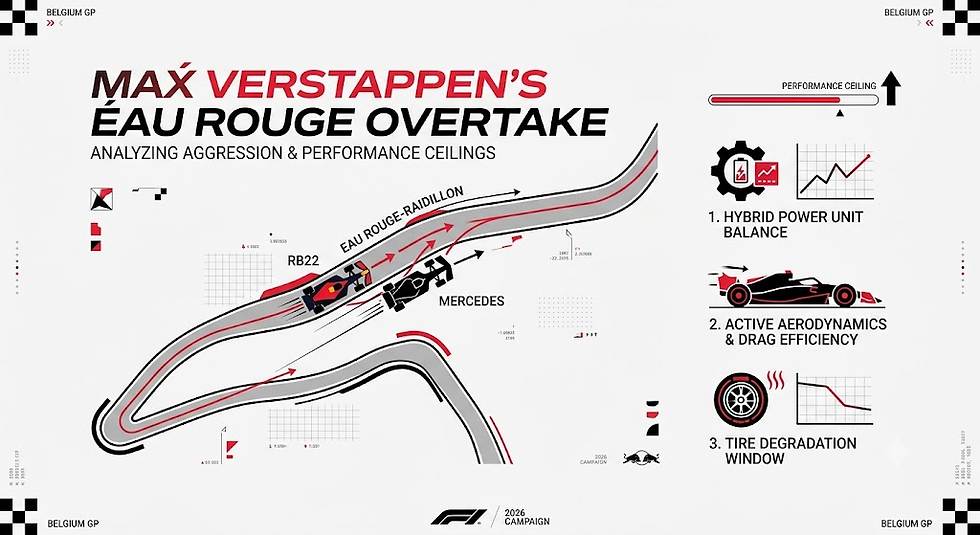
When the lights go out in modern Formula 1, few drivers command the opening sector quite like Max Verstappen. Known across the paddock for his relentless instincts, the four-time World Champion has built a career on high-stakes, millimeter-precise overtaking maneuver choices during the opening lap. Nowhere was this raw aggression more visible than at the iconic Circuit de Spa-Francorchamps, where Verstappen unleashed an audacious launch into Turn 1 and carried maximum momentum into the legendary Eau Rouge–Raidillon complex to briefly take the race lead.
However, in the era of new regulations, individual brilliance frequently collides with cold, hard engineering realities. While Verstappen’s opening-lap heroics sent shockwaves through the grandstands, the aftermath on the Kemmel Straight revealed a sobering story regarding Red Bull Racing’s package.
This deep-dive analysis breaks down the telemetry, driver psychology, and aerodynamics of that dramatic move, while examining what it tells us about Red
Bull’s current performance ceiling in the 2026 World Championship campaign.
The Anatomy of the Launch: How Verstappen Placed His Car
The Belgian Grand Prix at Spa-Francorchamps remains the ultimate litmus test for bravery and tactical positioning. Starting from second on the grid behind polesitter Kimi Antonelli, Verstappen knew his best opportunity to seize control of the race lay in the opening few hundred meters.
1. The La Source Exit
The setup for the move began long before the cars reached the bottom of the hill. Positioning his car on a slightly wider entry into the tight La Source hairpin, Verstappen squared off the corner to maximize his exit traction. While Antonelli took a conventional racing line, Verstappen got on the throttle early, utilizing the mechanical grip of his RB22 to slingshot down the sweeping hill toward the Eau Rouge compression.
2. High-Speed Placement through Eau Rouge
As the cars roared down toward Turn 2, Verstappen refused to back out. Pulling alongside Antonelli’s Mercedes, Verstappen kept the throttle planted through the sudden left-right sweep of Eau Rouge. Carrying higher entry speed through the bottom compression, he slotted his front wing ahead before climbing the blind crest of Raidillon. It was a textbook display of spatial awareness, placing his car in a position that forced his rival to compromise their line through the uphill transition.
Deconstructing the Physics: The Max Verstappen Eau Rouge Overtake
Executing a high-speed overtake in one of motorsport's most dangerous corner sequences requires a delicate balance between mechanical balance, aerodynamic downforce, and hybrid power management. The successful Max Verstappen Eau Rouge overtake was a masterclass in exploiting immediate track position, but it came at a technical cost that played out moments later on the Kemmel Straight.
Phase of Move | Technical Action | Driver Input | Telemetry Insight |
La Source Exit | Apex Squaring | Early Throttle Application | +4 km/h delta over lead car |
Eau Rouge Entry | High Compression Load | Minimum Steering Angle | Maximum floor downforce generated |
Raidillon Crest | Crest Elevation Shift | Full Overdrive Battery Deployment | Energy deployment peaked at 100% |
Kemmel Straight | Draft & Recirculation | Defensive Line Holding | Battery state-of-charge drained |
Energy Deployment vs. Battery Depletion
To pull off the pass before the crest of Raidillon, Verstappen had to drain a substantial portion of his hybrid system's electrical energy. Under the active engine regulations, power units rely heavily on precise energy management over full lap cycles.
By demanding maximum electrical output from Turn 1 through Turn 2, Verstappen achieved the immediate speed differential necessary to clear Antonelli. However, as he crested Raidillon and looked into his mirrors, his MGU-K battery status had plummeted. Without electrical boost remaining for the 1.8-kilometer Kemmel Straight, Verstappen became a sitting duck for both Antonelli’s re-charge and Charles Leclerc’s approaching Ferrari.
"I went through Eau Rouge, looked at my battery status, and thought, 'Well, that's going to be a difficult run to Les Combes.' I expected Kimi to come by, and then I looked in my mirror and saw a red rocket coming."— Max Verstappen on his opening lap at Spa
Verstappen was forced to hold a disciplined central line into Les Combes to avoid a terrifying high-speed collision—what he candidly termed an "airplane shunt"—as both Mercedes and Ferrari blew past him with superior straight-line velocity.
Understanding Red Bull Racing’s 2026 Performance Ceiling
While Verstappen's opening-lap move highlighted his signature tactical aggression, the remainder of the race exposed the performance boundary currently constraining Red Bull Racing. For several seasons, Verstappen’s exceptional race craft masked underlying vehicle handicaps. In the current competitive landscape, however, Red Bull is encountering a distinct performance ceiling that prevents them from consistently fighting for race victories.
  2026 Constructor Hierarchy (Pace Index)
  -------------------------------------------------------------
  1. Mercedes AMG Petronas    [████████████████████] Peak Pace
  2. Scuderia Ferrari         [██████████████████  ] -0.15s/lap
  3. McLaren F1 Team          [█████████████████   ] -0.25s/lap
  4. Red Bull Racing (RB22)   [███████████████     ] -0.40s/lap
  -------------------------------------------------------------
1. Hybrid Power Unit Balance and Compression Limits
The shift to the 2026 engine regulations introduced new challenges for Red Bull Powertrains and Ford. With the introduction of the mandatory 16:1 compression ratio limit and increased reliance on electrical power generation, engine manufacturers have been locked in a fierce development battle.
While Red Bull has pushed their power unit to the absolute edge of compliance, rivals like Mercedes have demonstrated superior energy recovery efficiency and thermal expansion management on long straights. This disparity leaves the RB22 vulnerable at power-sensitive circuits like Spa, Monza, and Silverstone.
2. Active Aerodynamics and Drag Efficiency
The introduction of active aerodynamics—switching between High Downforce (Corner Mode) and Low Drag (Straight Line Mode)—reshaped how teams manage airflow.
Mercedes & Ferrari: Excel in seamlessly transitioning their active wing elements to drop drag without destabilizing the rear axle during braking transitions.
Red Bull RB22: Struggles with balance consistency when shifting out of Low Drag mode. As Verstappen noted after his second stint at Spa, keeping the car in a clean operating window over long stints remains a persistent challenge.
3. The Tire Degradation Window
Earlier iterations of Red Bull cars were famous for treating their Pirelli rubber with unmatched gentleness. On the RB22, achieving optimal tire degradation requires a narrower setup window. When forced to defend aggressively in dirty air, the RB22 burns through its rear compound faster than the McLaren or Mercedes chassis, effectively setting a firm ceiling on their race-stint longevity.
Driver Mastery vs. Package Deficit: Can Verstappen Bridge the Gap?
Formula 1 history is full of moments where a generational driver elevates a sub-optimal car beyond its theoretical limits. Verstappen nearly pulled off a similar miracle during the tight 2025 title race against Lando Norris, dragging an unpredictable chassis to within two points of the crown through sheer consistency.
In the current era, however, energy management regulations dictate lap times far more strictly. When a power unit or aerodynamic package hits its ceiling, even the most aggressive driver inputs cannot create energy out of thin air.
Key Performance Drivers in Modern F1
Energy Recovery Efficiency: How quickly a unit recharges without penalizing corner-exit speeds.
Aerodynamic Map Stability: Maintaining consistent downforce across active wing state changes.
Mechanical Platform Consistency: Preventing mid-corner balance shifts over high-speed bumps and curb hits.
Verstappen’s podium finish at Spa—crossing the line in P3 behind Antonelli and Leclerc—was widely praised across the paddock as an outstanding drive that maximized every drop of potential from the RB22. Yet, as Red Bull Team Principal and engineers acknowledge, finishing 11+ seconds behind the leader underlines that driver skill can only buffer a performance gap, not eliminate it entirely.
The Road Ahead: How Red Bull Can Break Through Their Performance Ceiling
To turn podiums back into victories, Red Bull Racing must execute targeted upgrades across key areas of their development roadmap:
Upgrade Priorities for the RB22
MGU-K Mapping Optimization: Refining the software logic governing energy deployment out of low-speed traction zones to prevent early battery drain.
Active Rear Wing Efficiency: Redesigning active aero flap actuators to reduce wake drag during straight-line mode activation.
Suspension Geometry Adjustments: Improving anti-dive and anti-squat characteristics to preserve floor ride-height consistency through compression zones like Eau Rouge.
If Red Bull Powertrains can close the straight-line deployment gap to Mercedes, Verstappen's elite cornering speed and aggressive race craft will immediately make Red Bull a race-winning threat once again.
Frequently Asked Questions (FAQs)
What made the Max Verstappen Eau Rouge overtake so memorable?
The Max Verstappen Eau Rouge overtake showcased extraordinary driver bravery as Verstappen carried massive corner entry speed down the La Source hill, placing his Red Bull alongside Kimi Antonelli through the high-speed Eau Rouge compression and sweeping past before the blind crest of Raidillon.
Why did Verstappen lose the lead on the Kemmel Straight shortly after?
To complete the pass through Eau Rouge, Verstappen utilized maximum electrical power deployment. This left his hybrid battery depleted at the top of Raidillon, allowing both Antonelli (Mercedes) and Leclerc (Ferrari) to easily pass him using DRS and stored electrical boost on the long run to Les Combes.
What is current Red Bull Racing performance ceiling compared to Mercedes and Ferrari?
Red Bull is currently operating as the third or fourth fastest team on pure race pace, trailing Mercedes and Ferrari. Their current performance ceiling is primarily limited by hybrid power unit deployment longevity on long straights and rear-end balance stability during active aero transitions.
Can Red Bull bring upgrades to compete for race wins this season?
Yes. Red Bull Racing and Red Bull Ford Powertrains are actively developing software re-maps for energy management alongside aero floor revisions aimed at improving active wing efficiency and tire thermal management.
Stay Ahead of the F1 Grid
Want to dive deeper into Formula 1 engineering, telemetry breakdowns, and live race updates? Stay connected with the official sources driving the sport forward:
Explore official telemetry, race schedules, and championship standings on the Official Formula 1 Website.
Follow technical updates and driver reaction directly from Red Bull Racing Official.
Read official technical regulations and safety updates on the FIA Official Page.


Comments