MHT-CET Qualified? Here's How the Admission Process Will Unfold This Year
- Jun 18
- 6 min read
Congratulations! Clearing the Maharashtra Common Entrance Test (MHT-CET) is no small feat. As over 400,000 students vie for coveted seats in engineering, pharmacy, and agriculture courses across Maharashtra this year, securing a great percentile is only half the battle won. The true differentiator between landing your dream college and settling for an alternative is how you navigate what comes next.
The State Common Entrance Test Cell, Maharashtra, operates a highly structured, fully digital system known as the Centralized Admission Process (CAP). To help you transition from an aspirant to an admitted student, this comprehensive MHT CET admission process guide outlines every critical milestone, strategic maneuver, and regulatory update shaping the 2026 admission cycle.
Understanding the Centralized Admission Process (CAP)
The Centralized Admission Process (CAP) is a single-window, computer-based allocation system managed by the State CET Cell Maharashtra. It eliminates the need to apply to individual colleges, ensuring absolute transparency and merit-based allocations for institutions like COEP Technological University, VJTI Mumbai, ICT Mumbai, and hundreds of other private and government-aided colleges.
For professionals, counselors, and parents guiding students through this maze, understanding CAP is vital. It is a strict, sequential system where a single algorithmic choice or oversight can alter a student's academic trajectory. The entire ecosystem relies heavily on real-time data integration, document validation, and strict adherence to state-mandated reservation policies.
Key Trends and Developments in 2026 Admissions
The 2026 admission landscape features several structural updates aimed at boosting transparency, reducing vacancy rates, and aligning with modern educational frameworks.
1. Advanced E-Scrutiny Integration
The State CET Cell has upgraded its AI-assisted physical and e-scrutiny modules. Discrepancies in category certificates (OBC, EWS, SEBC, SC, ST) are flagged instantly, making early document readiness more critical than ever.
2. Implementation of NEP 2020 Multi-Entry/Exit Pathways
More Maharashtra institutions have adopted National Education Policy (NEP) guidelines for B.Tech programs. This introduces flexible, minor-degree specializations (e.g., B.Tech in Mechanical with a minor in AI) right at the option-entry stage.
3. Fee Regulating Authority (FRA) Strictures
The FRA has enforced strict caps on development fees this year. Colleges must display their broken-down fee structures transparently on the CAP portal before option form filling begins, protecting families from hidden costs.
Benefits, Challenges, and Strategic Opportunities
Navigating the CAP rounds presents distinct advantages, structural bottlenecks, and hidden opportunities that smart applicants can leverage.
Key Benefits of the CAP System
Absolute Meritocracy: Eliminates back-room management quotas in cap-governed seats; allocations rely strictly on your State Merit Number.
Unified Window: Access to over 300+ engineering colleges through a single online portal.
Reservation Safetynets: Seamless execution of home-university (HU), other-than-home-university (OHU), and institutional quotas.
Major Challenges to Anticipate
The "Freeze vs. Float" Dilemma: Misunderstanding seat acceptance rules can lead to accidental forfeiture of excellent seats.
Document Rejection Bottlenecks: Tight turnarounds for submitting Non-Creamy Layer (NCL) or Income Certificates often catch students off-guard.
Cutoff Volatility: Drastic shifts in branch preferences—particularly the skyrocketing demand for Computer Science and specialized AI/ML tracks—make historical cutoffs unpredictable.
Strategic Opportunities
TFWS (Tuition Fee Waiver Scheme): Meritorious students from economically weaker sections can claim a 100% tuition fee waiver by opting for TFWS specific seats during form filling.
The CAP Round 3 Clean Sweep: Historically, aggressive yet realistic option forms yield unexpected upgrades in the final CAP round as institutional vacancies open up.
Industry Insights & Expert Analysis
Data from recent admission cycles highlights a massive shift in how students choose their careers. While Computer Science and Engineering (CSE) fields continue to dominate, data-driven industries are advising students not to discount core fields like Mechanical, Civil, and Chemical Engineering—especially when offered by tier-1 institutions.
With Maharashtra actively positioning itself as India's premier semiconductor and electric vehicle manufacturing hub, core engineering branches augmented with computer minors are yielding high corporate placement rates.
Expert Insight: "Choosing a minor branch at a tier-1 institute like VJTI or COEP frequently yields better long-term career ROI than choosing a generic computer science track at an unranked, tier-3 suburban college."
Step-by-Step Practical Recommendations
To ensure a seamless transition from result declaration to campus registration, execute these steps methodically.
1. The Definitive Admission Checklist
Before the portal opens, organize your digital and physical folders with these mandatory documents:
Document Type | Requirement Details | Applicability |
Primary Identity | MHT-CET 2026 Scorecard & Admit Card | All Applicants |
Academic Proofs | Class 10th & 12th Marksheets, School Leaving Certificate | All Applicants |
Domicile Status | Domicile Certificate of Maharashtra / Birth Certificate | Maharashtra State Candidates |
Income Proof | Parent's Income Certificate (Issued by Tahsildar) | TFWS / EWS Applicants |
Category Documents | Caste Certificate, Caste Validity, and Valid Non-Creamy Layer | Reserved Category Applicants |
2. A Chronological Strategy for CAP Success
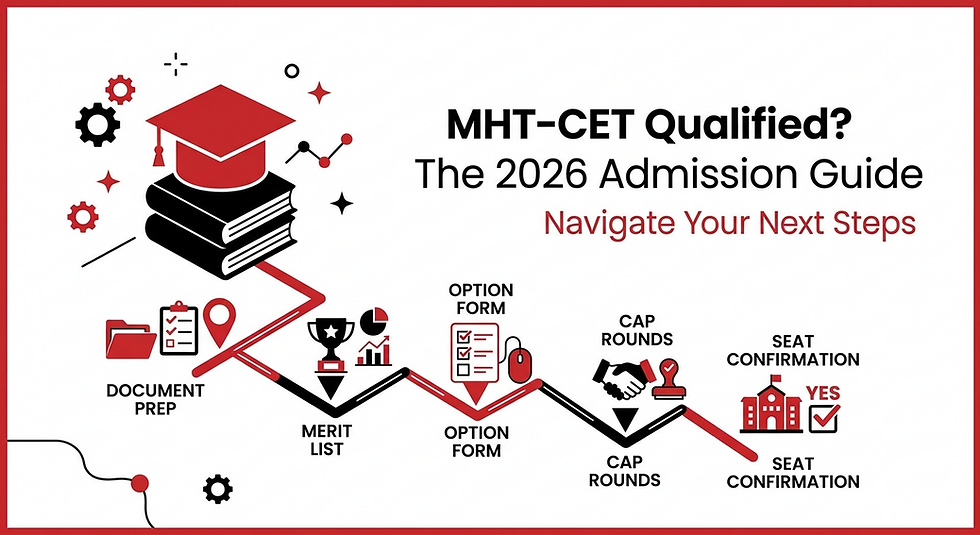
[Registration & Document Upload] ➔ [E-Scrutiny Verification] ➔ [Provisional Merit List Released] ➔ [Grievance Redressal Window] ➔ [Final Merit List & Seat Matrix] ➔ [Option Form Submission]
Register Early and Verify Accurately: Fill out your personal details exactly as they appear on your HSC marksheet. Select either "E-Scrutiny" (online verification) or "Physical Scrutiny" (visiting a Facilitation Centre).
Analyze the Seat Matrix: Once the State CET Cell releases the official seat matrix, calculate your realistic chances. Do not rely solely on last year's marks; check the provisional merit list MHT CET rankings instead, as percentile-to-rank ratios fluctuate annually.
Master the Option Form Filling Strategy: You can list up to 300 choices.
Choice 1: Your absolute dream seat (If allocated, this is an automatic Auto-Freeze; you must accept it and exit the process).
Choices 2–20: Realistic, highly desirable colleges slightly above your merit rank.
Choices 21–50: Safe colleges perfectly matching your merit rank.
Choices 51+: Safety nets you are guaranteed to get into.
3. Common Mistakes to Avoid
Putting an unwanted college as Choice #1: If you are allocated your first preference, you cannot participate in subsequent rounds, even if you change your mind.
Missing the Seat Acceptance Fee Payment: If allocated a seat in Round 1 and you choose to "Float" (look for a better seat in Round 2), you must still pay the nominal Seat Acceptance Fee online. Failure to do so ejects you from the entire CAP ecosystem.
Frequently Asked Questions (FAQ)
Q1: What is this year's official MHT CET admission process guide for handling the "Float" option?
A: If you are allocated a seat in CAP Round 1 that is not your first preference, but you want to hold it while trying for a better college in Round 2, you must select the "Not-Freeze" (Float) option. You must then pay the online seat acceptance fee to secure that seat. This ensures you do not lose your current seat if no better options open up in subsequent rounds.
Q2: What is the difference between the provisional merit list MHT CET publishes and the final merit list?
A: The provisional merit list is a preliminary ranking based on your scores and submitted categories. It allows students to check for errors in their name, marks, or reservation status. If you spot an error, you can submit a correction during the grievance period. After reviewing all grievances, the State CET Cell publishes the final merit list, which determines your definitive allocation rank.
Q3: Can I participate in CAP Round 2 if I am not allocated any seat in Round 1?
A: Yes. If you receive no allocations in Round 1, you automatically move to CAP Round 2. You will have the opportunity to edit, reorder, or add new choices to your option form based on the updated vacancy reports published before Round 2 begins.
Q4: Is a Tuition Fee Waiver Scheme (TFWS) seat automatically applied to all eligible candidates?
A: No. You must explicitly opt for TFWS seats while filling out your initial CAP application form and provide a valid income certificate proving your family income is below ₹8 Lakhs per annum. Additionally, when filling your choice codes, you must explicitly choose the codes ending with the letter "T" (which denotes TFWS choices).
Q5: What happens if my category documents are rejected during e-scrutiny?
A: If your reservation documents (such as Caste Validity or Non-Creamy Layer certificates) are rejected and you cannot rectify the issue during the grievance period, your candidature will automatically be converted from the reserved category to the Open/General category, provided you meet the general eligibility cutoffs.
Q6: Can other-than-home-university (OHU) students get admission into top Mumbai colleges?
A: Yes. While a significant percentage of seats in state universities are reserved for Home University (HU) candidates, a dedicated percentage is allocated for OHU candidates. Furthermore, institutional rounds and All-India seats (based on JEE Main scores) offer additional pathways into these top institutes.
Conclusion
The MHT-CET admission cycle rewards strategy as much as it rewards high scores. By treating the upcoming weeks with the same focus you gave your exam preparation, you can avoid common pitfalls and make the state's allocation algorithm work in your favor. Gather your documents early, audit your options systematically, and approach the option form with a balanced mix of ambition and realism.
Action Plan & Official Resources
To take the next steps in your admission journey, check out this definitive MHT CET admission process guide toolkit of verified portals and next steps:
Suggested Next Steps for Readers
Download the Archive: Review the previous years' closing cutoffs on the official CET portal to get a baseline understanding of college rankings.
Verify Digital Formats: Ensure all your certificates are scanned clearly in PDF format under the maximum size limit specified by the portal.
Draft Your Checklist: Create a spreadsheet listing your top 40 college-branch combinations using their official choice codes.
Trusted Resources & Reference Links
State Common Entrance Test Cell, Maharashtra — The ultimate authority for all CAP registrations, schedules, and official notices.
Directorate of Technical Education (DTE), Maharashtra — For comprehensive institutional statistics, curriculum details, and framework regulations.
Fee Regulating Authority (FRA), Mumbai — To verify and audit the approved fee structures for any professional engineering or pharmacy institution across the state.


Comments