Middle East Conflict Indian Equities: Navigating Market Volatility in 2026
- Mar 20
- 6 min read
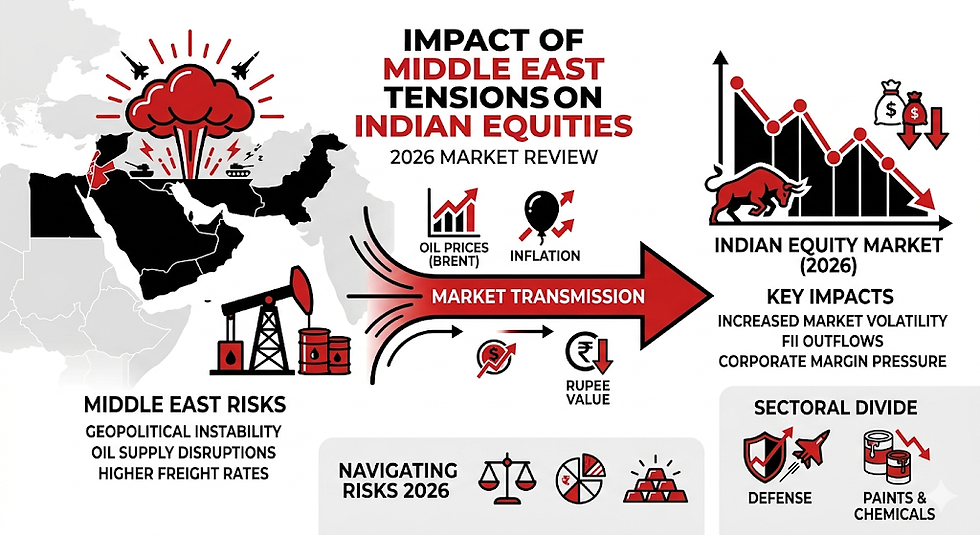
If you’ve checked your portfolio this March 2026, you’ve likely noticed a sea of red—unless, of course, you’re heavily invested in defense stocks. As of late March 2026, the geopolitical temperature in the Middle East has moved from "simmering" to a "boil," and Dalal Street is feeling the heat.
The relationship between Middle East Conflict Indian Equities is one of the most significant transmission channels for global volatility. With Brent crude oil prices scaling past $115 per barrel and major trade routes like the Strait of Hormuz under threat, the Indian market is currently navigating one of its most turbulent phases since the post-pandemic recovery.
In this blog, we’ll break down why these tensions matter, which sectors are catching a bid, and how you should position your investments in 2026.
The 2026 Geopolitical Context: What’s Happening?
The year 2026 began with a fragile peace, but by late February, the situation escalated dramatically. Following the death of Iran’s Supreme Leader, Ayatollah Ali Khamenei, and subsequent military exchanges involving Israel and the United States, the global markets entered a "risk-off" mode.
On March 19, 2026, the Indian indices witnessed a historic "bloodbath." The Sensex plunged by over 2,500 points (3.26%), ending at 74,207.24, while the Nifty 50 dropped below the crucial 23,000 mark. Investors lost nearly ₹14 lakh crore in a single session. This wasn't just a random correction; it was a direct reaction to the escalating Middle East Conflict Indian Equities correlation.
Why the Middle East Matters to Your Portfolio
India is an "energy-importing superpower." We import roughly 85% of our crude oil and a significant portion of our natural gas. When the Middle East sneezes, the Indian economy catches a cold—and the stock market gets a fever.
1. The Crude Oil Shock
Oil is the "lifeblood" of the Indian economy. When Brent crude prices surge (as they have, hitting $115 in mid-March 2026), it creates a domino effect:
Inflation: Higher fuel costs increase transportation expenses for everything from tomatoes to television sets.
Fiscal Deficit: The government’s bill for oil imports balloons, putting pressure on the fiscal deficit.
Corporate Margins: Companies in sectors like paints, chemicals, and aviation see their raw material costs skyrocket, leading to lower profits.
2. The Rupee Under Pressure
As oil becomes more expensive, India needs more US Dollars to buy it. This increases the demand for the Greenback and weakens the Indian Rupee. In March 2026, we’ve seen the INR slip toward the ₹91–₹92 per dollar range, making imports even costlier and unsettling foreign investors.
3. Supply Chain Chokepoints
The Strait of Hormuz and the Red Sea are vital for Indian trade. Over 20% of global oil passes through the Strait of Hormuz. In 2026, disruptions in these zones have forced shipping lines to reroute around the Cape of Good Hope, adding 14 to 20 days to transit times and sending freight rates up by as much as 400%–600%.
Sectoral Analysis: Understanding the Middle East Conflict Indian Equities Impact
Not every sector is bleeding. In fact, some are thriving amidst the chaos. Let's look at the winners and losers in this 2026 landscape.
The Winners: Defense and Upstream Energy
Defense (The "Hedge" Sector): Stocks like HAL (Hindustan Aeronautics), BEL (Bharat Electronics), and Paras Defence have been the stars of March 2026. On March 2 alone, while the broader market crashed, Paras Defence surged 13.5%. The logic? Global instability leads to increased defense spending and a push for "Atmanirbhar" (self-reliant) military technology.
Upstream Oil & Gas: Companies like ONGC and Oil India benefit from higher realizations on the oil they produce. When crude prices are high, their profit per barrel increases significantly.
The Losers: OMCs, Aviation, and Paints
Oil Marketing Companies (OMCs): IOC, BPCL, and HPCL are in a tough spot. While crude prices are rising, they often face "informal" pressure to keep retail petrol and diesel prices stable to control inflation. This "margin squeeze" makes them unattractive during geopolitical spikes.
Paints and Chemicals: Crude oil derivatives are primary raw materials for these industries. Companies like Asian Paints or Berger Paints often see their stock prices dip when oil crosses $100/bbl.
Aviation: Jet fuel (ATF) accounts for nearly 40% of an airline's operating costs. With oil at $115, stocks like InterGlobe Aviation (IndiGo) face severe headwind.
FII vs. DII: The Great Tug-of-War
One of the most fascinating aspects of the 2026 market crash is the behavior of institutional investors.
Foreign Institutional Investors (FIIs): They have been net sellers, pulling out billions. On March 20, 2026, FIIs recorded a net selling of approximately ₹5,300 crore. They view emerging markets as "risky" during global conflicts and prefer moving capital to "safe havens" like Gold or US Treasuries.
Domestic Institutional Investors (DIIs): Here is the silver lining. Indian mutual funds and insurance companies have been aggressive buyers, absorbing the FII selling. On the same day FIIs sold ₹5,300 crore, DIIs bought nearly ₹5,500 crore.
This "Domestic Cushion" is the reason why, despite a 2,500-point crash, the market hasn't entered a free-fall. Your monthly SIP (Systematic Investment Plan) is literally the shield protecting the Indian market right now.
Historical Perspective: Is 2026 Different?
If we look back at the 2003 Iraq War, the 2011 Arab Spring, or the 2022 Russia-Ukraine conflict, a pattern emerges:
Initial Panic: Markets drop 5%–10% in the first few weeks.
Absorption: Markets begin to price in the "new normal."
Recovery: Once the conflict stabilizes (even if it doesn't end), markets tend to recover within 3–6 months.
However, the 2026 crisis is unique because of the simultaneous disruption of the Strait of Hormuz and the Red Sea, combined with high domestic valuations. The "duration" of this conflict will matter far more than its "intensity."
Strategic Advice for Investors in 2026
How should you handle the Middle East Conflict Indian Equities volatility? Here are four golden rules:
Don't Panic Sell: Selling during a 3% crash is usually a recipe for regret. History shows that markets eventually mean-revert.
Focus on "Domestic-Facing" Sectors: While export-oriented sectors (like IT or Textiles) might struggle with global demand and shipping costs, sectors like Banking, Infrastructure, and FMCG are more insulated from Middle Eastern geopolitics.
Gold as a Hedge: Gold prices have jumped over 2% this March. Keeping 10%–15% of your portfolio in Gold (Sovereign Gold Bonds or ETFs) provides a perfect buffer during war-like situations.
Gradual Accumulation: Use the "dips" to buy high-quality blue-chip stocks. On March 19, many stocks were trading at 52-week lows despite strong fundamentals.
FAQ: Understanding the Middle East Conflict Indian Equities Impact
Q1: How exactly does the Middle East Conflict Indian Equities relationship affect my mutual funds?
A: Your mutual funds are affected primarily through "sectoral exposure." If your fund is heavy on Energy or Defense, it might be outperforming. However, if it has high exposure to OMCs or Paint companies, you might see a temporary dip in NAV. The overall volatility is driven by FIIs pulling out money from emerging markets like India to reduce global risk.
Q2: Will the stock market continue to fall in April 2026?
A: This depends on two factors: the stability of the Strait of Hormuz and the Federal Reserve's stance on interest rates. If oil supply remains choked, we could see more pressure. However, if the "Domestic Cushion" (DII buying) remains strong, the market may form a base around the Nifty 22,500–22,800 levels.
Q3: Should I stop my SIPs during this Middle East crisis?
A: Absolutely not. In fact, falling markets are the best time for SIPs because you get more units for the same amount of money (Rupee Cost Averaging). Historically, investors who continued their SIPs through the 2022 and 2024 geopolitical crises saw the highest returns.
Q4: Which stocks are considered "safe havens" right now?
A: Defense heavyweights like HAL and BEL, as well as IT majors (due to their dollar-denominated earnings which benefit from a weaker Rupee), and high-dividend-paying PSU stocks are currently seen as safer bets.
Conclusion: Resilience in the Face of Uncertainty
The Middle East Conflict Indian Equities saga is a reminder that the global economy is deeply interconnected. While the headlines in March 2026 are concerning, India’s macro-fundamentals—boosted by strong GST collections (₹1.8 lakh crore in Feb 2026) and resilient domestic demand—remain intact.
The key to surviving this "geopolitical storm" is patience and a focus on long-term goals. Markets are volatile in the short term, but they are productive in the long term. Stay invested, stay diversified, and keep an eye on the oil charts.
Stay Updated with Real-Time Market Data
Track Live Nifty/Sensex Levels: NSE India Official Website
Check FII/DII Activity Daily: MoneyControl FII/DII Tracker
Latest Geopolitical News Updates: Reuters World News
Monitor Global Crude Oil Prices: Bloomberg Energy Prices


Comments