NEET Cutoff Trends 2020–2026: Category-Wise Analysis for Government Medical Colleges in India
- Apr 24
- 5 min read
The landscape of medical education in India is shifting beneath the feet of millions of aspirants. If you are a medical student or a parent looking at the 2026 session, you already know that the National Eligibility cum Entrance Test (NEET) is no longer just a test of knowledge—it is a race of high-stakes precision.
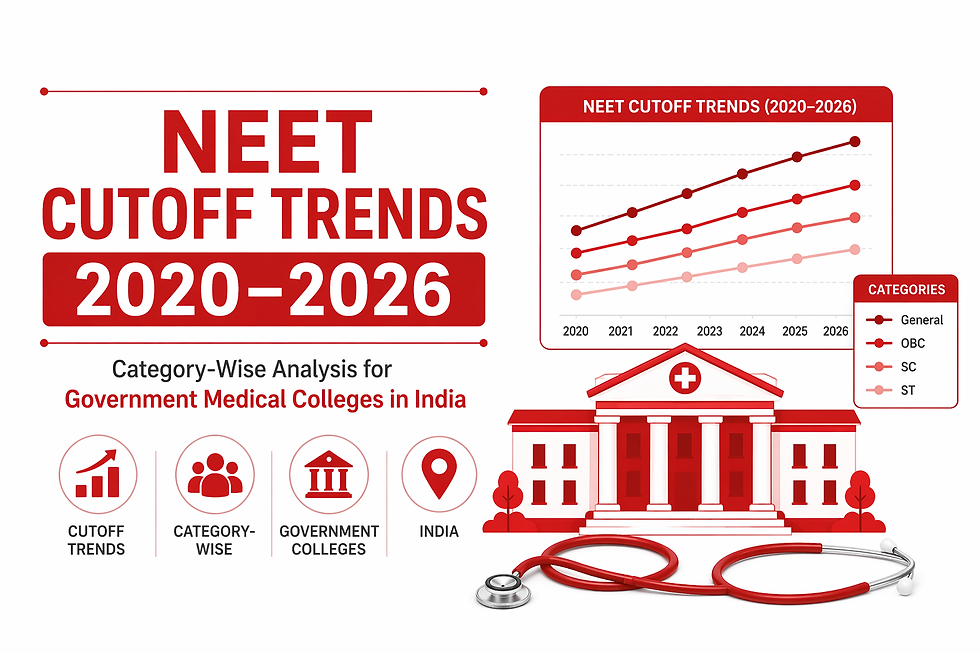
The NEET Cutoff Trends 2020–2026 reveal a startling narrative: despite a significant increase in the number of MBBS seats across the country, the qualifying marks and admission cutoffs for Government Medical Colleges (GMCs) have climbed steadily. In 2020, a score of 610 was often a golden ticket to a respectable government seat. By 2026, that same score might leave a General category student on the waiting list.
Understanding these trends isn’t just about looking at old PDF files; it’s about decoding the competition of over 25 lakh students and preparing for a reality where every single mark can shift your rank by thousands.
📊 Category-Wise Qualifying Cutoff Trends (2020–2026)
The qualifying cutoff is the minimum percentile required to even participate in the counseling process. While it doesn't guarantee a seat, it serves as the first filter. Based on historical data and the projected difficulty for the 2026 cycle, here is how the qualifying marks have evolved:
Year | UR / EWS (50th Percentile) | OBC / SC / ST (40th Percentile) | UR-PH (45th Percentile) |
|---|---|---|---|
2020 | 147 | 113 | 129 |
2021 | 138 | 108 | 122 |
2022 | 117 | 93 | 105 |
2023 | 137 | 107 | 121 |
2024 | 164 | 129 | 146 |
2025 | 166 | 131 | 148 |
2026 (Est.) | 168+ | 133+ | 150+ |
The 2026 Reality: For the upcoming session, the expected qualifying cutoff is projected to be the highest in history. A score of 720–168 is likely necessary for the General category just to be eligible for counseling.
🏛️ Cutoff for MBBS in Government Colleges (AIQ 15%)
Securing a seat in a GMC through the 15% All India Quota (AIQ) remains the ultimate goal for top-tier aspirants. However, the "safe score" has seen a massive inflation. Let’s break down the NEET Cutoff Trends 2020–2026 for admission into these coveted institutions.
General / Unreserved (UR)
The jump here has been the most aggressive. In 2020, students were comfortable with 610+ marks. By 2025, that threshold moved to 655+.
2026 Prediction: To secure a mid-tier GMC under AIQ, you will likely need a score of 658–662+.
OBC / EWS
The gap between General and OBC/EWS has shrunk to almost zero. Often, the difference is a mere 2 to 5 marks.
2026 Prediction: Candidates in these categories should aim for nothing less than 655+ to remain in the safe zone for a government seat.
SC (Scheduled Caste)
There was a time when 500 marks guaranteed a top-tier college for SC candidates. Those days are gone.
2026 Prediction: A score of 560+ is now the benchmark for top-tier state GMCs and mid-tier AIQ seats.
ST (Scheduled Tribe)
While relatively lower than other categories, the ST cutoff has risen by nearly 60 marks over the last six years.
2026 Prediction: Aim for 535–540+ to ensure you aren't left out during the final rounds of counseling.
🚩 Why is the Cutoff Increasing in 2026?
You might wonder: "If the government is opening new medical colleges, why is the cutoff still rising?" The answer lies in a combination of demographic shifts and technological accessibility.
Explosive Candidate Volume: Over 25 lakh students are expected to appear in 2026. While the number of seats has crossed the 1.1 lakh mark, the applicant pool is growing at a much faster rate.
The Physics Tie-Breaker: NTA's change in tie-breaking rules—prioritizing Physics marks—has forced students to master a subject that was once the "rank-decider." Today’s top-tier students are scoring near-perfect marks in Physics, pushing the overall merit list higher.
Democratization of Coaching: High-quality online resources have leveled the playing field. A student in a remote village in Maharashtra now has access to the same quality of mock tests as a student in Kota, leading to a much higher average score across the board.
The "Repeaters" Factor: A large percentage of the top 50,000 ranks are now held by "droppers" who have spent 2–3 years perfecting their NCERT accuracy.
📌 The AIIMS Factor: The Extreme Top
For those eyeing AIIMS New Delhi, the trends have essentially hit a ceiling. Since 2020, the cutoff has remained at the extreme top, usually requiring a rank within the Top 50-70 AIR. In 2026, this translates to a near-impossible score of 715+. At this level, even one silly mistake in Biology can cost you a seat in the nation’s premier institute.
📑 State-Wise vs. All India Quota: Which is Easier?
While the AIQ is highly competitive, the 85% State Quota often provides a slight cushion, though this varies by state.
High-Cutoff States: Rajasthan, Delhi, Uttar Pradesh, and Haryana consistently see state cutoffs that rival the AIQ.
Moderate-Cutoff States: Maharashtra, West Bengal, and Gujarat offer slightly better odds, but even here, the trend is moving upward.
Safe Score Strategy: Always aim for the AIQ cutoff. If you hit that mark, your state seat is virtually guaranteed, giving you more choices during choice filling.
❓ Frequently Asked Questions (FAQs)
1. What are the expected NEET Cutoff Trends 2020–2026 for General category students?
The General category has seen a consistent upward trend. While the qualifying marks are expected to be around 168+ in 2026, the admission cutoff for a Government Medical College (GMC) is likely to range between 658 and 662 marks for the All India Quota.
2. Is 600 a safe score for a government seat in 2026?
Unfortunately, for General and OBC candidates, 600 is no longer considered a "safe" score for the All India Quota. While you might secure a seat in some states via the State Quota, for AIQ, you should aim for 650+ to be secure.
3. How many students are appearing for NEET 2026?
Initial projections suggest over 25 lakh aspirants will register for NEET 2026, making it the most competitive medical entrance exam in India to date.
4. Does the increase in MBBS seats lower the cutoff?
While more seats are being added (approximately 1.1 lakh+ in 2026), the sheer volume of high-scoring candidates usually offsets the seat increase, causing the cutoff to either remain stable or continue its upward climb.
🚀 Final Thoughts for 2026 Aspirants
The data is clear: the NEET Cutoff Trends 2020–2026 demand a shift in how you prepare. You are no longer competing for "passing marks"—you are competing for a high-percentile rank. As Physics becomes the primary tie-breaker and competition intensifies, your focus must move from just "finishing the syllabus" to "eliminating negative marks."
Success in 2026 will belong to those who respect the data and adjust their mock test targets accordingly. Don't just aim to qualify; aim to dominate.


Comments