New NCERT Syllabus 2026: Major Changes & Updates for Students
- Apr 1
- 4 min read
INTRODUCTION
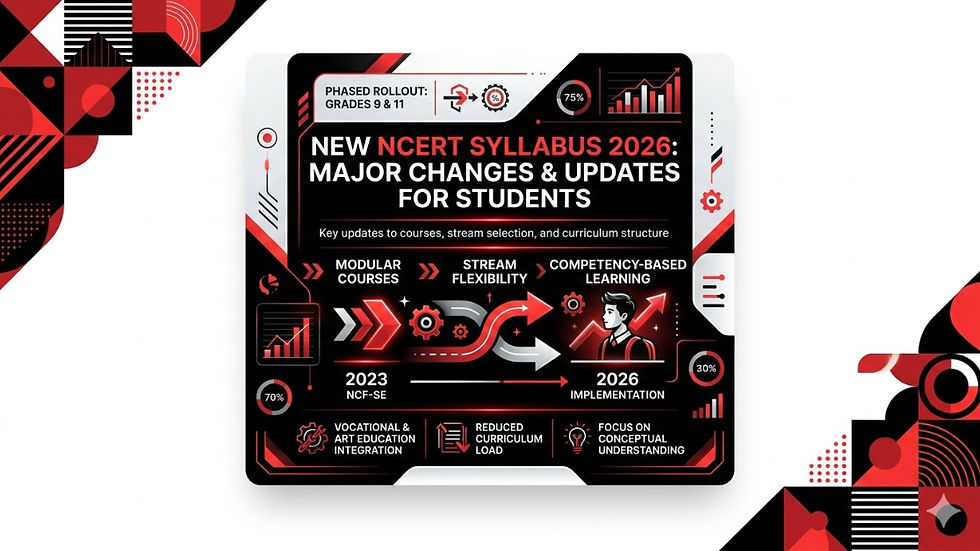
The academic landscape in India is undergoing a monumental shift. As we enter the 2026-27 academic session, the Latest NCERT Syllabus Updates 2026 are no longer just "rationalization" tweaks but a fundamental overhaul of how courses and streams are structured. Guided by the National Curriculum Framework for School Education (NCF-SE 2023), the new syllabus aims to replace rote learning with a modular, flexible, and competency-based approach.
Whether you are a student transitioning into Secondary Stage Phase I (Class 9) or choosing your specialized subjects in Phase II (Class 11), understanding these updates is critical for your academic planning.
The Core Shift: Understanding the NCF-SE 2023 Framework
The Latest NCERT Syllabus Updates 2026 are anchored in the 5+3+3+4 design. For students in 2026, the most significant change lies in the "Secondary Stage," which covers Grades 9 through 12.
Phased Textbook Rollout in 2026
NCERT has confirmed a phased implementation for the 2026-27 session:
Grade 9: Entirely new textbooks and syllabi based on NCF-SE 2023 are being introduced in March 2026.
Grade 10 & 11: For the 2026-27 session, existing textbooks will largely continue, with the new curriculum scheduled for the 2027-28 rollout.
Focus on Competency: Even where old books remain, the assessment pattern has shifted toward "Competency-Based Questions," prioritizing application over memorization.
New NCERT Syllabus 2026
One of the biggest student concerns regarding the Latest NCERT Syllabus Updates 2026 is how it affects stream selection. The traditional "Science, Commerce, Arts" silos are becoming increasingly porous.
1. Multi-Disciplinary Flexibility
Starting in 2026, the distinction between "curricular" and "extracurricular" is blurring. Students in Class 11 can now combine traditional subjects with vocational and art education. For instance, a student can major in Physics while taking a credit-based course in Indian Classical Music or Web Development.
2. New Curricular Areas for Class 9 & 10
The 2026 syllabus for Phase I (Grades 9-10) now includes ten mandatory curricular areas:
Three Languages: (R1, R2, and R3) focusing on multilingualism.
Mathematics and Computational Thinking.
Science.
Social Science.
Individuals in Society: Moving toward Environmental Education by Grade 10.
Vocational Education: Integrated into the core course structure.
Arts Education.
Physical Education and Well-being.
Planning your higher education? Check out the detailed guide on course selection at CollegeSimplified to align your NCERT subjects with future degree requirements.
Subject-Wise Breakdown of Changes
Mathematics and Science
In the Latest NCERT Syllabus Updates 2026, Mathematics is being re-imagined as "Computational Thinking." The focus is on data interpretation, statistics, and logical reasoning. In Science, the 2026 textbooks emphasize "The World of Living" and "Natural Phenomena" through experiential learning—meaning more lab-based and project-based marks than before.
Social Science and Humanities
The 2026 Social Science curriculum introduces a more integrated approach. Instead of isolated History and Geography, the syllabus uses "Cross-Curricular Linkages." Students will study the economic impact of historical events or the geographical constraints on political boundaries.
Vocational and Skill Subjects
CBSE and NCERT have added new skill subjects for 2026, including:
Design Thinking and Innovation
Land Transportation Associate
Electronics and Hardware
Assessment Changes: PARAKH and Board Exams 2026
The Latest NCERT Syllabus Updates 2026 also change how you are graded. The National Assessment Centre, PARAKH, has set new standards for "Holistic Progress Cards."
Holistic Progress Card (HPC): Instead of just marks, you will be assessed on self-evaluation, peer evaluation, and teacher feedback.
9-Point Grading: Class 12 will move toward a 9-point grading system, similar to Class 10, to reduce the high-pressure environment of "cut-off" percentages.
FAQs on Latest NCERT Syllabus Updates 2026
Q1: What are the Latest NCERT Syllabus Updates 2026 for Class 9?
A: The Latest NCERT Syllabus Updates 2026 for Class 9 include a move to ten curricular areas under the NCF-SE 2023, featuring new textbooks that focus on experiential learning and Indian Knowledge Systems (IKS).
Q2: Will there be a change in the Science stream for Class 11 in 2026?
A: Yes, under the Latest NCERT Syllabus Updates 2026, students have more flexibility to choose elective subjects across streams. While the core Science content remains stable for 2026, the assessment is now 50% competency-based.
Q3: Are the old NCERT books still valid for 2026?
A: For Grades 10, 11, and 12, the old books remain the primary resource for the 2026 session. However, the Latest NCERT Syllabus Updates 2026 dictate that questions will follow the new NCF-SE competency guidelines.
Q4: How does the Latest NCERT Syllabus Updates 2026 impact vocational courses?
A: The Latest NCERT Syllabus Updates 2026 elevate vocational courses to the same status as academic subjects, allowing them to be counted toward overall credits and board results.
Q5: Where can I download the Latest NCERT Syllabus Updates 2026 PDF?
A: You can download the Latest NCERT Syllabus Updates 2026 directly from the official NCERT website or through simplified student portals.
Conclusion
The Latest NCERT Syllabus Updates 2026 represent a shift from "what to learn" to "how to think." For students, this means less pressure to memorize thick textbooks and more opportunities to explore diverse subjects through a modular course structure. Staying updated with these changes is the first step toward academic success in the new NEP era.
For comprehensive resources on how these syllabus changes affect your college admissions and stream eligibility, visit CollegeSimplified.in.


Comments