NIAT Course Details 2026: Is it Better Than a Local Tier-3 Engineering College?
- 4 days ago
- 4 min read
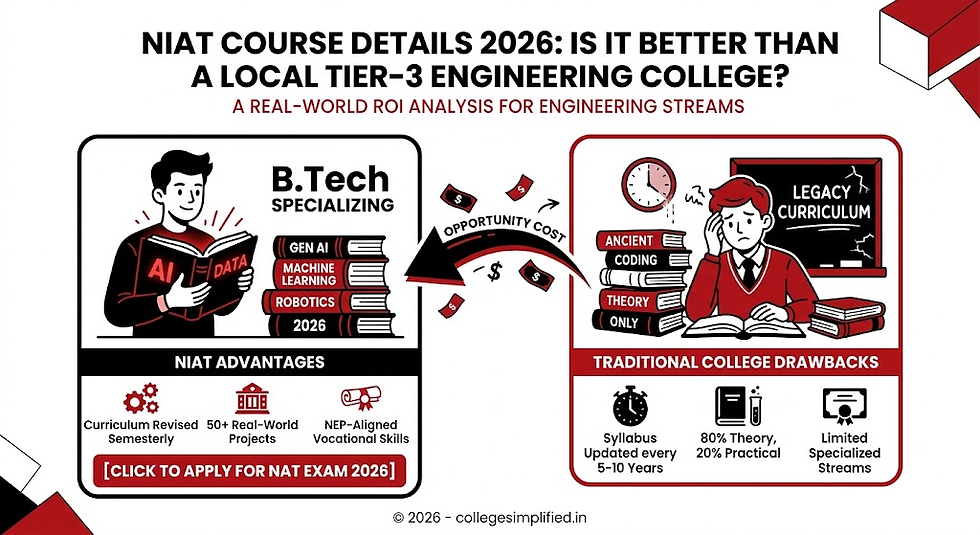
Choosing the right engineering pathway in 2026 is no longer just about getting a degree; it’s about the relevance of the curriculum in an AI-driven economy. As we navigate the 2026 academic landscape, many students face a critical dilemma: Should I opt for the established stability of a local Tier-3 engineering college, or pivot toward the industry-integrated NIAT course details 2026?
This real-world analysis breaks down the structural differences between these two paths, focusing specifically on course architecture, stream specializations, and the ROI of your learning hours.
The Shift in Engineering Education: 2026 Context
By 2026, the gap between theoretical academia and industry requirements has widened. Traditional Tier-3 colleges often struggle with "Legacy Curriculum Syndrome," where students spend four years learning technologies that the market has already moved past. In contrast, the NIAT course details 2026 focus on a "Zero-Nonsense" approach, integrating upskilling directly with university-affiliated degrees.
Comparison: NIAT Course Details 2026 vs. Tier-3 Colleges
Feature | NIAT (NxtWave Institute) 2026 | Local Tier-3 Engineering College |
Curriculum Update | Revised every semester based on 3,000+ company insights. | Revised every 5–10 years via university boards. |
Stream Focus | AI, ML, Full Stack, Cyber Security, Robotics. | Traditional CSE, ECE, Civil, Mechanical. |
Learning Model | 70% Practical (Labs, Hackathons, Projects). | 80% Theory (Lectures, Pen-and-paper exams). |
Specializations | Advanced Computing, Prompt Engineering. | General Computer Science. |
1. Specialized Streams and B.Tech Pathways
The core of the NIAT course details 2026 lies in its diversified specialization list. Unlike a standard Tier-3 college where "Computer Science" is a broad umbrella, NIAT offers targeted streams including:
AI & Machine Learning: Deep dives into neural networks and GenAI.
Data Science & Quantum Technologies: Combining big data with future-gen computing.
Cloud, DevOps, and Automation: Focusing on the infrastructure of modern tech giants.
Full Stack Development: Mastering the MERN stack from Year 1.
2. Hands-on Project Architecture
In a local Tier-3 college, a student might complete 2-3 major projects over four years. However, the NIAT course details 2026 mandate over 50 real-world projects. This includes building applications for healthcare, defense, and e-commerce, ensuring that by the time you reach your final year, your portfolio outshines a standard resume.
Ready to level up? Join the next generation of engineers who are industry-ready from day one.Apply for the NIAT NAT Exam 2026 Here (Limited Phase 1 slots available!)
ROI Analysis: Time and Skill Acquisition
When we talk about ROI in 2026, we aren't just looking at the ₹18 Lakhs fee versus a Tier-3 fee. We are looking at the opportunity cost.
Tier-3 College: Students often spend 4 years on a degree and then another 6-12 months in a coaching center to learn actual coding skills.
NIAT 2026 Pathway: The skilling happens inside the 4-year degree. You graduate as a "Pro," saving a year of post-college struggle.
Deep Dive into NIAT Course Details 2026 Subjects
The curriculum is designed for "Industry 4.0." In the first year, while Tier-3 students are studying Engineering Drawing and Chemistry, NIAT students are already building responsive web applications and mastering Data Structures (DSA).
Why Choose NIAT over Traditional Colleges?
Direct Industry Mentorship: Learning from "SuperMentors" at companies like Google and Amazon.
NEP-Aligned Learning: The 2026 curriculum is fully aligned with the National Education Policy, emphasizing vocational skill integration.
Advanced Labs: Access to Drones, IoT, and Robotics labs that are often missing in local colleges.
Explore More: For a detailed breakdown of other engineering entrance exams and college comparisons, visit CollegeSimplified.in.
FAQ: Understanding NIAT Course Details 2026
Q1: What are the primary NIAT course details 2026 for B.Tech students?
A1: The NIAT course details 2026 include a 4-year integrated program where students earn a B.Tech degree from a collaborating university (like Alard or Chaitanya University) while completing an intensive industry-ready upskilling curriculum in AI, ML, and Full Stack Development.
Q2: How does the NIAT course details 2026 curriculum differ from a regular B.Tech?
A2: While a regular B.Tech focuses on theoretical fundamentals, the NIAT course details 2026 curriculum is project-based. It replaces outdated electives with modern subjects like Prompt Engineering, Cloud-native applications, and Quantum Data Science.
Q3: Are the NIAT course details 2026 specializations recognized by the government?
A3: Yes. All degrees offered through the NIAT ecosystem are awarded by UGC-recognized and AICTE-approved partner universities. The NIAT course details 2026 simply enhance the standard university syllabus with industry-specific modules.
Q4: Can I see the NIAT course details 2026 for the first year?
A4: In the first year, NIAT course details 2026 prioritize foundational coding (Python/JavaScript), MERN stack development, and core CS concepts, allowing students to start building projects within the first six months.
Q5: What are the eligibility requirements for the NIAT course details 2026 programs?
A5: To access the NIAT course details 2026, students must have completed 10+2 with at least 60% in PCM and successfully qualify for the NxtWave Assessment Test (NAT).
Final Verdict: Is it worth it?
If you are looking for a traditional campus experience with a focus on theoretical research, a Tier-3 college might suffice. However, if your goal is to be a top-tier software architect or AI engineer by the time you graduate, the NIAT course details 2026 offer a significantly higher "Skill ROI."
In 2026, the market doesn't pay for the name on your degree; it pays for the code in your GitHub repository. NIAT ensures that repository is full.
CTA
Don't wait for the final admission rounds. Start your journey into advanced technology today.
Step 1: Review the full stream list on CollegeSimplified.in.
Step 2: Register for the NAT assessment to unlock these specialized courses.
Step 4: Secure your seat in a future-ready branch. NIAT 2026 Registration Link.


Comments