NIAT vs IIT: Which is Better for Future Tech Careers in 2026?
- Apr 22
- 4 min read
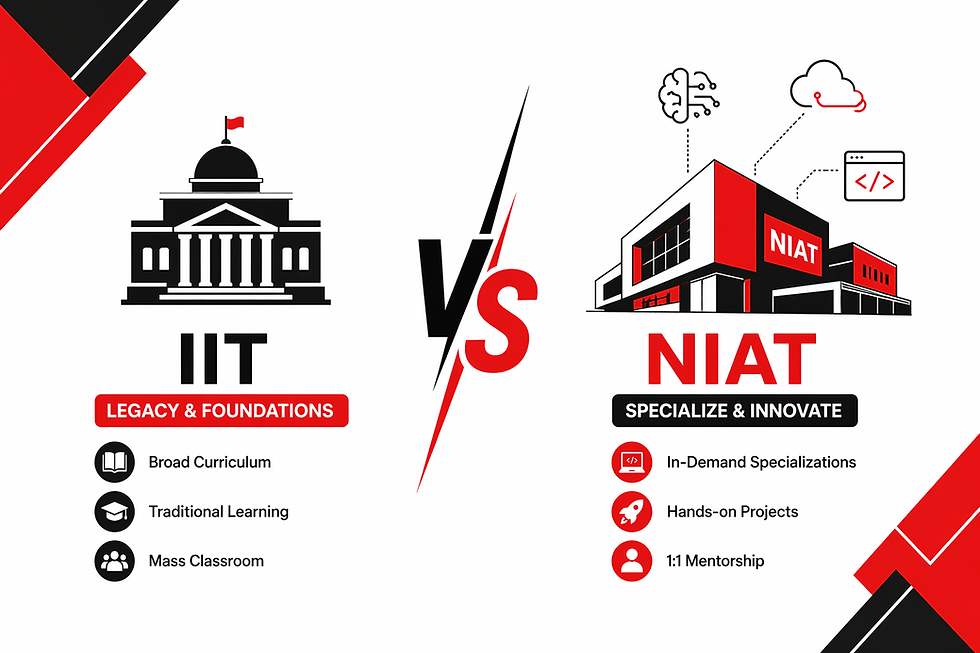
The year 2026 marks a pivotal shift in how we define a "premier" engineering education. For decades, the Indian Institutes of Technology (IITs) have been the undisputed champions of the technical landscape. However, as the 2026 tech ecosystem pivots toward Agentic AI, distributed cloud architectures, and rapid product shipping, a new contender has emerged: the NxtWave Institute of Advanced Technologies (NIAT).
When comparing NIAT vs IIT 2026, students are no longer just looking at legacy brands; they are looking at course agility and stream specialization. While IITs offer a broad academic foundation, NIAT provides a surgical focus on modern software craftsmanship. If you are ready to bypass traditional rote learning and dive straight into specialized engineering, you can start your journey by applying for the and using Coupon Code: NIATCS400 for an exclusive discount.
Course Structure: Foundations vs. Fast-Track Specialization
The primary difference in the NIAT vs IIT 2026 debate lies in the curriculum philosophy.
The IIT Approach: The Generalist Path
IITs follow a traditional four-year B.Tech model. In 2026, students still spend their first year studying general engineering subjects like Chemistry, Workshop Calculation, and Engineering Drawing. While this builds a broad scientific base, it often delays core computer science immersion until the second year.
The NIAT Approach: The Specialist Path
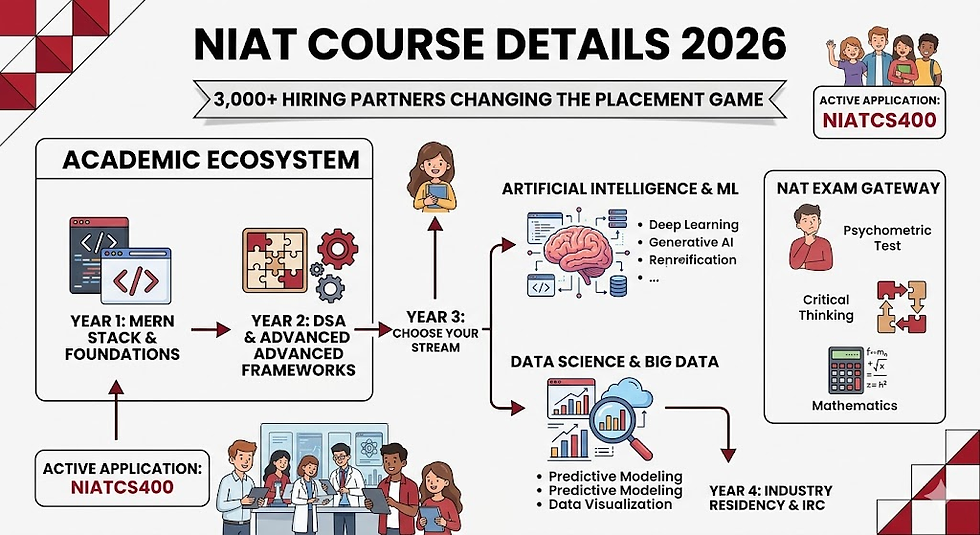
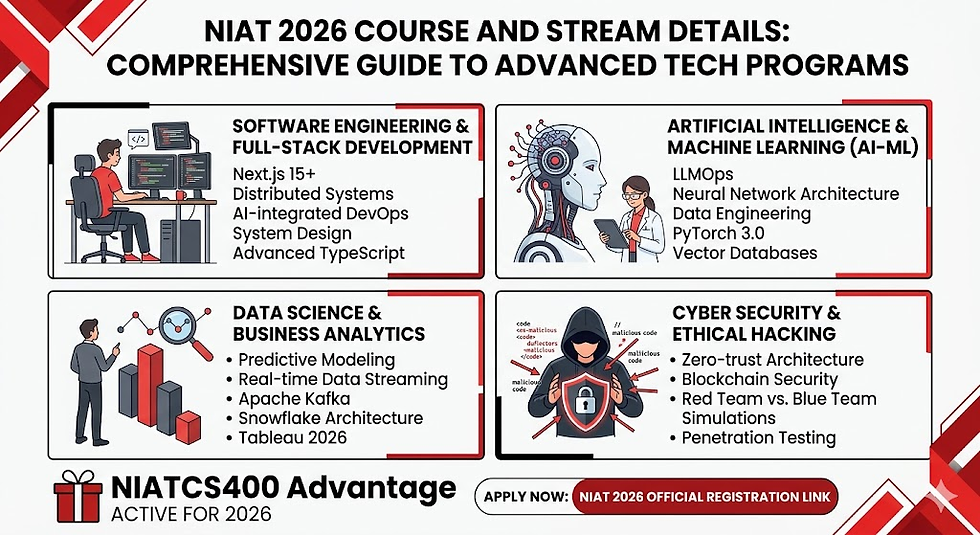
NIAT’s curriculum is designed for the 2026 market from Day 1. Instead of generic subjects, students dive into high-demand technical streams:
CSE with AI & Machine Learning: Focusing on building autonomous systems and fine-tuning LLMs.
CSE with Data Science: Mastering real-time analytics and data engineering.
Full-Stack Development: Learning to build scalable, production-ready applications using 2026’s modern tech stacks.
Ready to skip the generic subjects? Apply for the and use Coupon Code: NIATCS400.
Entrance Exams: JEE vs. NIAT NAT 2026
The barrier to entry defines the student cohort. In 2026, the contrast between these two paths is stark.
JEE Advanced (IITs)
The Joint Entrance Examination (JEE) remains one of the world's toughest tests. It requires two years of intensive preparation in Physics, Chemistry, and Advanced Mathematics. For many, this "filter" tests endurance and theoretical memorization more than actual coding potential.
NIAT Assessment Test (NAT 2026)
The NIAT vs IIT 2026 comparison is most visible here. The NAT is a 90-minute online test that ignores Physics and Chemistry to focus on:
Psychometric Test: Evaluates personality traits and emotional balance.
Critical Thinking: Tests logical reasoning and adaptability.
Mathematics: Focuses on applied problem-solving and numerical ability.
The NAT 2026 is designed to find "builders" rather than "test-takers." To secure your seat in the upcoming batch, register at the and use Coupon Code: NIATCS400.
Why Choose NIAT over IIT in 2026?
A significant factor in the NIAT vs IIT 2026 analysis is the speed of innovation.
1. Industry-Integrated Degree
NIAT partners with collaborating universities to offer a B.Tech degree that is recognized by UGC and AICTE, but the delivery is managed by industry veterans. Unlike IITs, where curriculum updates can take years, NIAT updates its modules every six months to match the 2026 industry pulse.
2. 1:1 Mentorship Model
While an IIT professor might address a hall of 100 students, NIAT utilizes a high-touch mentorship model. Students receive direct feedback on their code from senior engineers working at top-tier product firms.
3. Focus on "Shipping" Products
In 2026, the market values engineers who can "ship" (deploy real products). NIAT students spend their semesters building real-world applications, which are often integrated into their portfolios before they even reach their final year.
Expert Insight: For a detailed breakdown of which collaborating universities offer the NIAT program in your region, visit .
The Verdict: Which is Better for You?
The final decision in NIAT vs IIT 2026 depends on your goals:
Choose IIT if: You want a legacy brand, a traditional vast campus experience, and a broad foundation in general engineering and research.
Choose NIAT if: You want to be a specialist from Day 1, prefer hands-on building over theoretical exams, and want a curriculum that evolves with the 2026 tech market.
Don't miss the 2026 intake. Apply via the and enter Coupon Code: NIATCS400 at checkout.
FAQ: NIAT vs IIT 2026 Comparison
1. Is the NIAT degree as valid as an IIT degree? Yes. In 2026, NIAT's collaborating universities provide a standard B.Tech degree that is fully valid for higher studies (MS/PhD) and government jobs. The primary difference is the specialized technical delivery by NIAT.
2. Can I get a scholarship for the NIAT program in 2026? Yes. Based on your NAT 2026 score, NIAT offers significant scholarships. You can also use Coupon Code: NIATCS400 when you to save on your application fees.
3. Does NIAT require JEE scores for admission? No. NIAT has its own assessment called NAT (NxtWave Assessment Test), which focuses on cognitive ability and logical reasoning rather than the JEE PCM syllabus.
4. What are the key technical streams in NIAT vs IIT 2026? While IITs offer general CSE, NIAT provides specialized streams in AI & ML, Data Science, and Full-Stack Engineering, specifically updated for 2026 standards.
5. How does the "Learnability" section in NIAT NAT differ from JEE? JEE tests what you have already memorized. The NIAT NAT tests how quickly you can learn and apply a new concept given to you during the exam.

Comments